How to Use Retirement Accounts (IRA/401k): Step-by-Step Guide (2026)
This article contains affiliate links. If you click through and make a purchase, we may earn a commission at no additional cost to you. Read full disclosure
You know you should be saving for retirement. But between Traditional IRAs, Roth IRAs, 401(k)s, and the alphabet soup of contribution limits, tax rules, and income phase-outs, actually using these accounts feels like navigating a maze blindfolded.
The good news: retirement accounts aren’t nearly as complicated as they seem once you understand the system. By the end of this guide, you’ll know exactly how to set up and maximize your IRA or 401(k) in 2026—including which account type fits your situation, how much you can contribute, and how to avoid the most common (and expensive) mistakes.
This guide walks you through the complete process step by step, using 2026’s current contribution limits and rules. Whether you’re opening your first retirement account or optimizing an existing one, you’ll have a clear action plan.
What you need before starting:
- Your current income information and tax filing status
- Access to your employer’s benefits portal (if using a 401(k))
- Basic banking information for setting up contributions
- Estimated time: 30-45 minutes for initial setup
—
Step 1: Choose Between IRA and 401(k) Based on What’s Available
You can’t start until you know which account type you have access to—and the answer depends on your employment situation.
If you work for an employer: Check if they offer a 401(k) or 403(b) plan. Log into your benefits portal or ask HR directly. If your employer offers a plan with matching contributions, this becomes your priority account.
If you’re self-employed or don’t have access to an employer plan: You’ll use an IRA (Individual Retirement Account). Anyone with earned income can open an IRA—you don’t need an employer to sponsor it.
If you have access to both: You can contribute to both a 401(k) and an IRA in the same year. Most people max out the 401(k) match first, then contribute to an IRA for additional tax-advantaged savings.
You should see: A clear answer about which account type(s) you can use. If you have a 401(k) available, you’ll see it listed in your employer benefits materials. If not, an IRA is your path forward.
—
Step 2: Understand Your 2026 Contribution Limits
Before you can contribute, you need to know the legal maximum for your situation. The IRS sets these limits annually, and 2026 brought several increases.
For 401(k), 403(b), and most 457 plans:
- Standard limit: $24,500 for the year
- If you’re 50 or older: add $8,000 in catch-up contributions (total: $32,500)
- If you’re between 60-63 years old: add $11,250 in super catch-up contributions (total: $35,750)
According to the IRS announcement from November 2025, these are the highest contribution limits in the program’s history.
For Traditional and Roth IRAs:
- Standard limit: $7,500 for the year
- If you’re 50 or older: add $1,100 in catch-up contributions (total: $8,600)
Important note: These limits apply across all your accounts of that type. If you have two 401(k)s from different employers, your total contributions across both cannot exceed $24,500. The same rule applies to IRAs—your $7,500 limit is shared between Traditional and Roth IRAs combined.
You should see: The maximum dollar amount you’re legally allowed to contribute based on your age and account type.
> Note: If you contribute more than the limit, you’ll face a 6% excess contribution penalty every year until you withdraw the excess. Set up your contributions carefully to avoid this.
—
Step 3: Decide Between Traditional and Roth Contributions
Both 401(k)s and IRAs come in two tax flavors: Traditional (tax deduction now, pay taxes later) and Roth (no deduction now, tax-free withdrawals later). This choice significantly impacts your financial outcome.
Choose Traditional if:
- You expect to be in a lower tax bracket in retirement
- You want to reduce your taxable income this year
- Your current tax rate is high (24% bracket or above)
Choose Roth if:
- You expect to be in a higher tax bracket in retirement
- You’re early in your career with decades of tax-free growth ahead
- You want flexibility to withdraw contributions (Roth IRA only) without penalty
For most people under 40: Roth contributions make more sense because of the long time horizon for tax-free growth.
For high earners: Traditional contributions offer immediate tax relief at your current (likely high) rate.
You should see: A clear decision on whether Traditional or Roth better fits your situation. You can also split contributions between both if you’re uncertain—there’s no rule requiring you to pick just one.
> Note: High earners face income restrictions on Roth IRAs. For 2026, Roth IRA eligibility phases out between $153,000-$168,000 for single filers and $242,000-$252,000 for married couples filing jointly, according to Principal’s 2026 limits guide.
—
Step 4: Open Your Retirement Account (IRA Only)
If you’re using an employer 401(k), skip to Step 5—your account already exists through your employer. For IRA users, you need to open an account with a financial institution first.
- Choose a brokerage or robo-advisor (popular options include Vanguard, Fidelity, Schwab, or Betterment)
- Visit their website and select “Open an IRA”
- Choose Traditional IRA or Roth IRA based on your Step 3 decision
- Provide personal information: name, Social Security number, date of birth, address
- Link your checking or savings account for contributions
- Complete identity verification (usually instant)
The entire process typically takes 10-15 minutes and can be completed online. Most brokerages require no minimum deposit to open the account, though some require a minimum to start investing.
You should see: A confirmation that your IRA is now open with your chosen institution, along with your new account number.
—
Step 5: Set Your Contribution Amount
Now that you have an account, decide how much to contribute based on your budget and goals.
The ideal target: Contribute enough to max out your annual limit if possible. For 2026, that means $24,500 for a 401(k) or $7,500 for an IRA (plus catch-up contributions if eligible).
If you can’t max out: Follow this priority order:
- Contribute enough to your 401(k) to get the full employer match (if available)—this is free money
- Max out an IRA ($7,500) for better investment options and lower fees
- Return to your 401(k) and increase contributions toward the $24,500 limit
- Consider a taxable brokerage account once retirement accounts are maxed
Calculate your per-paycheck contribution:
- For 401(k): Divide your annual target by the number of paychecks you receive per year
- Example: $24,500 ÷ 24 paychecks = $1,020.83 per paycheck
For IRA: You can contribute the full amount in one lump sum or set up automatic monthly transfers. Many people choose monthly contributions ($625/month to reach the $7,500 limit) to dollar-cost average their investments.
You should see: A specific dollar amount you’ll contribute per paycheck (401(k)) or per month (IRA) that aligns with your annual goal.
> Note: You can change your contribution amount anytime during the year. Start with what you can afford and increase it when you get a raise or pay off debt.
—
Step 6: Enroll in Your 401(k) or Set Up IRA Contributions
This is where you officially start contributing money to your retirement account.
For 401(k) enrollment:
- Log into your employer’s benefits portal (ask HR for the link if you don’t have it)
- Navigate to the retirement plan section
- Select your contribution rate (enter the per-paycheck amount from Step 5)
- Choose whether contributions should be Traditional or Roth
- Review and confirm your elections
- Set your start date (usually the next available pay period)
For IRA contributions:
- Log into your brokerage account
- Select “Transfer Money” or “Contribute”
- Choose the linked bank account you set up in Step 4
- Enter your contribution amount and frequency (one-time or recurring monthly)
- Confirm the transfer
You should see: Confirmation that your contributions are scheduled. For 401(k)s, you’ll see the deduction on your next paystub. For IRAs, you’ll see the transfer scheduled or completed in your account dashboard.
—
Step 7: Choose Your Investments
Contributing money to a retirement account doesn’t automatically invest it—you need to select where that money goes. An uninvested retirement account earns almost nothing.
For 401(k) plans:
- Access your 401(k) provider’s website (separate from your employer’s benefits portal—you should have received login credentials)
- Review available investment options (usually 10-30 mutual funds)
- Select investments based on your risk tolerance and timeline:
– Target-date funds: Set it and forget it—pick the fund closest to your planned retirement year (e.g., “Target 2060 Fund” if you plan to retire around 2060)
– DIY approach: Build a portfolio with stock index funds (like S&P 500 fund) and bond funds
Most experts recommend target-date funds for beginners—they automatically adjust from aggressive to conservative as you approach retirement.
For IRA plans:
- Navigate to the “Trade” or “Buy” section of your brokerage account
- Search for low-cost index funds or ETFs (popular choices: VTI, VOO, or target-date funds)
- Enter the dollar amount you want to invest (should match your contribution amount)
- Set up automatic investment for future contributions
You should see: Your contribution dollars invested in specific funds, not sitting in cash. Your account should show holdings with ticker symbols and current values.
> Note: According to Fidelity’s 2026 contribution guide, one common mistake is contributing to a 401(k) but never selecting investments—leaving money in a low-yield cash position for years.
—
Step 8: Verify Your Contributions Are Working
After setting everything up, confirm that money is actually flowing into your retirement account as planned.
For 401(k) verification:
- Wait for your next paystub
- Check that your retirement contribution appears as a deduction
- Log into your 401(k) account 3-5 business days after payday
- Verify the contribution amount matches your paystub
- Confirm the money is invested (not sitting in cash)
For IRA verification:
- Check your linked bank account to confirm the transfer completed
- Log into your IRA account
- Verify the contribution is recorded for the current tax year (2026)
- Confirm the money is invested in your selected funds
You should see: Money moving from your paycheck or bank account into your retirement account, and that money invested in your chosen funds—not sitting uninvested.
> Note: Your first contribution can take 1-2 pay cycles to appear in a 401(k) due to processing time. If you don’t see it after the second paycheck, contact your HR department.
—
Step 9: Understand Income Limits and Phase-Outs (IRA Users)
If you’re using an IRA, your income affects what you can deduct (Traditional IRA) or contribute at all (Roth IRA). This doesn’t apply to 401(k) users.
Traditional IRA deduction limits:
According to Fidelity’s IRA limits guide, if you (or your spouse) have access to a 401(k) at work, your ability to deduct Traditional IRA contributions phases out based on income:
- Single filers: phase-out range of $81,000-$91,000
- Married filing jointly: phase-out range of $129,000-$149,000
- Married filing separately: phase-out range of $0-$10,000
If your income falls in these ranges, you can still contribute the full $7,500—but you may only deduct part of it (or none of it) on your taxes.
Roth IRA contribution limits:
Your ability to contribute to a Roth IRA phases out entirely based on income:
- Single filers: phase-out range of $153,000-$168,000
- Married filing jointly: phase-out range of $242,000-$252,000
If you earn above these thresholds, you cannot contribute directly to a Roth IRA. High earners often use a “backdoor Roth IRA” strategy instead—contributing to a Traditional IRA (non-deductible) and immediately converting it to Roth.
You should see: Whether your income affects your IRA strategy. If you’re below all phase-out ranges, you have full access to both Traditional and Roth IRAs without restrictions.
—
Step 10: Maximize Employer Match (401(k) Users Only)
If your employer offers matching contributions to your 401(k), this is the closest thing to free money in personal finance. Never leave it on the table.
How matching works:
Common matching formulas include:
- “Dollar-for-dollar up to 3% of salary”—employer matches 100% of your contributions up to 3% of your pay
- “50 cents on the dollar up to 6% of salary”—employer matches 50% of your contributions up to 6% of your pay
Calculate your required contribution:
- Find your matching formula in your benefits documents
- Multiply your annual salary by the match percentage
- Set your contribution to at least this amount
Example: You earn $80,000 and your employer matches dollar-for-dollar up to 3%.
- Required contribution: $80,000 × 0.03 = $2,400 per year
- Per paycheck (24 pay periods): $100
You should see: Your 401(k) account receiving two deposits per pay period—your contribution and your employer’s matching contribution.
> Note: Employer contributions don’t count toward your $24,500 limit. According to Fidelity’s contribution guide, combined employee and employer contributions can total up to $72,000 in 2026.
—
Step 11: Set Annual Reminders to Increase Contributions
Retirement saving isn’t a set-it-and-forget-it task—you should review and increase contributions regularly.
Set up these three annual reminders:
- New Year (January): Check if the IRS increased contribution limits for the new year. For 2026, limits increased significantly—from $23,500 to $24,500 for 401(k)s and from $7,000 to $7,500 for IRAs.
- After your annual raise: Increase your 401(k) contribution by at least half of your raise percentage. If you got a 4% raise, increase your contribution rate by 2%. You’ll still see a bump in your take-home pay while building retirement savings.
- Age 50 milestone: The year you turn 50, you become eligible for catch-up contributions. Add an extra $8,000 to your 401(k) or $1,100 to your IRA if your budget allows.
Many 401(k) plans offer automatic annual increases—a feature that raises your contribution by 1-2% each year. Enable this if available.
You should see: Gradually increasing contribution amounts year over year, helping you reach the annual maximum without draining your current budget.
—
Step 12: Track Your Progress and Avoid Common Mistakes
Now that everything is running, maintain your retirement accounts properly to avoid costly errors.
Monthly check (5 minutes):
- Log into your accounts
- Verify contributions are still processing
- Confirm money is invested, not in cash
- Check that you’re on track for your annual goal
Annual review (30 minutes):
- Calculate total contributions for the tax year
- Verify you didn’t exceed contribution limits (especially if you have multiple accounts)
- Rebalance investments if needed
- Update your contribution amount for the new year
Common mistakes to avoid:
- Contributing beyond the limit: If you have multiple jobs with 401(k)s, you’re responsible for ensuring total contributions don’t exceed $24,500. The IRS will penalize excess contributions.
- Missing the contribution deadline: IRA contributions for 2026 can be made until April 15, 2027 (tax filing deadline). 401(k) contributions must be made during the calendar year.
- Forgetting to invest contributions: Money sitting in your retirement account’s default cash position earns almost nothing. Always select investments.
- Stopping contributions during market downturns: Keep contributing through market drops—you’re buying shares at lower prices.
You should see: A growing account balance over time, with consistent contributions and investment returns working together.
—
You Just Set Up Your Retirement Account the Right Way
You now have a functioning retirement account with proper contributions and investments—the foundation of long-term wealth building. By following these 12 steps, you’ve moved from confusion about IRA and 401(k) rules to having an active, optimized retirement savings strategy.
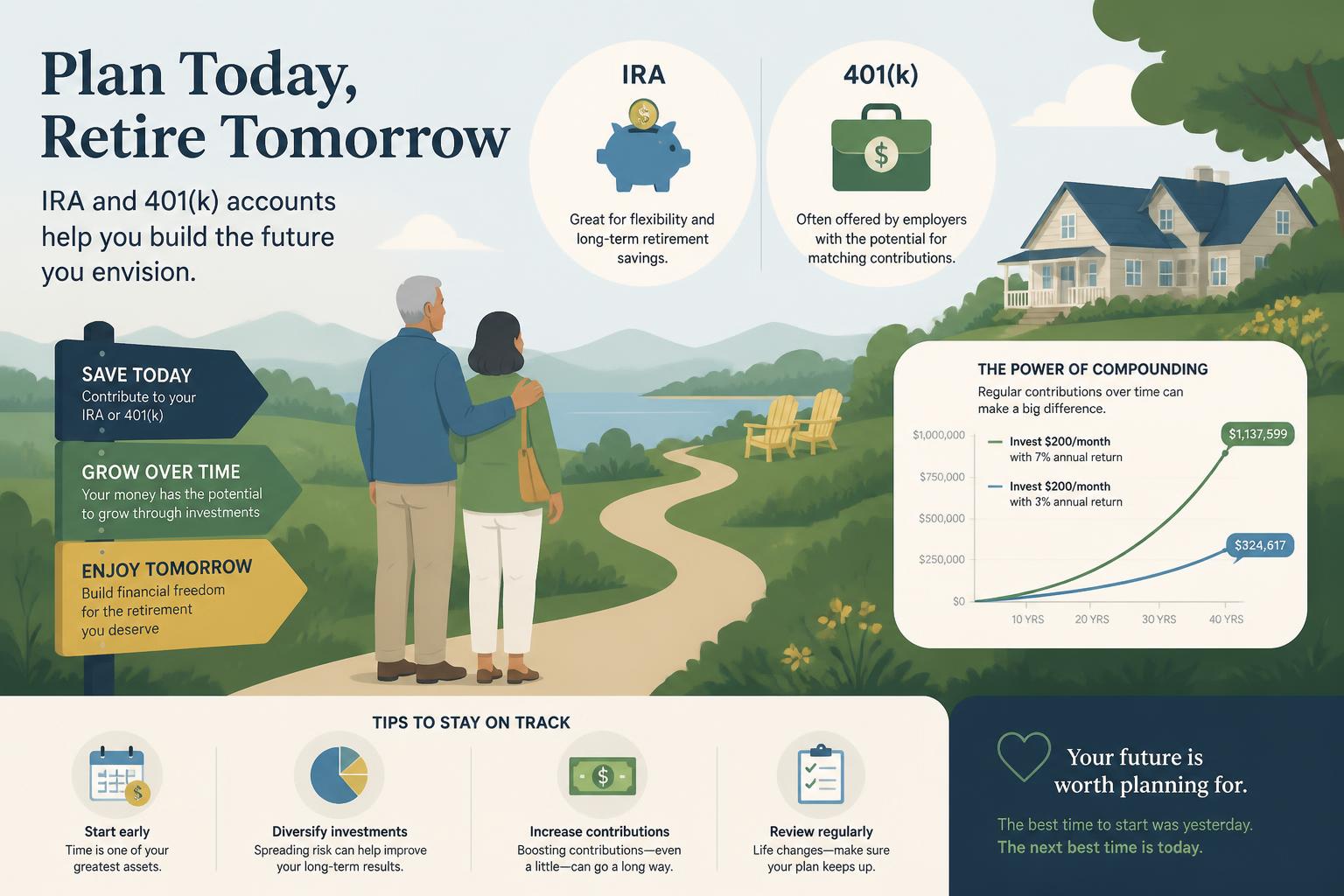
The accounts you set up today will compound for decades. According to Vanguard’s retirement planning data, maxing out a 401(k) for 30 years at historical market returns (approximately 10% annually) could build a portfolio worth over $4 million.
What happens next:
Continue your regular contributions and let compound interest work. Review your accounts quarterly at first until you’re comfortable with the system, then shift to annual reviews. As your income grows, increase your contribution percentages—every raise is an opportunity to save more without reducing your lifestyle.
If you have questions about contribution limits, investment choices, or account types, most major brokerages offer free financial planning consultations to account holders.
—
Troubleshooting Common Issues
“My 401(k) contributions aren’t showing up in my account”
This usually happens during the first 1-2 pay periods after enrollment. Employer plans often have a processing delay. If contributions aren’t visible after your second paycheck, contact your HR department or the 401(k) provider directly (not your employer).
“I exceeded the contribution limit—what do I do?”
Contact your 401(k) provider or IRA custodian immediately. Request a return of excess contributions before the tax filing deadline. If you don’t correct this, you’ll pay a 6% penalty on the excess every year it remains in the account.
“Can I contribute to both a Traditional and Roth IRA?”
Yes, but the $7,500 limit is shared between them. You could contribute $4,000 to a Traditional IRA and $3,500 to a Roth IRA—but the total cannot exceed $7,500.
“I forgot to select investments and my money is in cash”
Log into your account, navigate to the trade/invest section, and invest your current balance in a target-date fund or index fund. Most brokerages also let you set up automatic investment for future contributions to prevent this from happening again.
“My income changed mid-year and now I’m over the Roth IRA limit”
If you’ve already contributed to a Roth IRA but your income ended up too high, you can recharacterize the contribution to a Traditional IRA before the tax filing deadline, or withdraw the excess contribution (plus earnings) to avoid penalties.
—
Next Steps: Advanced Strategies
Once you’re consistently maxing out your retirement accounts, consider these additional strategies:
Backdoor Roth IRA: If your income is too high for direct Roth IRA contributions, contribute to a Traditional IRA (non-deductible) and immediately convert it to Roth. This legal workaround gives high earners access to Roth tax benefits.
Mega Backdoor Roth: Some 401(k) plans allow after-tax contributions beyond the $24,500 limit (up to the $72,000 combined limit). You can then convert these to Roth, creating massive tax-free growth potential.
Health Savings Account (HSA): If you have a high-deductible health plan, an HSA offers triple tax benefits (deductible contributions, tax-free growth, tax-free withdrawals for medical expenses) and can function as a supplemental retirement account.
Spousal IRA: If you’re married and one spouse doesn’t work, you can still contribute to an IRA in the non-working spouse’s name based on the working spouse’s income—effectively doubling your household IRA contributions to $15,000.
—
Frequently Asked Questions
Do I need a paid plan or account minimums to start?
No. You can open an IRA with most major brokerages (Vanguard, Fidelity, Schwab) with no minimum deposit and no account fees. 401(k)s are provided free through your employer. Some brokerages require minimum investments (typically $1,000-$3,000) for certain mutual funds, but most now offer fractional shares of ETFs with no minimums.
How long does it take to set up and start contributing?
Opening an IRA takes 10-15 minutes online. Enrolling in a 401(k) takes about 30 minutes, but your first contribution may not appear for 1-2 pay periods due to processing time. Total time from decision to first dollar invested: 1-3 weeks depending on account type.
Can I do this without a financial advisor?
Yes. The steps in this guide are designed for self-directed setup. For basic retirement saving (choosing between Traditional and Roth, selecting a target-date fund, setting contributions), you don’t need to pay an advisor. Consider professional advice if you have complex tax situations, multiple income sources, or need estate planning.
What if I need to access this money before retirement?
401(k) early withdrawals (before age 59½) face a 10% penalty plus income taxes, with some exceptions (first home purchase, certain medical expenses, hardship withdrawals). Roth IRA contributions (not earnings) can be withdrawn anytime without penalty—making Roth IRAs more flexible for younger savers who might need emergency access.
Is my employer’s 401(k) match guaranteed?
Not always. Employer matches often come with a vesting schedule—you must work for the company a certain number of years before the matched contributions are fully yours. Check your plan documents for vesting details. Your own contributions are always 100% yours immediately.
What happens if I change jobs?
Your 401(k) comes with you—you don’t lose it. You have several options: leave it with your old employer (if allowed), roll it over to your new employer’s 401(k), or roll it over to an IRA (which often provides more investment choices and lower fees). Never cash out a 401(k) when changing jobs—you’ll lose 30-40% to taxes and penalties.
—
Affiliate Disclosure
This article contains affiliate links to financial products and services. If you open an account or make a purchase through these links, we may receive a commission at no additional cost to you. We only recommend products we genuinely believe will help you build wealth and reach your financial goals. All contribution limits, tax rules, and strategies discussed are accurate as of 2026 regardless of whether you use our affiliate links.
Your retirement savings decisions should be based on your personal financial situation. This article provides educational information, not personalized financial advice. Consider consulting a qualified financial advisor or tax professional for guidance specific to your circumstances.