How to Get Started with Index Funds & ETFs: A Step-by-Step Guide (2026)
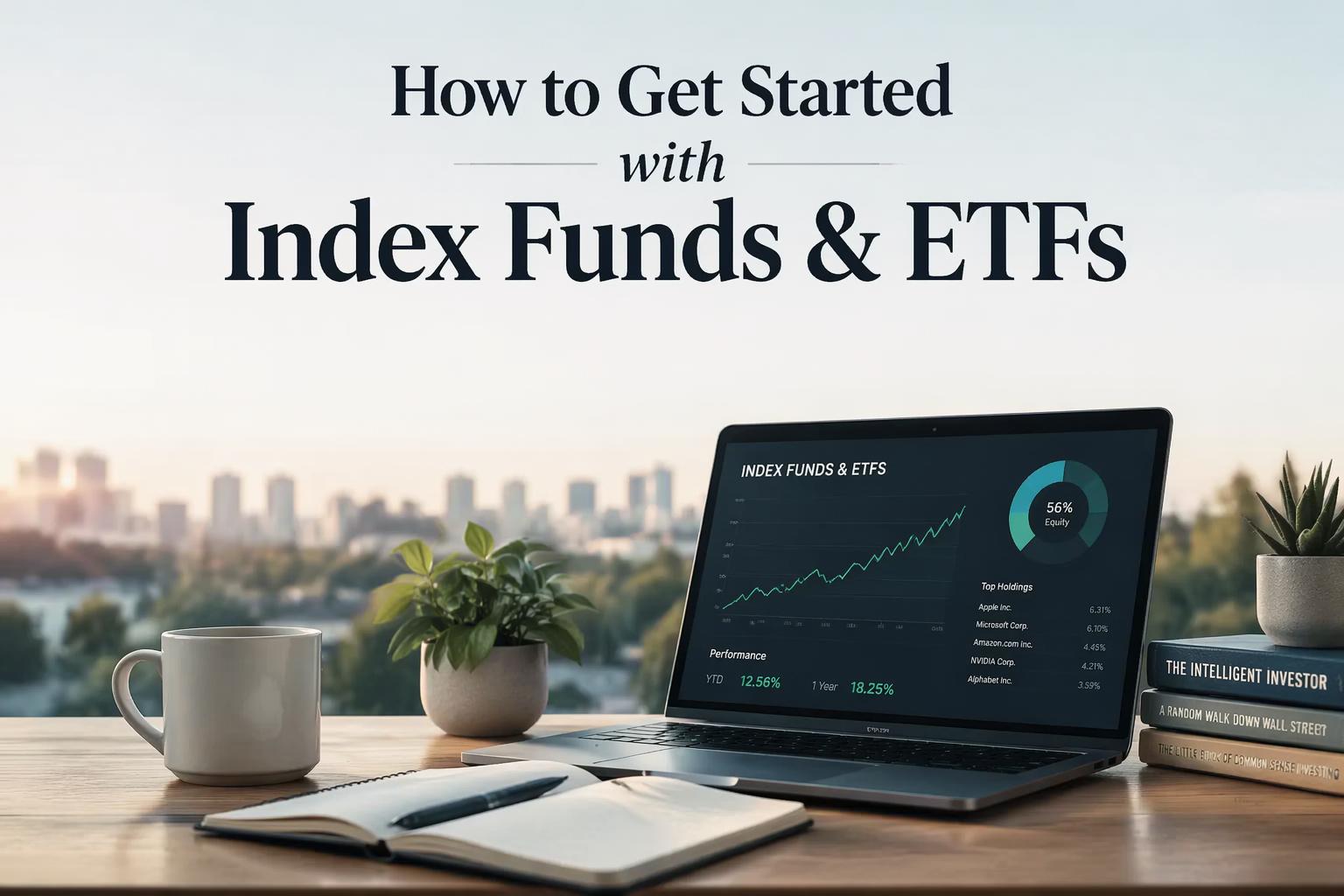
You’ve heard that index funds and ETFs are the smart way to build wealth without spending hours researching individual stocks. But when you actually try to get started, you run into a wall of questions: Which fund do you pick? How much do you need to start? Are you overpaying in fees?
By the end of this guide, you’ll have a working investment portfolio with index funds or ETFs that matches your goals, costs you less than 0.20% in annual fees, and requires about 15 minutes of active management per year.
Estimated time: 45-60 minutes for your first investment
Disclosure: This article contains affiliate links. If you sign up for a service through one of these links, I may receive a commission at no additional cost to you. I only recommend products I’ve personally researched or used.
—
What You Need Before Starting
Before you invest your first dollar, make sure you have:
- An emergency fund with 3-6 months of expenses (keep this in a high-yield savings account, not invested)
- No high-interest debt (anything above 6-7% APR should be paid off first)
- A brokerage account — You’ll need one to buy index funds or ETFs. I’ll walk you through choosing one in Step 1.
- At least $100 to invest (some brokers have no minimum, but this is a practical starting point)
- Your investment timeline — When do you need this money? Less than 5 years = don’t use stocks. 5-10 years = moderate allocation. 10+ years = you can be more aggressive.
Do I need to know how to pick stocks? No. That’s exactly what index funds solve — you’re buying hundreds or thousands of companies in a single purchase.
—
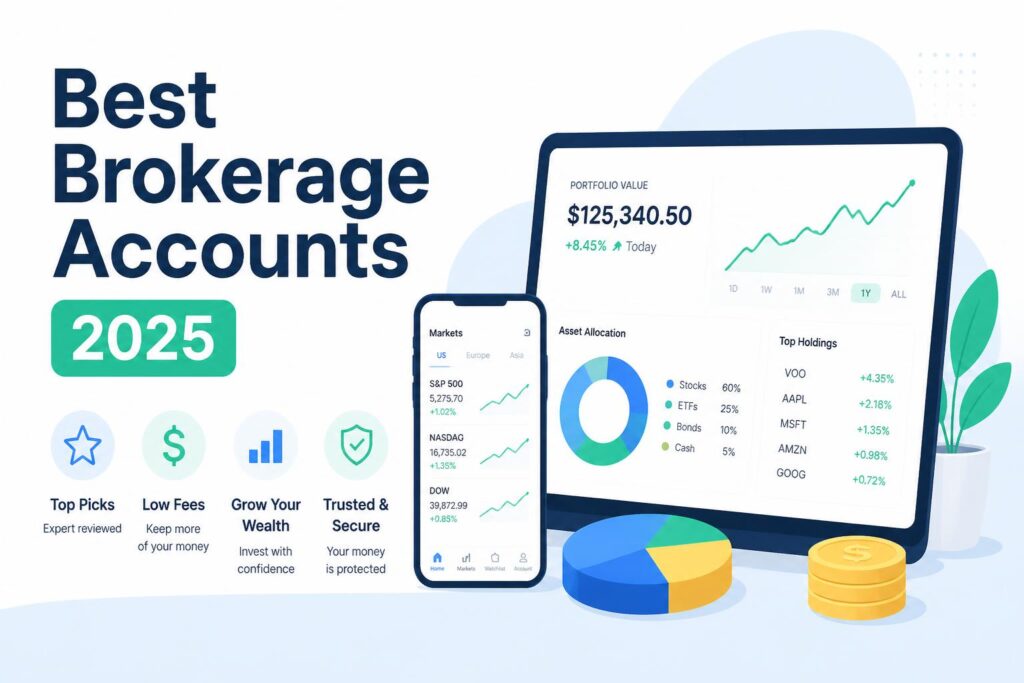
Step 1: Choose a Brokerage Account
An index fund is just a product. You need a brokerage account to buy it, the same way you need an Amazon account to buy a book.
The best brokers for index fund investing in 2026 charge $0 per trade and have no account minimums. Here are the top three:
1. Fidelity — Best overall. Zero expense ratio index funds (yes, actually free). Excellent research tools.
2. Vanguard — The company that invented index funds. Slightly higher minimums ($1,000 for most funds, but $1 for ETFs).
3. Charles Schwab — Great mobile app. Strong customer service. Wide ETF selection.
How to decide:
- If you have less than $1,000 → Fidelity or Schwab
- If you want the lowest possible fees → Fidelity (their FZROX fund has a 0.00% expense ratio)
- If you’re a Vanguard purist → Vanguard (but be ready for a slightly clunky interface)
Action: Go to your chosen broker’s website and click “Open an account.” You’ll need:
- Social Security Number
- Driver’s license or state ID
- Bank account info for transferring money
- Employment information
Choose “Individual brokerage account” (not IRA) if this is your first time. You can open retirement accounts later.
You should see: A confirmation email within 5-10 minutes. Most accounts are approved instantly if you’re over 18 with a clean identity verification.
> Note: If you’re opening this for retirement savings, open a Roth IRA instead of a standard brokerage account. The steps for buying funds are identical, but you get tax-free growth.
—
Step 2: Understand the Difference Between Index Funds and ETFs
Both track the same market indexes (like the S&P 500). The difference is how you buy them:
Index Mutual Funds:
- You buy them directly from the fund company
- Priced once per day after market close
- You can invest exact dollar amounts ($500.00)
- Often have minimum investments ($1,000-$3,000 at Vanguard)
ETFs (Exchange-Traded Funds):
- You buy them on the stock market like individual stocks
- Price changes throughout the day
- You buy in whole shares ($150 per share means you need multiples of $150)
- No minimum investment beyond the share price
Which should you choose?
- If you have less than $1,000 or want to invest small amounts regularly → ETFs
- If you want to automate monthly investments of exact amounts → Index mutual funds
- If you’re at Fidelity and want zero fees → Their index mutual funds (FZROX, FZILX, etc.)
For beginners, I recommend ETFs — lower barriers to entry, and every broker lets you buy fractional shares now, which solves the “whole share” problem.
—
Step 3: Decide What You Want to Own
You don’t need to pick individual companies. You need to pick which part of the market you want to own.
Here are the four core building blocks:
1. U.S. Total Stock Market
- Every publicly traded U.S. company (around 4,000 stocks)
- Examples: VTI (Vanguard), ITOT (iShares), FSKAX (Fidelity)
- This should be 40-60% of most portfolios
2. International Stocks
- Companies outside the U.S.
- Examples: VXUS (Vanguard), IXUS (iShares), FTIHX (Fidelity)
- Adds diversification — when the U.S. slumps, international can outperform
- Aim for 20-40% of your stock allocation
3. U.S. Bonds
- Government and corporate debt
- Examples: BND (Vanguard), AGG (iShares), FXNAX (Fidelity)
- Less volatile than stocks — use these to balance risk
- The older you are, the more bonds you hold (rough rule: your age as a percentage)
4. Real Estate (Optional)
- REITs (Real Estate Investment Trusts)
- Examples: VNQ (Vanguard), IYR (iShares)
- Adds another layer of diversification
- Keep this to 5-10% if you use it at all
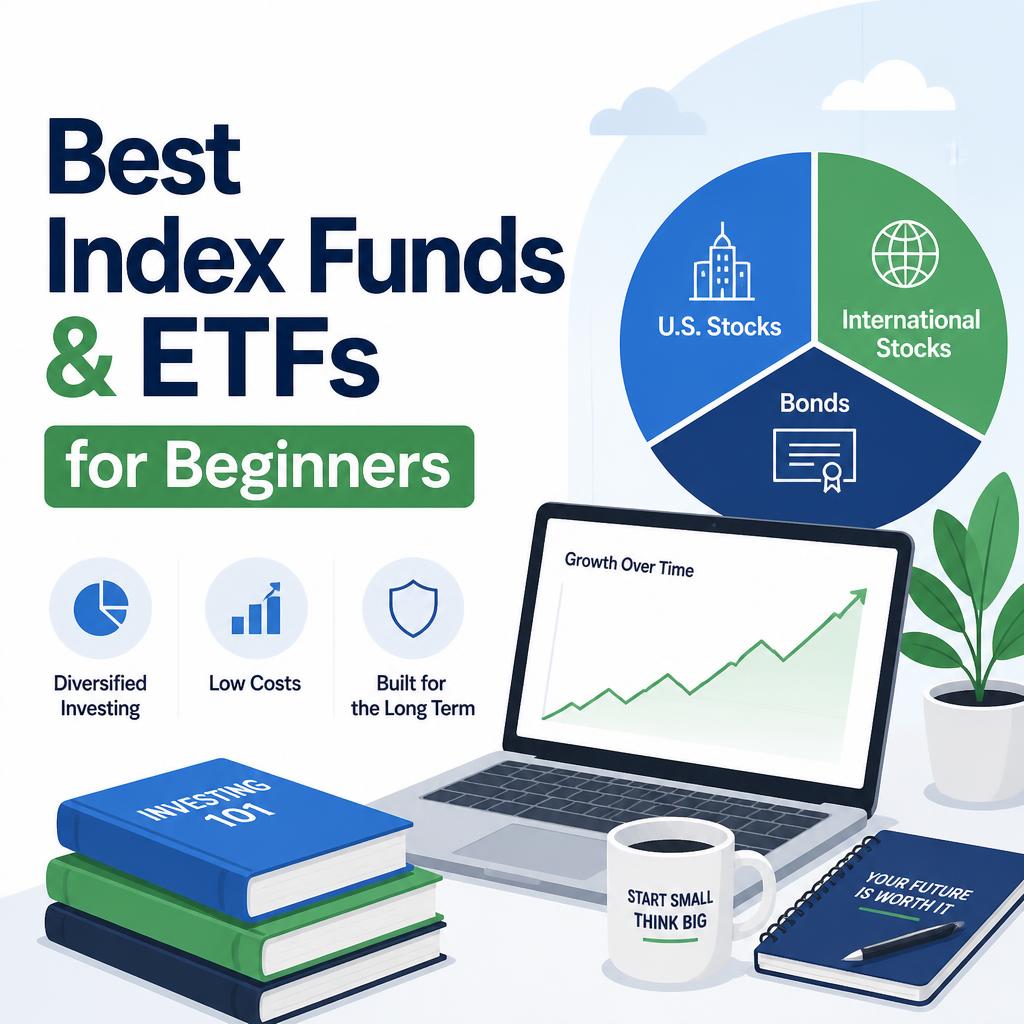
The simplest possible portfolio for beginners:
- 60% U.S. Total Market (VTI)
- 30% International (VXUS)
- 10% Bonds (BND)
Adjust the bond percentage based on your timeline: 5-10 years out = 20-30% bonds. 20+ years = 0-10% bonds.
—
Step 4: Check the Expense Ratio
The expense ratio is the annual fee the fund charges. It’s taken automatically from your returns — you never see a bill.
What’s a good expense ratio?
- Excellent: 0.00% – 0.10%
- Good: 0.10% – 0.20%
- Acceptable: 0.20% – 0.50%
- Too high: Anything above 0.50% for a basic index fund
Where to find it:
Go to your broker’s website, search for the fund ticker (like VTI), and look for “Expense Ratio” in the fund details.
Example:
- VTI (Vanguard Total Stock Market ETF): 0.03%
- FZROX (Fidelity ZERO Total Market Index Fund): 0.00%
- SPY (SPDR S&P 500 ETF): 0.09%
Rule: Never pay more than 0.20% for a plain index fund. If you see 1.00% or higher, you’re looking at an actively managed fund (which 80% of the time underperforms index funds after fees).
—
Step 5: Place Your First Trade
Now you’re ready to buy.
For ETFs:
- Log into your brokerage account
- Navigate to “Trade” or “Buy/Sell”
- Enter the ticker symbol (e.g., VTI)
- Select “Market Order” (this buys at the current price)
- Enter the number of shares or dollar amount
- Review the order — make sure it says “$0 commission”
- Click “Place Order”
You should see: A confirmation screen showing your purchase. The shares will appear in your account within seconds (during market hours) or the next business day.
For Index Mutual Funds:
- Log into your brokerage account
- Go to “Buy Funds” or “Mutual Funds”
- Search for the fund name (e.g., FZROX)
- Enter the dollar amount you want to invest
- Review and confirm
You should see: A pending transaction. Mutual fund orders placed before 4 PM ET are processed at the end of that trading day. After 4 PM, they process the next day.
> Note: If the market is closed (weekends, holidays, after 4 PM ET), your order will be queued for the next trading day. This is normal.
—
Step 6: Set Up Automatic Investments
This is how you build wealth without thinking about it.
Why automate?
- You can’t forget to invest
- You stop trying to “time the market” (which doesn’t work)
- Dollar-cost averaging — you buy more shares when prices are low, fewer when prices are high
How to set it up:
- In your brokerage account, find “Automatic Investments” or “Recurring Transfers”
- Choose the fund(s) you want to buy
- Select the amount and frequency (e.g., $500 on the 1st of every month)
- Link your bank account for automatic transfers
- Confirm
You should see: A confirmation email. Your first automatic purchase will happen on the next scheduled date.
How much should you invest?
- Start with whatever feels comfortable — even $50/month builds up over time
- A common rule: Invest 15-20% of your gross income for retirement
- Increase your automatic investment by 1% whenever you get a raise
—
Step 7: Rebalance Once Per Year
Over time, your portfolio will drift. If stocks go up 30% and bonds stay flat, your 60/30/10 portfolio might become 70/25/5.
Rebalancing means selling some of what went up and buying more of what went down to get back to your target allocation.
How often should you rebalance?
Once per year is plenty. More frequent rebalancing doesn’t improve returns and can trigger unnecessary taxes in taxable accounts.
How to rebalance:
- Log into your account in December (or your birthday, or January 1 — pick a date you’ll remember)
- Check your current allocation percentages
- If anything is more than 5 percentage points off target, adjust:
– Sell enough of the high performer to bring it back to target
– Use that money to buy more of the underperformer
You should see: Your portfolio back to your original allocation. This forces you to “buy low, sell high” automatically.
> Tax note: In a retirement account (IRA, 401(k)), rebalancing has no tax consequences. In a taxable brokerage account, selling triggers capital gains tax. For taxable accounts, rebalance by directing new contributions to the underweighted funds instead of selling.
—
Step 8: Ignore the Noise
The market will drop. Sometimes 10%, sometimes 30%, sometimes more. News headlines will scream about crashes.
What you should do: Nothing.
The U.S. stock market has averaged 10% annual returns over the past century including every crash, recession, and war. The people who lose money are the ones who panic-sell at the bottom.
Rules to live by:
- Don’t check your portfolio more than once per quarter
- Don’t sell in a panic — crashes are when you should be buying more if you have cash
- Remember: You’re not investing for next month. You’re investing for 10, 20, 30+ years.
You should see: Your balance growing over years, not months. Zoom out.
—
What You’ve Just Built
You now have:
- A brokerage account with low-cost index funds or ETFs
- A diversified portfolio across U.S. stocks, international stocks, and bonds
- Automatic monthly investments that run on autopilot
- A rebalancing plan that keeps you disciplined
This portfolio will outperform 80% of actively managed funds over the long term, and you’ll spend less than an hour per year maintaining it.
The only thing left is time. The earlier you start, the more compound growth does the heavy lifting for you.
—
Troubleshooting
“My order says ‘pending’ — is something wrong?”
No. Mutual fund orders always show as pending until the market closes and the price is calculated. ETF orders placed outside market hours (9:30 AM – 4:00 PM ET, Monday-Friday) will execute when the market opens.
“I can’t afford a full share of VTI ($250+). What do I do?”
Most brokers now offer fractional shares. Look for “dollar-based investing” or “fractional shares” in your account settings. You can invest $50 and own 0.2 shares.
“Should I wait for the market to drop before investing?”
No. Statistically, “time in the market beats timing the market.” Waiting for a dip means you miss gains while you wait. Start now, invest consistently, and let dollar-cost averaging smooth out the volatility.
“Do I need a financial advisor?”
Not for this. Index fund investing is simple by design. Save the advisor fees (typically 1% of assets per year) and do it yourself. If your situation is complex (inheritance, business sale, estate planning), then consider a fee-only fiduciary advisor (not someone paid on commission).
“What if I pick the wrong fund?”
There’s no “wrong” fund as long as you follow these rules: (1) Low expense ratio (under 0.20%), (2) Broad diversification (total market funds, not sector funds), (3) From a reputable company (Vanguard, Fidelity, Schwab, BlackRock). VTI and ITOT track the same index and will perform nearly identically.
—
Next Steps
Now that you have your first index fund portfolio running:
- Open a Roth IRA if you haven’t already — same funds, but tax-free growth for retirement
- Increase your automatic investment by 1% every time you get a raise
- Learn about tax-loss harvesting if you’re investing in a taxable account (this can save you money on taxes)
- Explore bond funds if you’re within 10 years of needing the money — bonds reduce volatility
The portfolio you built today is the same strategy Warren Buffett recommends for most investors. You’re now ahead of 90% of people who either don’t invest at all or pay too much in fees for actively managed funds.
—
FAQ
Do I need a paid brokerage plan to invest in index funds?
No. Fidelity, Vanguard, and Schwab all offer free accounts with $0 trading commissions on stocks and ETFs. You only pay the fund’s internal expense ratio (usually 0.03-0.10%), which is automatic and invisible.
How long does it take to set up my first investment?
About 45-60 minutes: 20 minutes to open the account, 10 minutes to transfer money, 10 minutes to research and pick your funds, 5 minutes to place the order.
Can I do this without a financial advisor?
Yes. Index fund investing is designed to be simple enough for individuals. Advisors typically charge 1% of your assets per year, which compounds to hundreds of thousands of dollars in lost returns over a lifetime.
What should I do if the market crashes right after I invest?
Keep investing. Market crashes are sales — everything is cheaper. The worst thing you can do is sell at the bottom. Every major market crash in history has been followed by a full recovery and new highs.
Is index fund investing free?
The brokerage account is free. Trading is free. But the funds themselves charge a small annual expense ratio (0.03-0.20% for good index funds). On a $10,000 investment, that’s $3-$20 per year — far less than the 1%+ fees charged by actively managed funds or advisors.
What’s the difference between VTI and VOO?
VTI tracks the entire U.S. stock market (about 4,000 companies). VOO tracks only the S&P 500 (the 500 largest companies). VTI is more diversified. Both are excellent choices — the performance difference over time is minimal.