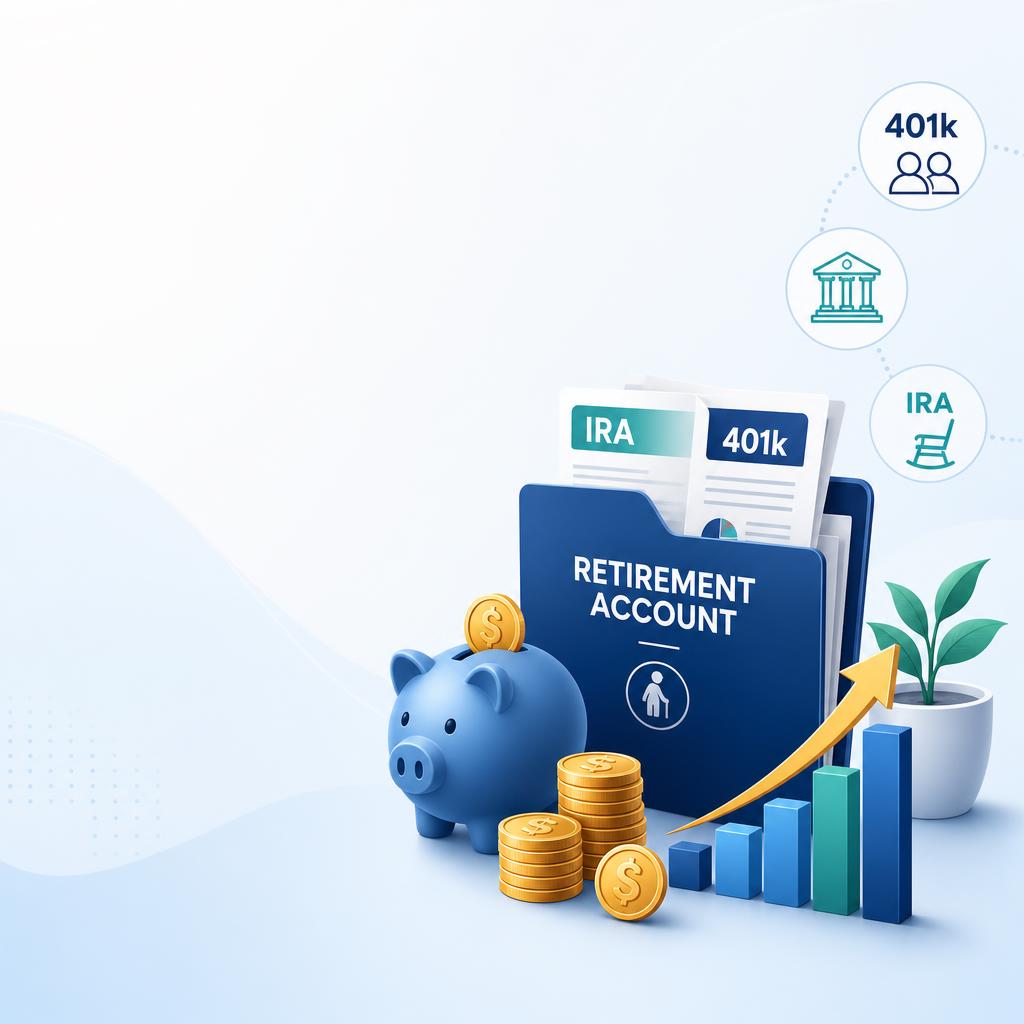
Best Retirement Accounts (IRA/401k) for Beginners: Your Complete Guide to Smart Retirement Planning
Choosing the right retirement account shouldn’t feel like decoding a foreign language. Yet for most beginners, the alphabet soup of IRAs, 401(k)s, Roths, and traditional accounts creates more confusion than clarity. You’re not alone if you’ve delayed opening a retirement account simply because you weren’t sure which one to pick—or worried you’d choose wrong and lose money.
The good news? There’s no single “wrong” choice, and starting with any retirement account beats waiting for perfect knowledge. This guide cuts through the jargon to help you understand which retirement accounts make sense for your situation, how much they actually cost, and how to avoid the most common beginner mistakes.
Understanding Your Retirement Account Options
Traditional 401(k): The Workplace Workhorse
Your employer’s 401(k) is often your first and best retirement vehicle, especially if your company offers matching contributions. Think of employer matching as free money—typically 50% to 100% of what you contribute, up to a certain percentage of your salary.
How it works: You contribute pre-tax dollars from each paycheck, reducing your taxable income today. The money grows tax-deferred until retirement, when withdrawals are taxed as ordinary income.
2024 contribution limits: $23,000 annually ($30,500 if you’re 50 or older)
Best for: Anyone with an employer match, high earners in their peak earning years, or those who expect to be in a lower tax bracket during retirement.
Real-world example: If you earn $60,000 and contribute 6% ($3,600), and your employer matches 50% up to 6%, they add $1,800. That’s an instant 50% return before any investment growth.
Roth 401(k): Tax-Free Retirement Income
Some employers offer a Roth 401(k) option alongside the traditional version. You contribute after-tax dollars now, but qualified withdrawals in retirement are completely tax-free.
How it works: Money comes from your paycheck after taxes are withheld. Your contributions and all investment growth can be withdrawn tax-free after age 59½, provided the account has been open at least five years.
2024 contribution limits: $23,000 annually ($30,500 if you’re 50 or older)—same as traditional 401(k)
Best for: Younger workers in lower tax brackets, anyone expecting higher taxes in retirement, or those who want tax diversification.
Key consideration: Employer matches go into a traditional (pre-tax) account even if you contribute to a Roth 401(k).
Traditional IRA: The Flexible Individual Account
Individual Retirement Accounts (IRAs) give you complete control over where you invest. You can open one at any major brokerage, even if you have a 401(k).
How it works: Similar to a traditional 401(k), you may deduct contributions from your taxable income (depending on your income and whether you have a workplace plan). Money grows tax-deferred until retirement.
2024 contribution limits: $7,000 annually ($8,000 if you’re 50 or older)
Best for: Self-employed individuals, those without workplace retirement plans, or anyone wanting more investment options than their 401(k) offers.
Deduction phase-outs: If you’re covered by a workplace plan, deductibility phases out between $77,000-$87,000 for single filers and $123,000-$143,000 for married filing jointly in 2024.
Roth IRA: The Tax-Free Growth Champion
The Roth IRA is often called the “holy grail” of retirement accounts for good reason—tax-free growth and tax-free withdrawals create a powerful long-term advantage.
How it works: You contribute after-tax dollars with no immediate tax benefit. After age 59½ (and five years of account ownership), you can withdraw contributions and earnings completely tax-free.
2024 contribution limits: $7,000 annually ($8,000 if you’re 50 or older)
Income limits: Contribution limits phase out between $146,000-$161,000 for single filers and $230,000-$240,000 for married filing jointly in 2024.
Best for: Younger workers, moderate earners, anyone prioritizing tax-free retirement income, and those who want penalty-free access to contributions before retirement.
Unique advantage: You can withdraw your contributions (but not earnings) anytime, penalty-free. This flexibility makes Roths excellent for young people worried about locking up money.
How to Choose: A Decision Framework
Step 1: Capture All Free Money
If your employer offers 401(k) matching, contribute at least enough to get the full match. This is a guaranteed 25-100% return on your money—no investment strategy beats that.
Action: Contribute the minimum percentage required to maximize your employer match to your traditional or Roth 401(k).
Step 2: Evaluate Your Tax Situation
Your current tax bracket versus your expected retirement tax bracket determines whether traditional (pre-tax) or Roth (after-tax) accounts make more sense.
Choose traditional accounts if:
- You’re in a high tax bracket now (24% or higher)
- You expect lower income in retirement
- You’re in your peak earning years (typically 40s-50s)
- You need to reduce taxable income today
Choose Roth accounts if:
- You’re in a low tax bracket now (12% or 22%)
- You’re early in your career with income growth ahead
- You expect higher taxes in retirement
- You want tax diversification or estate planning benefits
Step 3: Maximize Investment Options
After capturing employer matching, consider whether your 401(k) or an IRA better serves your needs.
Stick with your 401(k) if:
- It offers excellent, low-cost investment options
- You want simplicity and automatic contributions
- You’re a high earner who wants to contribute more than IRA limits allow
- You need creditor protection (401(k)s have stronger protections than IRAs)
Open an IRA if:
- Your 401(k) has limited or expensive investment options
- You want access to specific investments (individual stocks, best index funds and ETFs, or alternative investments)
- You prefer choosing your own brokerage account
- You’re self-employed or don’t have a workplace plan
Step 4: Layer Your Strategy
Many people benefit from using multiple account types for tax diversification. A common approach:
- Contribute to 401(k) up to employer match
- Max out a Roth IRA (if eligible)
- Return to 401(k) to contribute more
- Consider backdoor Roth strategies if over income limits
Where to Open Your Retirement Accounts
Best Brokerage Platforms for IRA Accounts
Fidelity: No account minimums, excellent research tools, zero expense ratio index funds. Best overall for most beginners.
Vanguard: Pioneer of low-cost investing, ideal if you want Vanguard index funds. Slightly dated interface but rock-solid.
Charles Schwab: Strong customer service, extensive branch network, excellent for those who want in-person support.
Betterment or Wealthfront: Robo-advisors that handle investment selection and rebalancing automatically. Good for hands-off investors willing to pay 0.25% annual fee.
All major platforms offer both traditional and Roth IRAs. Compare brokerage accounts for beginners to find the best fit for your needs.
401(k) Considerations
You’re typically stuck with your employer’s chosen 401(k) provider, but you can:
- Review the fund options and expense ratios
- Confirm you’re using the lowest-cost funds available
- Consider an IRA for additional control if 401(k) options are poor
- Roll over old 401(k)s from previous employers to an IRA for better options
How Much Does It Actually Cost?
One of the biggest fears beginners have is paying too much in fees. Here’s the reality:
Account Fees: Usually $0
Most major brokerages charge no annual fees for IRA accounts. Your 401(k) might have administrative fees (typically $20-50 annually), but these are often paid by your employer.
Investment Fees: Where Costs Matter
The investments you choose within your retirement account have ongoing expense ratios:
Target-date funds: 0.10-1.00% annually (choose ones under 0.20%)
Index funds: 0.03-0.20% annually (the sweet spot)
Actively managed funds: 0.50-1.50% annually (often not worth it)
Individual stocks: No ongoing fees (but you need to build a diversified portfolio)
Real cost example:
- $10,000 invested in a fund with 0.05% expense ratio = $5/year
- $10,000 invested in a fund with 1.00% expense ratio = $100/year
Over decades, that 0.95% difference costs tens of thousands in lost compounding growth.
Trading Commissions: Also $0 (Mostly)
Major brokerages eliminated stock and ETF trading commissions in 2019. Mutual fund trades are also typically free if you use the brokerage’s own funds.
Bottom line: Opening and funding a retirement IRA or 401(k) costs essentially nothing at major brokerages. Choose low-cost index funds and your total annual costs will be under 0.10%.
Common Beginner Mistakes to Avoid
Mistake 1: Analysis Paralysis
Waiting to open an account until you’ve researched everything perfectly costs you time in the market. Even investing in a simple target-date fund beats delaying.
Fix: Open an account this week. Choose a target-date fund matching your expected retirement year. Refine your strategy later.
Mistake 2: Neglecting Employer Matching
Approximately one-third of employees don’t contribute enough to capture full employer matching. That’s walking away from guaranteed returns.
Fix: Check your employer’s matching formula and increase contributions to the threshold. Even if you need to cut other expenses temporarily, the immediate return justifies it.
Mistake 3: Cashing Out When Changing Jobs
Taking a 401(k) distribution instead of rolling it to an IRA triggers taxes, penalties, and sacrifices decades of compound growth.
Fix: Always roll old 401(k)s into an IRA or your new employer’s plan. The process takes 30 minutes and preserves your retirement savings.
Mistake 4: Paying High Fees Unknowingly
Many beginners don’t realize their 401(k) or IRA investments carry 1%+ expense ratios, costing thousands over time.
Fix: Review your investment expense ratios. If you see numbers above 0.20%, switch to lower-cost index funds or target-date funds.
Mistake 5: Stopping at Retirement Accounts
Retirement accounts are tax-advantaged but not your only investment option. Once you max out tax-advantaged space, investing in regular taxable brokerage accounts still builds wealth.
Fix: After maximizing retirement contributions, continue investing in a regular brokerage account for dividend investing or other strategies.
Your First Steps
Here’s your action plan to go from confusion to clarity:
This week:
- Check if your employer offers 401(k) matching and what percentage triggers the full match
- Adjust your contribution to capture the full match
- Open a Roth IRA at Fidelity, Vanguard, or Schwab if you’re eligible
This month:
- Fund your Roth IRA with whatever amount you can afford
- Set up automatic monthly contributions to your IRA
- Choose a target-date fund or simple three-fund portfolio
This year:
- Work toward contributing at least 10-15% of your income to retirement accounts
- Review your investments quarterly but avoid checking daily
- Increase contributions whenever you get a raise
The Bottom Line
The best retirement account for you depends on your specific situation, but here’s the simplified version:
- Have an employer match? Max it out in your 401(k) first
- Eligible for a Roth IRA? Open one and contribute what you can
- High earner in peak years? Maximize traditional 401(k) contributions
- Self-employed? Consider a Solo 401(k) or SEP IRA for higher contribution limits
The perfect account choice matters far less than starting now and staying consistent. A “good enough” account opened today beats a “perfect” account you never start.
Time in the market beats timing the market, and starting with a straightforward approach beats waiting for expertise. Open an account, contribute regularly, invest in low-cost index funds, and let compound growth do the heavy lifting over decades.
Your future self will thank you for starting today rather than waiting for perfect knowledge tomorrow.
—
Affiliate Disclosure: We may earn a commission from some of the products mentioned in this article.