Best Index Funds & ETFs 2026: Your Complete Guide to Smart, Low-Cost Investing
Choosing the right index funds and ETFs doesn’t need to be complicated. Most investors spend hours comparing dozens of options, then second-guess themselves or miss hidden fees. Here’s the reality: a handful of proven funds can build wealth without the complexity or high costs of active management.
This guide shows you the best index funds and ETFs for 2025, how to pick them for your goals, and how to avoid the mistakes that drain returns.
What Are Index Funds & ETFs?
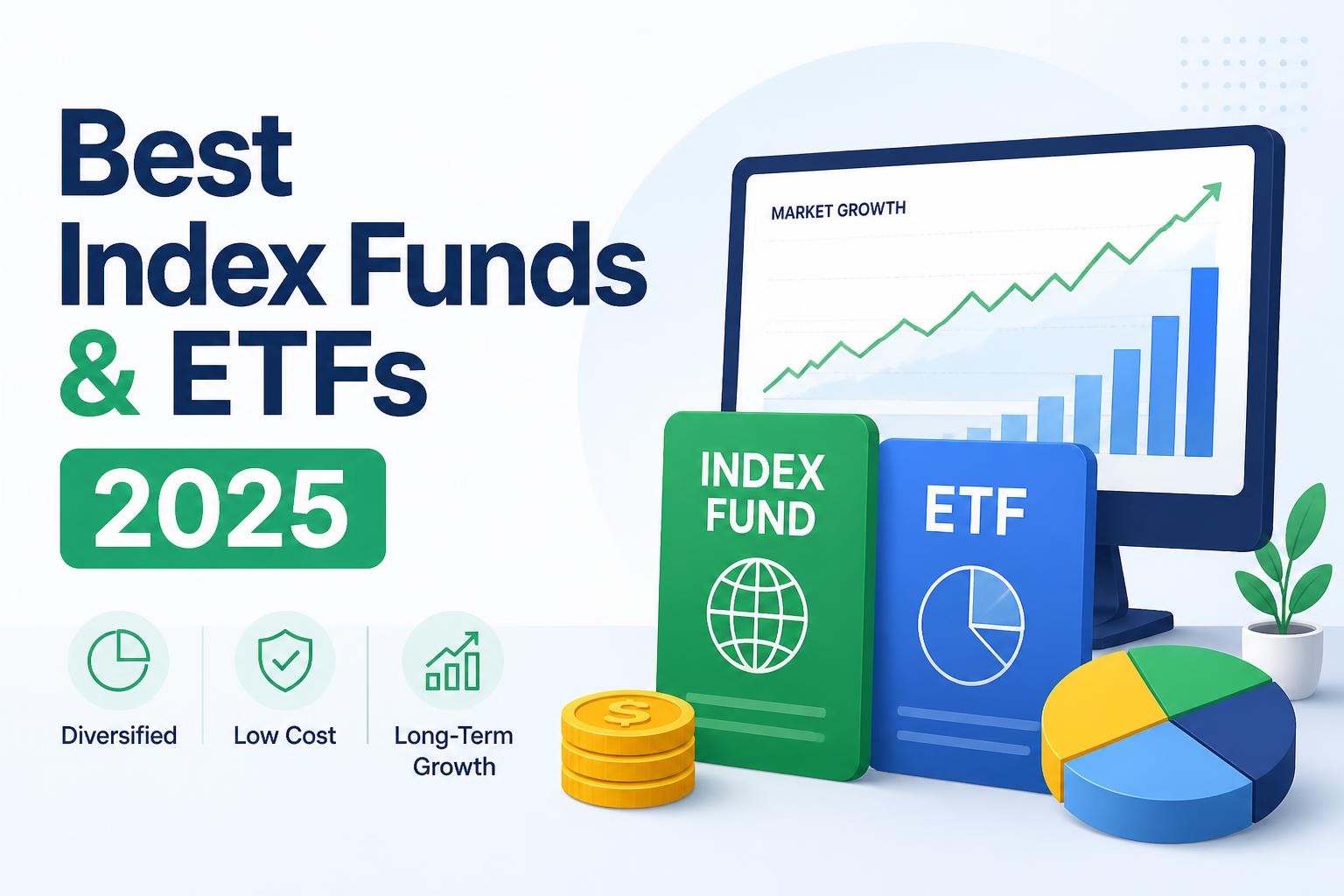
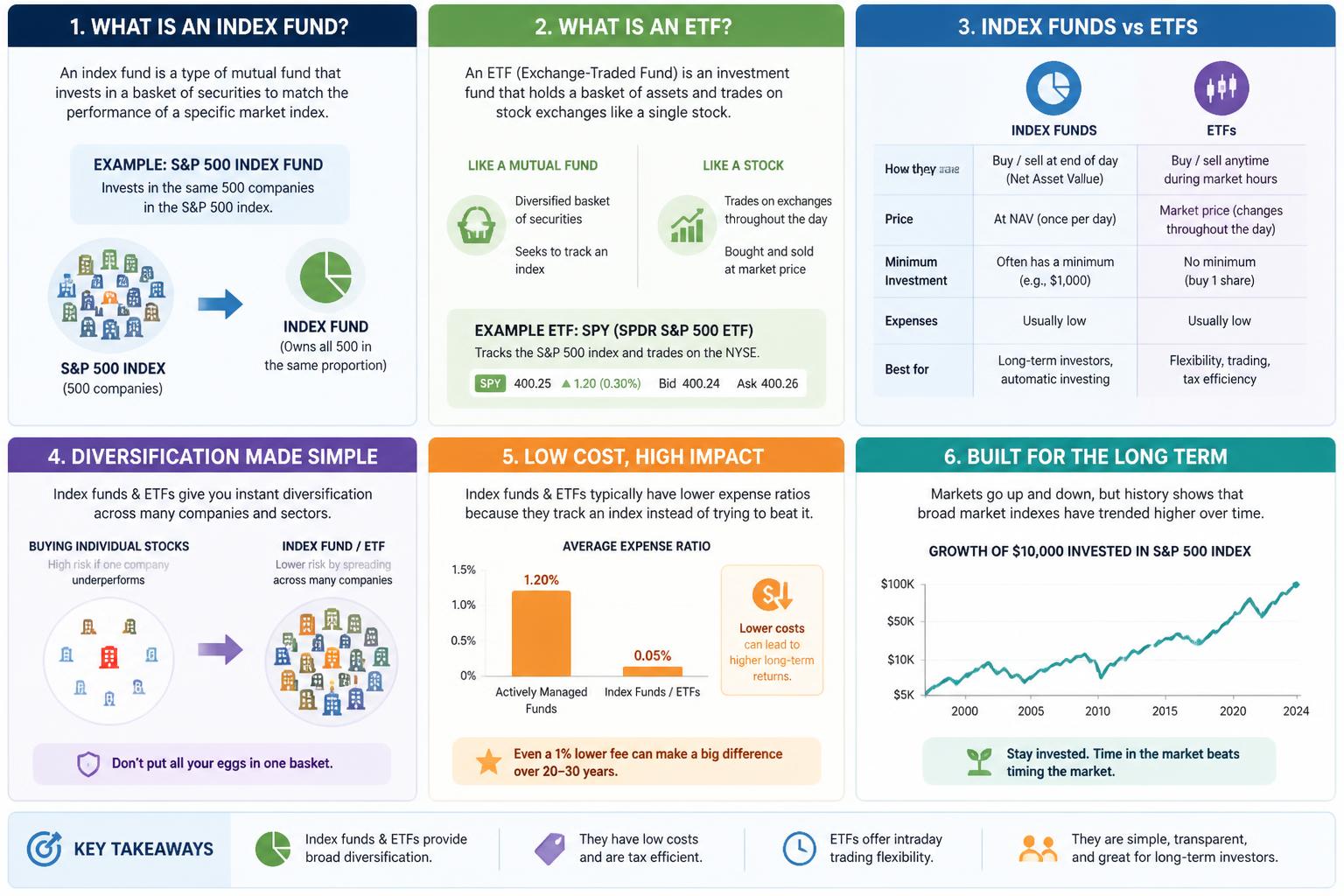
Index funds and ETFs track a market index—like the S&P 500 or total stock market—rather than trying to beat it. You’re not paying a fund manager to pick stocks. You’re buying a slice of an entire market segment automatically.
Index Funds are mutual funds that trade once per day at market close. You buy them directly from Vanguard, Fidelity, or Schwab, usually with no transaction fees if you stick to the company’s own funds.
ETFs trade like stocks throughout the day. They give you more timing flexibility and often slightly lower expense ratios, though you may pay small trading commissions depending on your broker.
Both follow the same philosophy: diversification, low costs, and market-matching returns that historically beat most active managers over the long term.
Why Index Funds & ETFs Beat Active Investing
The numbers are clear. According to S&P Dow Jones Indices, over 90% of actively managed funds underperform their benchmark over 15 years. High management fees, trading costs, and the near-impossibility of consistently timing the market eat returns.
Index funds flip this. With expense ratios as low as 0.03%, more of your money stays invested. A 1% fee difference sounds small, but over 30 years on $100,000, it’s the difference between $574,000 and $761,000.
You’re not paying someone to guess. You’re buying the market’s growth at a fraction of the cost.
Top Index Funds & ETFs for 2026
Best Overall Index Funds
Vanguard Total Stock Market Index Fund (VTSAX)
- Expense ratio: 0.04%
- Tracks: CRSP US Total Market Index (all U.S. stocks)
- Minimum: $3,000
- Why: Single-fund exposure to the entire U.S. market—large, mid, and small cap. Set and forget.
Fidelity ZERO Total Market Index Fund (FZROX)
- Expense ratio: 0.00%
- Tracks: Fidelity U.S. Total Investable Market Index
- Minimum: $0
- Why: Zero fees, no minimum. Perfect for beginners or small starting amounts.
Schwab Total Stock Market Index Fund (SWTSX)
- Expense ratio: 0.03%
- Tracks: Dow Jones U.S. Total Stock Market Index
- Minimum: $0
- Why: Ultra-low costs, no barrier to entry. Nearly identical performance to VTSAX.
Best Overall ETFs
Vanguard Total Stock Market ETF (VTI)
- Expense ratio: 0.03%
- Tracks: CRSP US Total Market Index
- Why: The ETF version of VTSAX with even lower costs and intraday trading.
Schwab U.S. Broad Market ETF (SCHB)
- Expense ratio: 0.03%
- Tracks: Dow Jones U.S. Broad Stock Market Index
- Why: Broad U.S. exposure with low fees and strong liquidity.
iShares Core S&P Total U.S. Stock Market ETF (ITOT)
- Expense ratio: 0.03%
- Tracks: S&P Total Market Index
- Why: Comprehensive U.S. coverage backed by BlackRock’s scale.
Best S&P 500 Index Funds & ETFs
The S&P 500 tracks the 500 largest U.S. companies—roughly 80% of total U.S. market value.
Index Funds:
- Vanguard 500 Index Fund (VFIAX): 0.04%, $3,000 minimum
- Fidelity 500 Index Fund (FXAIX): 0.015%, $0 minimum
- Schwab S&P 500 Index Fund (SWPPX): 0.02%, $0 minimum
ETFs:
- Vanguard S&P 500 ETF (VOO): 0.03%
- SPDR S&P 500 ETF Trust (SPY): 0.09% (most liquid, higher cost)
- iShares Core S&P 500 ETF (IVV): 0.03%
Best International Index Funds & ETFs
Diversifying beyond U.S. borders captures growth in developed and emerging markets.
Index Funds:
- Vanguard Total International Stock Index Fund (VTIAX): 0.11%
- Fidelity International Index Fund (FSPSX): 0.035%
ETFs:
- Vanguard Total International Stock ETF (VXUS): 0.07%
- iShares Core MSCI Total International Stock ETF (IXUS): 0.07%
- Schwab International Equity ETF (SCHF): 0.06%
Best Bond Index Funds & ETFs
Bonds provide stability and income, especially for balanced portfolios or near-retirees.
Index Funds:
- Vanguard Total Bond Market Index Fund (VBTLX): 0.05%
- Fidelity U.S. Bond Index Fund (FXNAX): 0.025%
ETFs:
- Vanguard Total Bond Market ETF (BND): 0.03%
- iShares Core U.S. Aggregate Bond ETF (AGG): 0.03%
- Schwab U.S. Aggregate Bond ETF (SCHZ): 0.03%
How to Choose the Right Index Funds & ETFs
Match Your Investment Goal
Long term growth (10+ years): Total stock market or S&P 500 index funds. Accept volatility for higher returns.
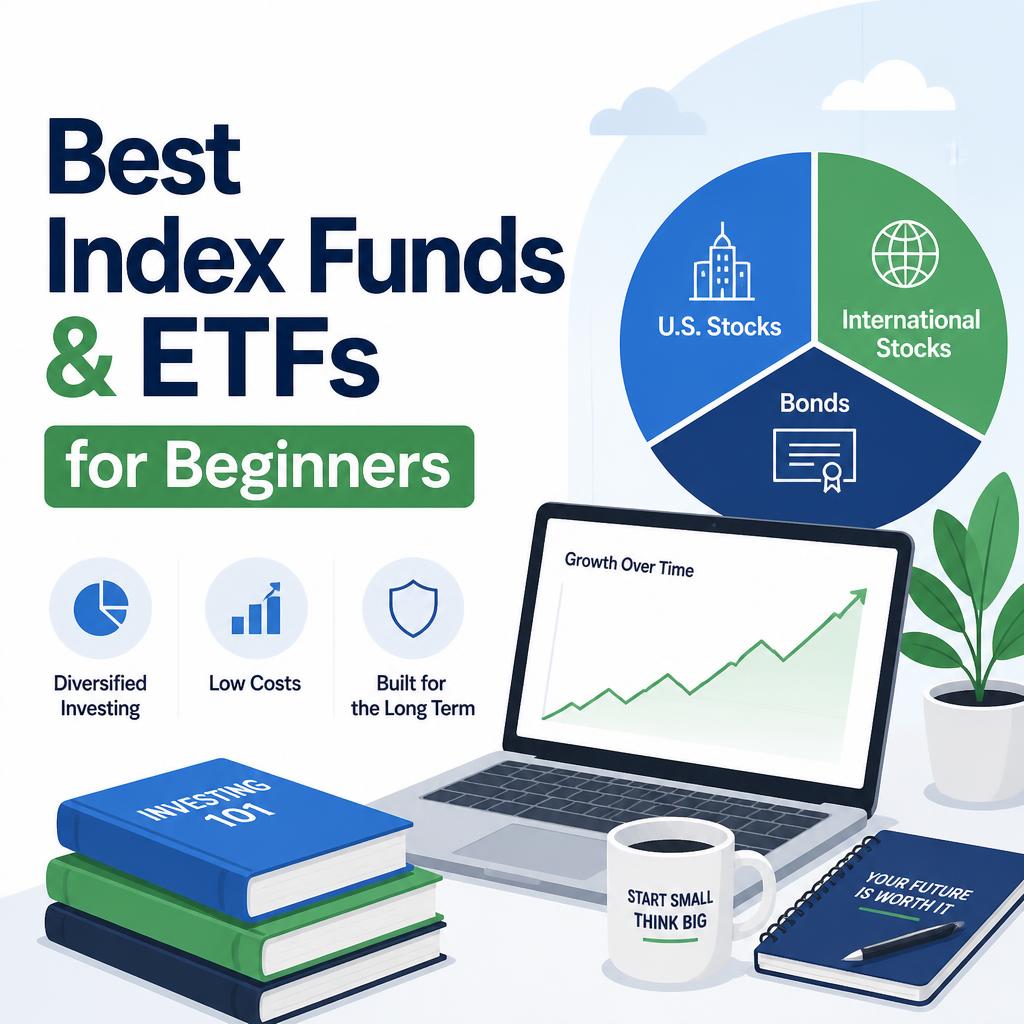
Diversified growth: U.S. stocks (70-80%), international stocks (10-20%), bonds (10-20%).
Income and stability: Weight more toward bond index funds, especially near retirement.
Compare Expense Ratios
Every 0.10% in fees costs roughly $100 per year on $100,000. Look for expense ratios under 0.10%. At Vanguard, Fidelity, and Schwab, you’ll routinely find 0.00% to 0.05%.
Don’t pay more than 0.20% for a passive index fund. If you see higher fees, you’re either looking at active management or getting ripped off.
Check Tracking Error
Tracking error measures how closely a fund matches its index. Look for under 0.10%. The best funds stay within 0.05% of their benchmark annually.
You can find this in fund prospectuses or on Morningstar.
Consider Tax Efficiency
ETFs are generally more tax efficient than mutual funds because of their structure, which minimizes capital gains distributions. If you’re investing in a taxable brokerage account, ETFs often edge out index funds.
In tax-advantaged accounts (401(k), IRA), the difference doesn’t matter much—choose based on expense ratio and access.
Index Fund vs ETF: Which to Choose?
Choose Index Funds if:
- You want to automate regular investments (dollar cost averaging)
- You prefer simplicity and don’t care about intraday trading
- You’re investing through a retirement account with low-cost index funds
Choose ETFs if:
- You want flexibility to trade during market hours
- You’re building a taxable portfolio
- You want the absolute lowest expense ratios
For most people, the difference is minimal. Pick the version at your broker with the lowest fees.
Common Mistakes to Avoid
Chasing Performance
Last year’s top fund often underperforms the next. Index funds eliminate this by delivering consistent market returns without guessing.
Overdiversifying
Owning 15 different index funds doesn’t reduce risk—it creates overlap and confusion. A simple portfolio of 2-4 funds (U.S. stocks, international stocks, bonds) covers everything.
Ignoring Fees
A 1% expense ratio compounds against you for decades. Always choose the lowest-cost option that tracks your desired index.
Market Timing
Trying to buy low and sell high defeats the purpose. Time in the market beats timing the market. Stay invested through volatility.
Forgetting Rebalancing
If stocks surge and bonds don’t, your 80/20 portfolio might drift to 90/10. Rebalance annually or semi-annually to maintain your risk level. Most brokers offer free automatic rebalancing.
Building a Simple Index Fund Portfolio
The Three Fund Portfolio
One of the most proven strategies:
- U.S. Stock Market: 60-70% (VTI, VTSAX, FZROX)
- International Stock Market: 20-30% (VXUS, VTIAX)
- U.S. Bond Market: 10-20% (BND, VBTLX)
Thousands of companies worldwide, multiple asset classes, three holdings.
The Two Fund Portfolio (Maximum Simplicity)
- Total World Stock: 80-90% (VT, VTWAX)
- Total Bond Market: 10-20% (BND, VBTLX)
One stock fund covers U.S. and international. One bond fund provides stability. Done.
Adjust for Your Age
Rough rule: subtract your age from 110 to find your stock allocation. At 30, that’s 80% stocks. At 60, it’s 50%. Younger investors can handle more volatility for growth; older investors need stability.
Not gospel—adjust for your risk tolerance—but a solid starting point.
Where to Buy Index Funds & ETFs
Best Brokers for Index Funds
Vanguard: Best for buy and hold investors. Their funds have rock-bottom fees, but the platform is less polished than competitors.
Fidelity: Zero fee index funds (FZROX, FZILX) and excellent research tools. Good for beginners.
Schwab: Competitive fees, strong customer service, solid mobile app. Good for ETF traders.
M1 Finance: Free automated rebalancing and fractional shares. Perfect for hands-off investors who want precise allocations.
401(k) and IRA Considerations
If your 401(k) offers index funds from Vanguard, Fidelity, or Schwab with expense ratios under 0.10%, use those. If not, contribute enough to get your employer match, then prioritize an IRA where you control fund selection.
For more on choosing the best index funds and ETFs for retirement accounts, understand the fee structures and fund availability in your plan.
Tax Strategies for Index Fund Investors
Harvest Tax Losses
In taxable accounts, sell losing positions to offset capital gains. Then immediately buy a similar (not identical) fund to stay invested. Sell VTI at a loss and buy ITOT—both track the total market but are different enough to avoid wash sale rules.
Hold for the Long Term
Index funds held over one year qualify for long term capital gains rates (0%, 15%, or 20% depending on income) instead of ordinary income rates up to 37%. Patience pays.
Prioritize Tax Advantaged Accounts
Max out 401(k)s and IRAs first. These accounts let your funds grow tax deferred or tax free, supercharging compounding.
Index Funds & ETFs for Specific Goals
For Early Retirement (FIRE Movement)
Aggressive growth with high stock allocation:
- 80% VTI (U.S. total market)
- 15% VXUS (international stocks)
- 5% BND (bonds for rebalancing)
For Passive Income
Focus on dividend index funds and bond ETFs:
- Vanguard High Dividend Yield ETF (VYM): 0.06%
- Vanguard Dividend Appreciation ETF (VIG): 0.06%
- BND or AGG for stable income
For College Savings (529 Plans)
Age based portfolios automatically shift from stocks to bonds as your child approaches college. Most 529s offer low cost index fund options from Vanguard or similar providers.
For Retirement (Traditional Approach)
Shift from growth to preservation near retirement. By 60, consider:
- 50% U.S. stocks (VTI, VOO)
- 20% international stocks (VXUS)
- 30% bonds (BND, AGG)
Looking Ahead: Index Funds & ETFs in 2025 and Beyond
Index investing isn’t about predicting the market—it’s about participating in long term economic growth. Whether 2025 brings bull markets, corrections, or volatility, index funds keep you invested without emotional decisions.
Developments to watch:
- Direct indexing platforms are making tax loss harvesting more accessible for smaller investors
- ESG index funds continue to grow, though fees are typically higher
- Thematic ETFs (clean energy, AI, robotics) offer targeted exposure but drift from true passive indexing
For most investors, classic total market and S&P 500 index funds remain the smartest, simplest, and cheapest path to wealth.
Stop Overthinking and Start Investing
The best index fund is the one you’ll actually buy and hold. Whether you choose VTSAX, VTI, FZROX, or any other low cost option from this guide, you’re already ahead of most investors who pay excessive fees or chase hot stocks.
Start with a simple portfolio. Automate contributions. Rebalance once a year. Ignore the noise. Repeat for decades.
That’s how you build wealth without wasting time or money.