Best Retirement Accounts for 2026: IRA vs 401(k)
Picking a retirement account gets treated like some impossible decision. It isn’t. The financial industry wants you confused so you’ll pay for advice you don’t need.
The wrong account can cost you thousands in fees or missed tax breaks. This guide tells you how to pick without overthinking it.
401(k) vs IRA: What’s the Difference?
401(k) Basics
Your employer sets up a 401(k). Money comes out of your paycheck before taxes. Some employers match your contributions—that’s free money.
2025 limits:
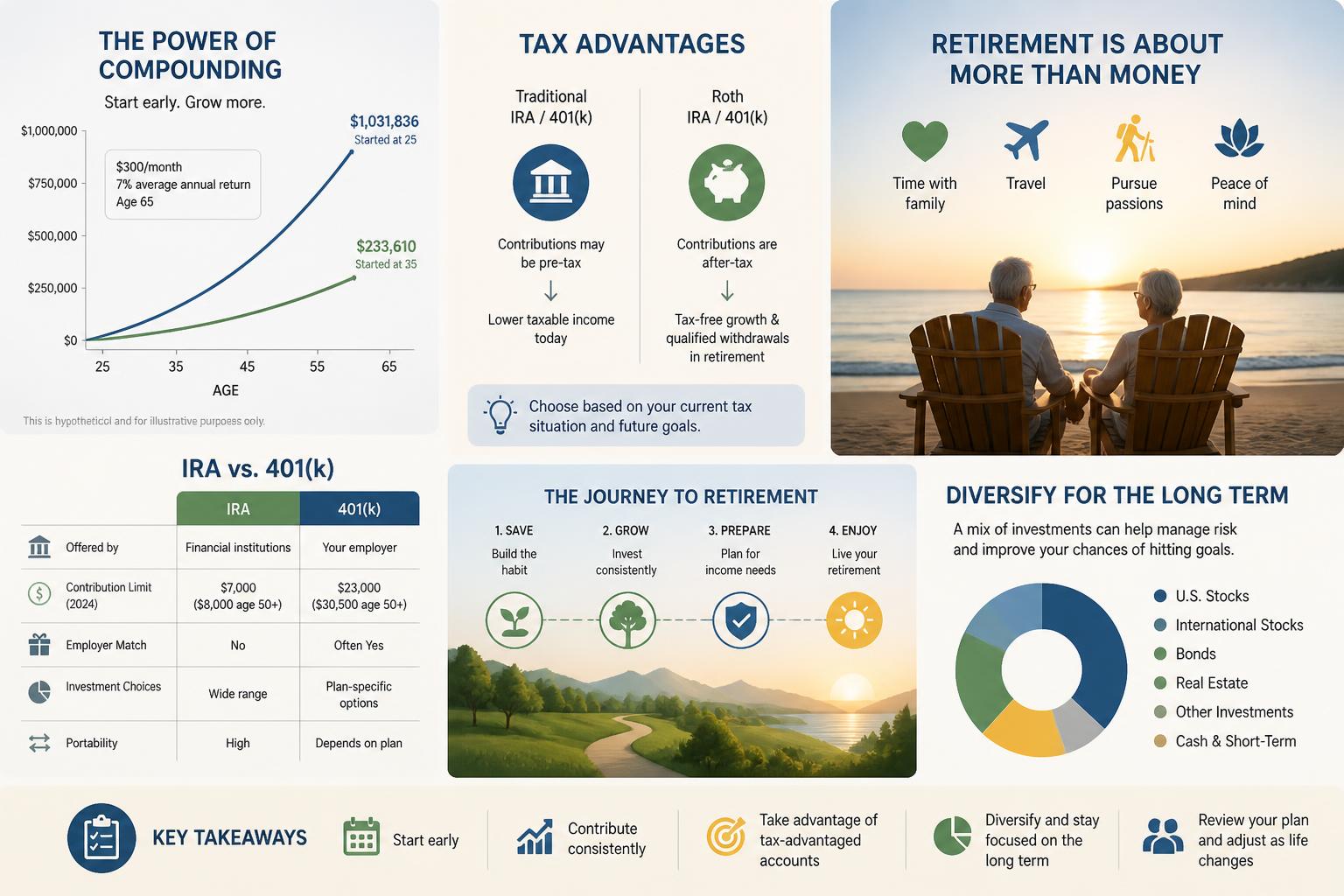
- $23,000 per year (under 50)
- $30,500 if you’re 50+
- Your employer picks the investments
- You have to start withdrawals at 73
IRA Basics
You open an IRA yourself. You control where the money goes.
Traditional IRA:
- Contributions may reduce your taxes now
- You pay tax when you withdraw
- $7,000 limit ($8,000 if 50+)
Roth IRA:
- You pay tax now
- Withdrawals are tax-free later
- Same limits as Traditional
- No forced withdrawals
Why This Actually Matters
People live longer. Healthcare costs more. Social Security might not cover what you need.
A 1% fee difference on $500,000 over 30 years? That’s $150,000 gone. The tax choice (now vs later) can swing your bill by tens of thousands.
How to Pick
1. Take the 401(k) Match First
If your employer matches, that’s your first move. A 50% match on 6% of your salary is a guaranteed 50% return. Nothing else comes close.
Contribute enough to get the full match before you do anything else.
2. Check the Fees
Some 401(k) plans charge too much or limit you to expensive funds.
Red flags:
- Admin fees over 0.50%
- Fund expense ratios above 0.75%
- Fewer than 10 investment options
- No cheap index funds
If your 401(k) is expensive, contribute to the match and stop. Put extra savings in an IRA.
3. Traditional or Roth?
Compare your tax rate now to what you expect in retirement.
Go Traditional if:
- You’re in a high bracket now (24%+)
- You expect less income later
- You need the deduction this year
Go Roth if:
- You’re early career with lower income
- You expect higher taxes later
- You want no forced withdrawals
- You’ve maxed everything else
Splitting between both works too.
4. Know the Income Limits
High earners get restricted.
2025 Roth IRA cutoffs:
- Single: $150k-$165k
- Married: $236k-$246k
If you make too much, use the backdoor Roth: contribute to a Traditional IRA (non-deductible), then convert to Roth immediately.
5. Max Out What You Can
After you’ve taken the match and funded IRAs, go back and fill up the 401(k) if you have money left.
2025 total:
- 401(k): $30,500 (with catch-up)
- IRA: $8,000 (with catch-up)
- Combined: $38,500
Best Places to Open Accounts
Solo 401(k) for Self-Employed
If you work for yourself, a Solo 401(k) lets you contribute up to $69,000 in 2025. You can make both employee and employer contributions.
Best providers: Fidelity, Schwab, E*TRADE
IRA Providers
Fidelity
- No minimums
- Free trading
- Good research tools
Vanguard
- Cheap index funds
- Strong track record
Schwab
- No fees
- Good service
- Wide selection
Betterment
- Automated management
- 0.25% fee
- Tax-loss harvesting
- For hands-off people
Don’t Do These Things
1. Skip the Match
Not contributing enough to get the full match is the biggest mistake. It’s free money.
2. Ignore Fees
1.5% in fees will eat 30% of your returns over 30 years. Read the fee disclosure.
3. Play It Too Safe When You’re Young
If you’re decades from retirement, being too conservative costs you growth. You have time to ride out drops.
4. Leave Old 401(k)s Behind
Roll them into an IRA or your new plan when you switch jobs. Orphaned accounts charge more and get forgotten.
5. Miss the HSA
If you qualify, Health Savings Accounts beat everything:
- Deductible going in
- Grows tax-free
- Tax-free out (for medical)
- Works like an IRA after 65
Advanced Moves
Mega Backdoor Roth
Some 401(k) plans let you contribute after-tax dollars beyond the $23,000 limit, then convert to Roth. You can add $46,000+ to Roth savings this way.
You need a plan that allows after-tax contributions and in-service conversions.
Convert in Low-Income Years
If you have a year with unusually low income, convert Traditional IRA money to Roth. You pay tax at the low rate now, then get tax-free withdrawals later.
The 55 Rule
Leave your job at 55 or later? You can tap your 401(k) without the 10% penalty (though you still owe regular tax).
What to Do Now
Month 1:
- Figure out your employer match percentage
- Adjust to capture the full match
- Check your 401(k) fees
- Open an IRA if you don’t have one
Month 2:
- Bump contributions 1-2%
- Set up automatic annual increases
- Rebalance if needed
Month 3:
- Roll over old 401(k)s
- Set up backdoor Roth if needed
- Aim for 15%+ savings rate
Bottom Line
There’s no universal right answer. It depends on your income, taxes, employer benefits, and age.
For most people:
- 401(k) to the match
- Max Roth IRA (or backdoor Roth)
- Fill the rest of the 401(k)
- HSA if eligible
Use cheap providers. The best account is the one you actually fund.
Start with whatever you can manage. Get the match. Increase over time.
More at https://moneysavingway.com/best-retirement-ira-401k/.
Don’t wait. Delaying costs you compound growth. Open the account, automate contributions, and stop thinking about it.