Vanguard Review: Low-Cost Investing in 2025
Picking index funds without overpaying is harder than it should be. Vanguard, founded by John Bogle in 1975, introduced the first index fund available to individual investors. Is it still the best choice? Here’s what you need to know.
What Makes Vanguard Different?
Vanguard is owned by its funds, which are owned by investors. Most brokerages are publicly traded companies that answer to shareholders seeking profits. Vanguard has no outside shareholders, so its only job is to keep costs low.
This explains why Vanguard’s expense ratios stay among the lowest in the industry. When other companies raise fees to boost profits, Vanguard passes the savings to you.
Vanguard’s Investment Options
Index Funds and ETFs
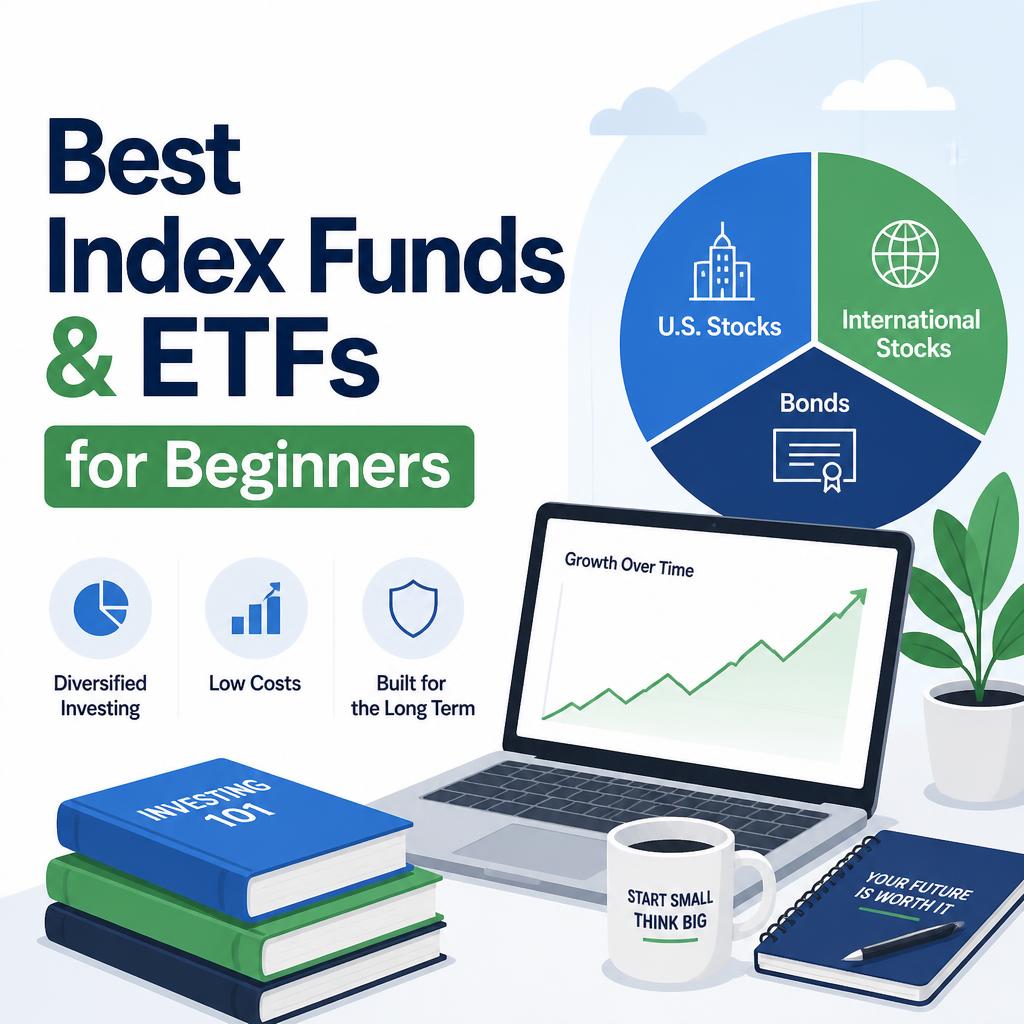
Vanguard offers over 200 funds and 80+ ETFs. Their flagship products:
Vanguard Total Stock Market Index Fund (VTSAX/VTI) — 0.04% expense ratio. Holds over 4,000 U.S. stocks.
Vanguard Total International Stock Index Fund (VTIAX/VXUS) — 0.11% expense ratio. Covers developed and emerging markets.
Vanguard Total Bond Market Index Fund (VBMFX/BND) — 0.05% expense ratio. U.S. investment-grade bonds.
Vanguard 500 Index Fund (VFIAX/VOO) — 0.04% expense ratio. Tracks the S&P 500.
For more on index funds across different providers, see our guide on the best index funds and ETFs.
Target-Date Funds
Vanguard’s Target Retirement Funds start around 90% stocks and 10% bonds, then gradually shift to more conservative allocations as you approach retirement. Pick a fund close to your retirement year, and Vanguard handles the rebalancing. Expense ratios run around 0.08%.
Actively Managed Funds
Vanguard also offers actively managed funds with expense ratios from 0.20% to 0.50%, compared to the industry average of 0.66% to 1.0%.

Vanguard’s Fee Structure
Expense Ratios
Vanguard’s average expense ratio is 0.08% vs. the industry average of 0.50%. On $100,000, that’s $420 saved per year.
A $10,000 investment growing at 7% annually over 30 years with a 0.08% expense ratio grows to $74,356. With a 0.50% expense ratio, it grows to $68,485. That small fee difference costs you nearly $6,000.
Account Minimums
Most ETFs have no minimum. Mutual funds require:
- Admiral Shares: $3,000 minimum
- Investor Shares: $1,000 minimum
- Target Retirement Funds: $1,000 minimum
If you don’t have the minimum, start with Vanguard ETFs.
Trading Fees
Vanguard eliminated commissions on online stock and ETF trades in 2020. You can buy or sell Vanguard ETFs commission-free. Some limitations:
- Selling Vanguard mutual funds held less than 30 days costs $25
- Non-Vanguard mutual funds may carry $20 to $75 transaction fees
Account Service Fees
Vanguard charges $25 annually for brokerage and IRA accounts with balances below $10,000, or for accounts enrolled in e-delivery with under $50,000 in qualifying assets. Waive it by:
- Keeping at least $10,000 in your account
- Signing up for electronic statements with $50,000+ in assets
- Enrolling in Vanguard’s premium advice services
Account Types and Services
Investment Accounts
Vanguard offers:
- Brokerage accounts
- Traditional and Roth IRAs
- SEP-IRAs and Solo 401(k)s
- 529 college savings plans
- Trust and estate accounts
Retirement Planning Tools
Vanguard’s Retirement Income Calculator estimates whether you’re on track. Their portfolio allocation models suggest asset mixes based on your time horizon and risk tolerance.
Advisory Services
Vanguard Digital Advisor — $3,000 minimum, 0.15% advisory fee. Automated portfolio management.
Vanguard Personal Advisor — $50,000 minimum, 0.30% advisory fee. Combines automated investing with access to human advisors. Most financial advisors charge 1.0%.
Platform Experience and User Interface
Website and Mobile App
Vanguard’s platform feels dated compared to Fidelity and Schwab. The interface isn’t intuitive, and navigation is clunky. Recent updates added mobile check deposit and biometric login, but it still lags behind newer fintech apps.
The website handles basics—checking balances, placing trades, moving money—but don’t expect polish.
Research and Educational Tools
Vanguard’s educational content covers investing basics, retirement planning, and portfolio construction. Research capabilities are adequate for index fund investors but limited for active traders.
No advanced charting tools, real-time streaming quotes, or sophisticated screening. If you’re buying and holding index funds, this won’t matter. Active traders should look elsewhere.
Customer Service
Phone support is available during extended business hours. Average wait times are usually under 10 minutes, though they spike during market volatility or tax season.
You can send secure messages through the website and app, but there’s no live chat.
Vanguard’s Strengths
Low Costs
Vanguard’s expense ratios are among the lowest in the industry. Their ownership structure means this won’t change—they have no reason to raise fees for shareholder profits.
Investor-First Approach
Vanguard prioritizes long-term investor success over short-term profits. You see this in their patient customer service, educational content, and reluctance to offer high-risk products.
Broad Fund Selection
Vanguard covers virtually every investment need, from broad market index funds to sector-specific investments, international exposure, and bonds. Most funds come in both mutual fund and ETF versions.
Scale and Stability
Vanguard manages nearly $8 trillion in global assets. This scale provides stability and bargaining power that keeps costs low.
Tax Efficiency
Vanguard’s patented ETF structure for mutual funds provides exceptional tax efficiency. Their index funds typically generate minimal capital gains distributions, keeping your tax bill low in taxable accounts.
Vanguard’s Weaknesses
Outdated Platform
The website and mobile app lack modern features and intuitive design. New investors will find the interface clunky, especially if they’re unfamiliar with investment terminology.
Limited Trading Features
Active traders will hate this platform. No advanced order types, limited research tools, and no options trading on the standard platform (only through Vanguard Brokerage Services for qualified investors).
Account Minimums
ETFs have no minimums, but mutual funds require $1,000 to $3,000. Fidelity and Schwab offer similar funds with no minimums.
Slow to Innovate
Vanguard moves cautiously when adopting new features. This protects investors from fads and high-risk products, but it means Vanguard lags behind competitors in convenience features.
Foreign Transaction Fees
Vanguard charges 0.50% on trades of certain foreign stocks. Many competitors offer commission-free international trading.
Who Should Choose Vanguard?
Vanguard works for:
Long-term index fund investors who value low costs and buy-and-hold strategies. If you’re building wealth through consistent investing in low-cost index funds, Vanguard’s fee structure will save you thousands.
Retirement savers who want simple, low-cost options. Target-date funds and traditional retirement accounts provide everything most people need.
Cost-conscious investors who prioritize expenses over platform features. If you’re willing to sacrifice user experience for the lowest fees, Vanguard delivers.
Portfolio simplifiers who want to consolidate investments. You can build a complete portfolio within a single account.
Who Should Look Elsewhere?
Vanguard probably isn’t right if you’re:
An active trader needing advanced tools, real-time data, and complex order types. Consider TD Ameritrade, Interactive Brokers, or TradeStation.
A beginning investor with limited capital who values a modern, intuitive platform. Fidelity offers similar low-cost funds with no minimums and a better user experience.
Seeking cutting-edge features like fractional shares, automated investing, or cryptocurrency. Try M1 Finance, Betterment, or Robinhood.
An options or futures trader who needs sophisticated derivatives tools. Vanguard’s options capabilities are limited to basic strategies.
Vanguard vs. Competitors
Vanguard vs. Fidelity
Fidelity matches Vanguard’s low costs with similar index funds at comparable expense ratios. Fidelity’s platform has a better user experience, better research tools, and no account minimums. Vanguard’s ownership structure provides more assurance that low costs will persist.
Vanguard vs. Schwab
Schwab has a more modern platform with better customer service and more branch locations. Their expense ratios closely match Vanguard’s for index funds. Schwab is better for active traders. Vanguard is the purer index investing option.
Vanguard vs. Betterment
Betterment offers automated portfolio management with a slicker interface and lower minimums ($10 to start). But Betterment charges a 0.25% advisory fee on top of underlying fund expenses, making it more expensive long-term than buying Vanguard funds directly.
Tax Considerations with Vanguard
Vanguard’s index funds are exceptionally tax-efficient in taxable accounts. Low turnover means minimal capital gains distributions. Their patented structure lets you switch between mutual fund and ETF share classes without triggering taxable events.
For tax-loss harvesting, Vanguard offers similar funds tracking different indexes, so you can maintain market exposure while realizing losses for tax purposes. The platform doesn’t automate this like some robo-advisors do.
Prioritize tax-efficient index funds in taxable accounts. Use less tax-efficient investments like bonds and REITs in IRAs and 401(k)s.
Getting Started with Vanguard
Opening an account takes 10-15 minutes online. You’ll need:
- Social Security number or Tax ID
- Bank account information for electronic transfers
- Employment information
- Beneficiary details (optional but recommended)
Fund your account via electronic bank transfer (ACH), wire transfer, or check. ACH transfers take 2-3 business days with no fees.
For mutual funds, you invest a dollar amount. For ETFs, you buy whole shares at current market prices.
Final Verdict
For long-term investors focused on low-cost index funds, Vanguard is an excellent choice. The investor-owned structure keeps costs low, and the fund selection covers virtually every investment need.
But Vanguard isn’t for everyone. Active traders, beginning investors who want modern interfaces, or people seeking cutting-edge features should explore alternatives. The dated platform and limited trading capabilities put it behind competitors in user experience.
If you’re building wealth through patient, long-term index fund investing and prioritize costs over convenience, Vanguard is worth considering. The thousands saved in fees will compound in your portfolio.
The right choice depends on your investing style, experience level, and priorities. Consider opening accounts at multiple brokerages to compare—most charge no account fees, so you can test platforms before committing significant assets.