Beginner’s Guide to Dividend Investing: Build Passive Income in 2026
You want to make money while you sleep. That’s the promise of dividend investing — and unlike most “passive income” hype, this one actually delivers. But here’s what nobody tells beginners: chasing high dividend yields can damage your long-term returns more than helping them.
This guide shows you what dividend investing actually is, how it works in 2026’s market environment, and the exact steps to build a portfolio that pays you regularly without the rookie mistakes that cost people thousands.
Table of Contents
- What Is Dividend Investing?
- How Dividend Income Works in Practice
- The 4 Dividend Dates Every Investor Must Know
- Why Dividend Quality Beats High Yield
- Building Your First Dividend Portfolio: Step-by-Step
- Examples of Beginner-Friendly Dividend Stocks and ETFs (2026)
- Common Mistakes That Kill Dividend Returns
- Tax Strategy: Why Your Account Type Matters
- FAQ
What Is Dividend Investing?
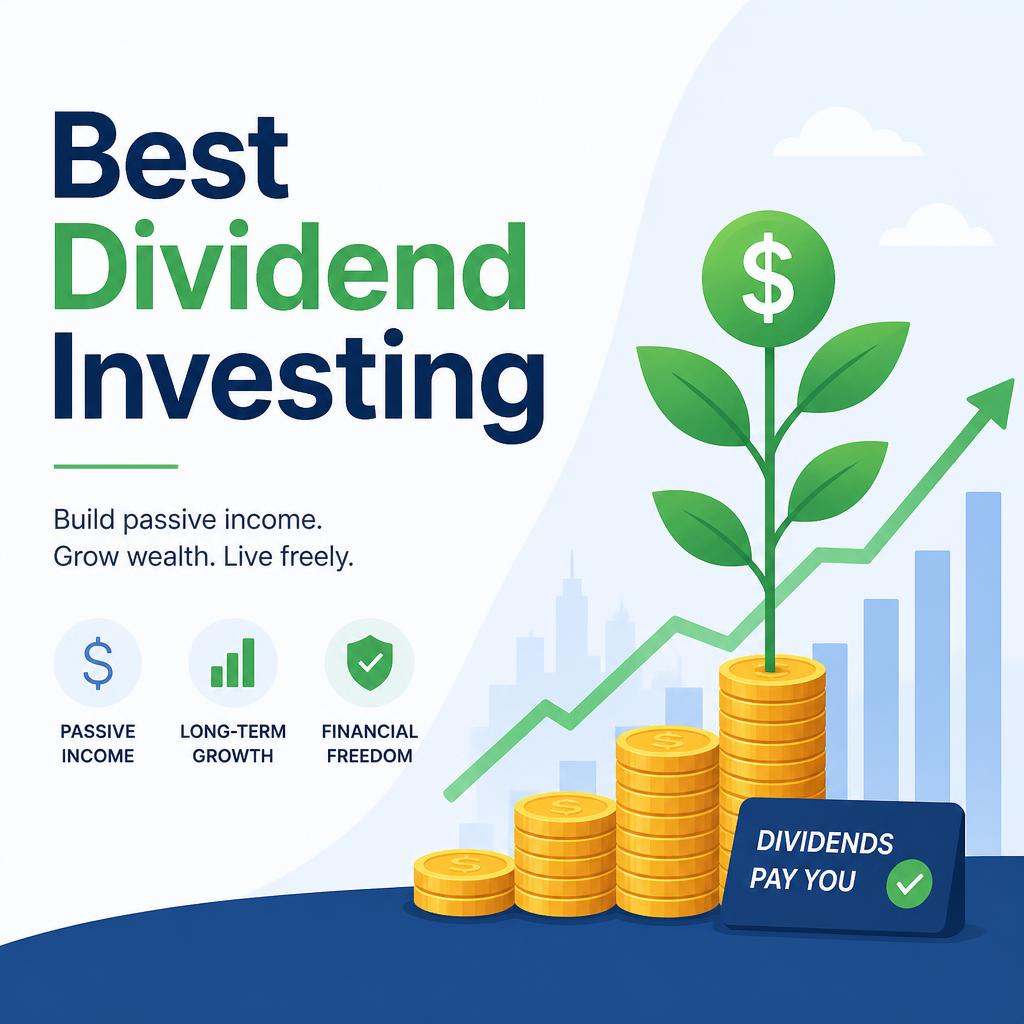
Dividend investing means buying shares in companies that regularly distribute a portion of their profits back to shareholders as cash payments. Instead of only profiting when you sell a stock at a higher price, you receive income just for holding it.
Most US dividend stocks pay quarterly — four times per year. You buy 100 shares of a company trading at $50 with a 3% annual dividend yield, and you’ll receive roughly $37.50 every three months, totaling $150 per year. Keep those shares for 10 years and you’ve collected $1,500 in dividends, plus any stock price appreciation.
The power multiplies when you reinvest those payments. According to research data from 2026, reinvesting dividends creates a 32% difference in total returns over 30 years compared to taking the cash. That gap comes from compounding — your dividends buy more shares, which generate more dividends, which buy even more shares.
How Dividend Income Works in Practice
Think of dividend stocks as partial ownership in a business that shares its profits with you. When PepsiCo earns money selling beverages and snacks, it keeps some to reinvest in the business and distributes the rest to shareholders. In 2026, PepsiCo’s dividend payment stands at $1.48 per share.
Here’s how the cash flow works:
- You buy shares — Let’s say 200 shares of a dividend stock
- The company declares a dividend — Board announces “$0.50 per share”
- You receive cash — $100 lands in your brokerage account (200 shares × $0.50)
- You decide what to do — Reinvest automatically, or withdraw for spending
The frequency matters. Most US companies pay quarterly, but the exact timing varies by company. Some pay monthly, others annually. Dividend Aristocrats — companies that have raised their dividends for at least 25 consecutive years — tend to be quarterly payers with predictable schedules.
The 4 Dividend Dates Every Investor Must Know
Miss these dates and you won’t get paid, even if you own the stock. Here’s what each one means:
- Declaration date — Company announces the dividend amount and payment schedule. This is when you learn how much you’ll receive and when.
- Ex-dividend date — The cutoff. You must own shares before this date to receive the upcoming dividend. Buy on or after the ex-dividend date and you miss this payment cycle entirely.
- Record date — Usually 1-2 business days after the ex-dividend date. The company reviews its shareholder list and confirms who gets paid. If you owned shares before the ex-dividend date, you’re on this list.
- Payment date — Cash hits your account. This is typically 2-4 weeks after the record date.
The ex-dividend date catches most beginners. If the ex-dividend date is June 15th, you need to own the stock by June 14th at market close to qualify. Buy on June 15th and you wait for the next quarter.
Why Dividend Quality Beats High Yield
A 10% dividend yield looks more attractive than a 2% yield. That’s the trap.
Picking a quality dividend stock isn’t about chasing the highest yield — it’s about sustainability and growth. Companies with wide economic moats have been less likely to cut dividends, according to Morningstar’s 2026 analysis. A wide moat means the business has competitive advantages that protect its profits: brand power, network effects, cost advantages, or switching costs.
Focus on these three metrics instead of yield alone:
1. Payout ratio — What percentage of earnings the company pays as dividends. A payout ratio of 89.33% (like one company in Morningstar’s 2026 research) signals danger — there’s little room for dividend growth or economic downturns. A payout ratio around 24.35% to 60% is healthier, leaving cash for reinvestment and stability.
2. Dividend growth history — Has the company raised its dividend consistently? Dividend Kings have increased payouts for 50+ consecutive years. Dividend Aristocrats have 25+ years of increases. That track record matters more than today’s yield because it shows the business can grow through recessions and market shifts.
3. Business fundamentals — Revenue growth, profit margins, competitive position, debt levels. Buying a dividend king without paying attention to valuation may mean sacrificing total return. S&P Global, for example, trades 21% below its $530 fair value estimate as of 2026, with a wide economic moat and exemplary capital allocation rating — that’s a quality setup.
A 4% yield from a struggling company that cuts its dividend next year destroys more wealth than a 2% yield from a grower that raises it 8% annually.
Building Your First Dividend Portfolio: Step-by-Step
Start with this framework, adjust as you learn your own preferences.
Step 1: Open the right account type
Tax efficiency is important for dividend investments. A Roth IRA allows for tax-free growth of investments — your dividends compound without annual tax drag. If you’re investing $600/month for 20 years, a Roth IRA can yield $3.3 million tax-free, according to 2026 projections assuming S&P 500 historical returns.
Taxable brokerage accounts work too, but qualified dividends get taxed at 0%, 15%, or 20% depending on your income, while ordinary dividends are taxed as regular income.
Step 2: Decide between individual stocks and ETFs
Individual dividend stocks give you control and higher potential yields, but require research and monitoring. ETFs give you instant diversification and professional management for a small fee.
For total beginners who want one-click diversification, start with a dividend-focused ETF like SCHD (Schwab U.S. Dividend Equity ETF). It focuses on quality and sustainability of dividends with a 0.06% expense ratio — you pay $6 per year for every $10,000 invested.
Step 3: Allocate across sectors
Don’t put everything in one industry. If you buy only oil stocks and energy prices crash, your entire dividend stream suffers. Spread across:
- Consumer staples — PepsiCo, Procter & Gamble (people buy food and household products in any economy)
- Healthcare — Medtronic, the largest pure-play medical-device maker with a narrow economic moat
- Utilities — Water utility stocks are essential and not dependent on discretionary spending
- Financials — Banks and insurers, though more sensitive to interest rate changes
- Industrials — Manufacturing, logistics, infrastructure
Step 4: Set up automatic dividend reinvestment (DRIP)
Most brokers offer a dividend reinvestment plan at no cost. Every dividend payment automatically buys more shares, compounding your position without you lifting a finger. That 32% return difference over 30 years comes from this feature.
Step 5: Monitor quarterly, don’t panic daily
Check your holdings every quarter when earnings come out. Look for dividend cuts, payout ratio changes, or deteriorating fundamentals. Daily stock price swings don’t matter when you’re collecting dividends for income.
Examples of Beginner-Friendly Dividend Stocks and ETFs (2026)
Here’s what’s working in 2026’s market environment, based on current research and Morningstar analysis.
Top Dividend ETFs for Beginners
SCHD (Schwab U.S. Dividend Equity ETF) — $50-150 per share
High-quality US dividend payers with a focus on sustainability. 0.06% expense ratio makes this one of the cheapest options. Best for total beginners who want one-click diversification.
VIG (Vanguard Dividend Appreciation ETF) — $50-150 per share
Broad dividend-growth focus with low fees. Tracks companies with a history of increasing dividends, not just paying them.
NOBL (ProShares S&P 500 Dividend Aristocrats ETF) — $50-150 per share
Only stocks with 25+ year dividend increase streaks. More concentrated than SCHD or VIG, higher quality bar.
SDY (SPDR S&P Dividend ETF) — $50-150 per share
Focuses on companies with 20+ years of dividend history. Slightly different selection criteria than NOBL, worth comparing holdings.
Individual Dividend Stocks Worth Researching
PepsiCo — Trading 15% below its $169 fair value estimate as of 2026
Wide economic moat, exemplary capital allocation rating, $1.48 dividend payment. Consumer staples play — people buy Pepsi, Lay’s, Gatorade, and Quaker in any economy.
S&P Global — Trading 21% below its $530 fair value estimate
Wide economic moat, exemplary capital allocation, $0.97 dividend payment. Financial data and analytics provider with pricing power.
Medtronic — Fair value estimate of $112
Largest pure-play medical-device maker with a narrow economic moat. Healthcare demand is non-discretionary.
Mondelez International — Fair value estimate of $73
Wide economic moat with leading snack brands (Oreo, Ritz, Cadbury). Global consumer staples exposure.
EOG Resources — Fair value estimate of $139
Growing its dividend since becoming independent in 1999. Energy exposure for diversification, though more volatile.
American States Water Co. — Among top recommended stocks for June 2026
Water utility with essential services. Dividend safety score of 3.7-4.5 range, meaning low cut risk.
Procter & Gamble — Sustains dividend yield through brand strength
Consumer staples giant with pricing power. Owns Tide, Pampers, Gillette, and dozens of household brands.
All valuation data reflects Morningstar’s 2026 research. Check current prices before buying — these estimates shift as markets move.
Common Mistakes That Kill Dividend Returns
Chasing the highest yield without checking sustainability
A 12% yield usually means the market expects a dividend cut. High yields often come from falling stock prices, not generous companies.
Ignoring valuation
Buying a dividend king without paying attention to valuation may mean sacrificing total return. Overpaying for quality still results in poor returns.
Concentrating in one sector
Five bank stocks aren’t diversification. Spread across consumer staples, healthcare, utilities, industrials, and financials.
Forgetting about taxes
Holding dividend stocks in a taxable account when you qualify for a Roth IRA costs you compound growth. Run the math on tax-advantaged accounts first.
Selling winners too early
That stock you bought at $40 now trades at $80, and the yield on your purchase price is 6% even though new buyers only get 3%. Your yield on cost keeps growing — don’t sell just because the current yield looks low.
Panic selling during dividend cuts
Sometimes cuts are strategic repositioning, not business failure. Check whether the company is preserving cash to invest in growth or actually struggling. Context matters.
Tax Strategy: Why Your Account Type Matters
Dividend income gets taxed differently depending on where you hold it:
Roth IRA — Dividends grow tax-free forever. You pay no taxes on dividends or gains when you withdraw in retirement. This is the most powerful account for dividend investors under age 59½ who qualify (2026 contribution limit applies).
Traditional IRA — Dividends grow tax-deferred. You pay ordinary income tax on withdrawals in retirement, but avoid annual tax drag during accumulation.
Taxable brokerage account — Qualified dividends are taxed at 0%, 15%, or 20% depending on your income bracket. Ordinary dividends (REITs, some foreign stocks) are taxed as regular income. You receive a 1099-DIV each year and owe taxes even if you reinvest.
The difference compounds. Investing $600/month for 20 years in a Roth IRA can yield $3.3 million tax-free, according to 2026 projections. The same investment in a taxable account loses a chunk to annual dividend taxes, reducing your compound growth.
With the Federal Reserve holding rates at 3.5%-3.75% in 2026, qualified dividend income becomes more attractive relative to bonds and savings accounts, especially inside tax-advantaged accounts.
FAQ
Can you make $1,000 a month in dividends?
Yes, but it requires significant capital. At a 4% annual yield (typical for quality dividend stocks in 2026), you’d need $300,000 invested to generate $12,000 per year, or $1,000 per month. Start smaller and reinvest dividends — that $600/month contribution strategy can build toward this goal over 15-20 years.
Should I reinvest dividends or take cash?
Reinvest during accumulation years. The 32% difference in total returns over 30 years comes from compounding — dividends buying more shares, which generate more dividends. Take cash only when you need the income for living expenses, typically in retirement.
What’s the difference between qualified and ordinary dividends?
Qualified dividends are taxed at lower capital gains rates (0%, 15%, or 20%). Ordinary dividends are taxed as regular income. Most US stocks pay qualified dividends if you hold them for at least 60 days during the 121-day period surrounding the ex-dividend date. REITs and some foreign stocks pay ordinary dividends.
How often are dividends paid?
Most US dividend stocks pay quarterly — four times per year. Some companies pay monthly (common with REITs), others annually. Dividend Aristocrats and Dividend Kings typically pay quarterly on predictable schedules.
Are dividend stocks a good investment for beginners?
Yes, if you focus on quality over yield. Dividend stocks provide regular income, force you to buy established companies with real profits, and historically show lower volatility than non-dividend payers. Start with a dividend ETF like SCHD for instant diversification, then research individual stocks as you learn.
What qualifies a company as a dividend king?
A Dividend King has increased its dividend for 50+ consecutive years. That track record demonstrates the company survived multiple recessions, market crashes, and competitive threats while still growing payouts. It’s a higher bar than Dividend Aristocrats (25+ years).
Why do some companies not pay dividends?
Growth companies reinvest profits into expansion instead of paying dividends. Amazon, Tesla, and Alphabet historically paid no dividends because they used cash to build new businesses. Mature companies with fewer growth opportunities tend to pay dividends. Neither approach is wrong — it depends on the business stage and strategy.
How do companies decide the dividend amount?
The board of directors reviews earnings, cash flow, growth investments, and shareholder expectations each quarter. They aim for a sustainable payout ratio (typically 30-60% of earnings) that allows dividend increases over time without sacrificing business health. Companies with exemplary capital allocation ratings balance dividends, buybacks, debt reduction, and growth investments.
What are Dividend Aristocrats?
Companies in the S&P 500 that have raised dividends for at least 25 consecutive years. They’re a subset of dividend kings (50+ years) and represent high-quality businesses with pricing power and durable competitive advantages. ETFs like NOBL track this group exclusively.