Retirement (IRA/401k) Pros and Cons: What Financial Advisors Won’t Tell You in 2026
Most people think retirement accounts are a no-brainer. Tax advantages, compound growth, employer matches. But nobody mentions that IRAs and 401(k)s can lock up your money for decades, trigger surprise tax bills, and force you into a one-size-fits-all savings strategy that might not fit your life at all.
The financial industry makes billions pushing everyone toward the same advice: “Max out your 401(k)!” In 2026, with contribution limits hitting $24,500 for 401(k)s and $7,500 for IRAs, the stakes are higher than ever. Before you funnel thousands into these accounts, you need to understand what you’re actually signing up for.
This breaks down the real pros and cons: the tax traps, the flexibility you’re giving up, and the situations where traditional advice completely backfires.
Table of Contents
- What Actually Is a Retirement Account (IRA vs 401k)?
- The Real Pros: Why These Accounts Dominate
- The Cons Nobody Talks About
- 2026 Contribution Limits and What They Mean for You
- The Tax Trap: Traditional vs Roth
- When You Should NOT Max Out Your 401(k)
- Catch-Up Contributions: The 50+ Advantage
- Common Mistakes That Cost Thousands
- FAQ
What Actually Is a Retirement Account (IRA vs 401k)?
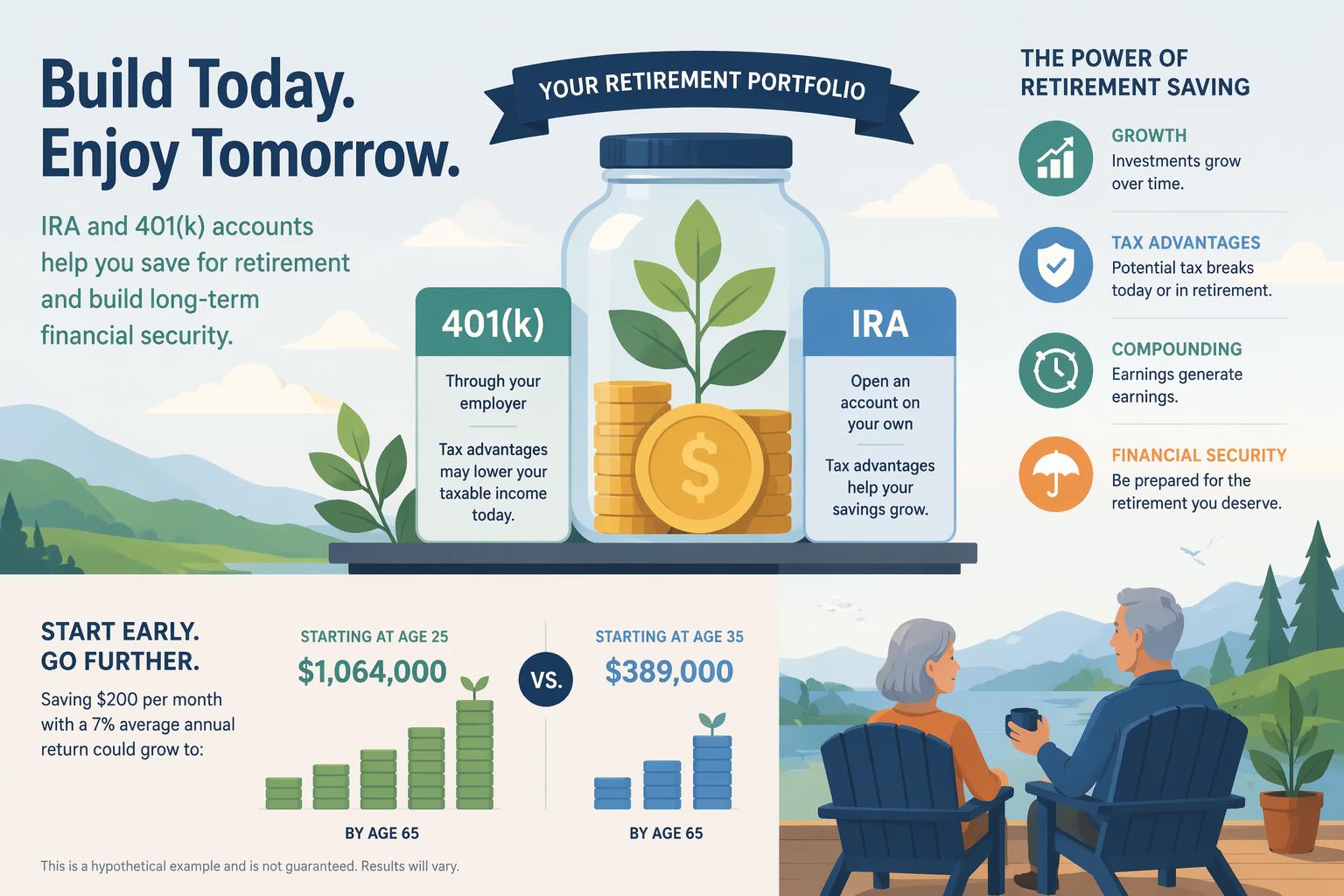
A 401(k) is an employer-sponsored account. Your contributions come directly from your paycheck, often with an employer match (free money). An IRA is an individual account you open yourself, through a bank, brokerage, or robo-advisor.
Both give you tax advantages for saving long-term. But they operate completely differently:
401(k) basics:
- Tied to your employer
- Higher contribution limits ($24,500 in 2026, according to the IRS)
- Often includes employer matching
- Limited investment options (whatever your plan offers)
- Automatically deducted from paycheck
IRA basics:
- You open it independently
- Lower contribution limits ($7,500 in 2026, per IRS guidelines)
- No employer involvement
- Complete investment freedom
- You manually contribute
Both lock your money until age 59½. Early withdrawals trigger a 10% penalty plus income taxes. That’s the trade-off for tax advantages.
The Real Pros: Why These Accounts Dominate
Tax advantages that compound over decades
Traditional 401(k)s and IRAs give you an upfront tax deduction. Contribute $10,000, and you might drop your taxable income by $10,000. If you’re in the 24% tax bracket, that’s $2,400 saved immediately.
Roth accounts flip it: you pay taxes now, but withdrawals in retirement are tax-free. That matters if you expect to be in a higher tax bracket later.
Either way, your investments grow tax-deferred. No capital gains taxes when you sell. No dividend taxes eating into returns. According to Fidelity’s research, small, consistent increases in your savings rate compound dramatically over time. Bumping contributions by just 1% can significantly enhance your retirement lifestyle.
Employer match is guaranteed return
If your employer matches 401(k) contributions, that’s an immediate 50% to 100% return on your money. Not taking the match is leaving cash on the table.
Forced discipline through automation
Payroll deductions remove the decision-making. The money disappears before you see it. Behavioral finance research shows this automation dramatically increases savings rates compared to manual contributions.
Creditor protection in most states
401(k)s are protected from bankruptcy and lawsuits under federal law. IRAs have some protection, but it varies by state. If you’re in a high-risk profession (doctor, small business owner), that safety net matters.
The Cons Nobody Talks About
Your money is locked up for decades
That 10% early withdrawal penalty isn’t theoretical. Need cash for an emergency, a business opportunity, or a career pivot before 59½? Tough luck. The IRS doesn’t care about your reasons.
There are narrow exceptions (first-time home purchase, qualified education expenses, medical hardships), but they’re limited and come with paperwork.
You’re betting on future tax rates
Traditional accounts defer taxes. That’s great if you’re in a lower bracket in retirement. But what if tax rates rise across the board? What if you’re more successful than expected and your retirement income is higher?
Then you’ve just deferred taxes into a higher-rate environment. The Roth option hedges this, but only if you can afford to pay taxes now.
Limited investment options in 401(k)s
Your employer picks the menu. You’re often stuck with a handful of mutual funds, many with expense ratios above 0.50%. Meanwhile, IRAs give you access to individual stocks, ETFs, REITs, bonds—anything publicly traded.
That flexibility gap can cost you percentage points annually. Over 30 years, a 0.50% expense ratio difference on a $500,000 portfolio costs over $80,000 in lost returns.
Required minimum distributions (RMDs) force withdrawals
Starting at age 73, the IRS forces you to withdraw a percentage of your traditional IRA and 401(k) each year, whether you need the money or not. Those withdrawals are taxable income, potentially pushing you into higher brackets and affecting Medicare premiums.
Roth IRAs don’t have RMDs during your lifetime, but Roth 401(k)s do (though you can roll them to a Roth IRA to avoid this).
Income limits restrict Roth access
For 2026, if you’re single and earn between $153,000 and $168,000, your Roth IRA contribution phases out. Earn above $168,000? You’re locked out entirely (though backdoor Roth conversions remain a workaround).
Traditional IRAs have no income limits for contributions, but the tax deduction phases out if you’re covered by a workplace retirement plan. For singles in 2026, the deduction phases out between $81,000 and $91,000.
You’re trusting future political stability
Retirement accounts are subject to legislative whims. Contribution limits, tax treatment, withdrawal rules—Congress can change any of it. The SECURE Act already pushed RMD ages and altered inherited IRA rules. What happens in the next 30 years? Nobody knows.
2026 Contribution Limits and What They Mean for You
The IRS announced significant increases for 2026:
401(k) limits:
- Standard contribution: $24,500 (up from $23,500 in 2025)
- Age 50+ catch-up: additional $8,000 (total: $32,500)
- Age 60-63 super catch-up: additional $11,250 (total: $35,750)
IRA limits:
- Standard contribution: $7,500 (up from $7,000 in 2025)
- Age 50+ catch-up: additional $1,100 (total: $8,600)
SIMPLE IRA limits:
- Standard contribution: $17,000 (up from $16,500 in 2025)
These increases sound generous, but context matters. To max out a 401(k) at $24,500, you need to contribute $2,042 per month. That’s 41% of a $60,000 salary before taxes. Most people can’t afford it.
According to Principal, these higher limits particularly benefit high earners who can afford to save aggressively. But for median-income workers, the real challenge isn’t the limit. It’s finding the cash to contribute at all.
The Tax Trap: Traditional vs Roth
This is where most people mess up. The traditional vs Roth decision isn’t about which is “better.” It’s about tax arbitrage.
Choose Traditional if:
- You’re in a high tax bracket now (24%+)
- You expect lower income in retirement
- You want immediate tax savings to invest elsewhere
- You’re prioritizing short-term cash flow
Choose Roth if:
- You’re early in your career with lower current income
- You expect to be in a higher bracket later
- You want tax-free withdrawals in retirement
- You want to avoid RMDs
The math is simple: pay taxes when rates are lowest. If you’re a 28-year-old earning $50,000, you’re likely in the 12% bracket. Paying 12% now to avoid 22% or 24% later is a win.
But if you’re 45, earning $150,000, and in the 24% bracket, deferring those taxes with a traditional account makes sense, assuming you’ll drop to the 12% or 22% bracket in retirement.
One critical detail from the IRS: for 2026 and beyond, there is no age limit on making regular contributions to traditional or Roth IRAs. This wasn’t always the case. Prior to 2020, traditional IRA contributions stopped at age 70½.
When You Should NOT Max Out Your 401(k)
Scenarios where maxing out is the wrong move:
You have high-interest debt
If you’re carrying credit card debt at 18% APR, paying that off is a guaranteed 18% return. Your 401(k) might average 7-10% over decades. Pay the debt first, then save.
You have no emergency fund
Retirement accounts aren’t emergency funds. Locking up $24,500 while you have $0 in liquid savings is a recipe for financial disaster. Build 3-6 months of expenses in a high-yield savings account first.
Your 401(k) has terrible investment options
If your plan only offers high-fee funds (expense ratios above 1%), contribute enough to get the employer match, then stop. Max out an IRA instead, where you control the investments.
You’re planning a major life change
Starting a business? Going back to school? Taking a sabbatical? You need accessible capital. Retirement accounts aren’t it.
You’re in a historically low tax bracket
If you’re in the 10% or 12% bracket, Roth contributions make more sense than traditional. But if you’re already maxing Roth options and considering traditional 401(k) contributions, pause. At those income levels, you might benefit more from taxable brokerage accounts with flexibility.
Catch-Up Contributions: The 50+ Advantage
Turning 50 unlocks additional contribution room. For 2026, that’s an extra $8,000 for 401(k)s and $1,100 for IRAs.
But 2026 introduces a new tier: the “super catch-up” for ages 60-63. If you’re in that range, you can contribute an additional $11,250 to your 401(k) (total limit: $35,750).
Fidelity’s research shows that using catch-up contributions consistently from age 50 to 65 can result in an estimated $48,000 more in savings over time. That assumes you invest the catch-up amounts and they grow at historical stock market rates.
The math works because these are your peak earning years. You’re (hopefully) past major expenses like mortgages and college tuition. You can finally prioritize retirement without derailing your current lifestyle.
But the same caveats apply: don’t sacrifice liquidity or ignore high-interest debt just to max out catch-up contributions.
Common Mistakes That Cost Thousands
Ignoring the employer match
One-third of employees don’t contribute enough to capture the full employer match, according to various industry reports. That’s free money left behind.
Contributing to traditional when Roth makes sense
Early-career workers often default to traditional contributions because “everyone does it.” But at lower tax brackets, Roth is almost always better.
Not rebalancing
Your 401(k) isn’t set-it-and-forget-it. If you started with 80% stocks and 20% bonds, and stocks have surged, you might now be 90% stocks. That’s more risk than you intended. Rebalance annually.
Cashing out when you change jobs
Rolling over your 401(k) to an IRA when you leave a job is free and easy. Cashing it out triggers taxes and penalties. Yet millions do it every year.
Assuming “max out everything” is always right
Personal finance isn’t one-size-fits-all. Your risk tolerance, time horizon, liquidity needs, and tax situation are unique. Cookie-cutter advice fails.
Forgetting about income limits
High earners often assume they can contribute to Roth IRAs without checking. Then they discover they exceeded the income limits and have to deal with excess contribution penalties. For 2026, the phase-out range for singles is $153,000-$168,000.
Not coordinating spousal contributions
If you’re married and one spouse doesn’t work, you can still fund a spousal IRA for them—up to $7,500 in 2026 ($8,600 if age 50+). Many couples miss this.
FAQ
Can I contribute to both a 401(k) and an IRA?
Yes. The limits are separate. You can contribute $24,500 to a 401(k) and $7,500 to an IRA in 2026. However, your ability to deduct traditional IRA contributions phases out if you’re covered by a workplace retirement plan and your income exceeds certain thresholds ($81,000-$91,000 for singles in 2026).
What happens if I contribute too much?
You’ll owe a 6% excess contribution penalty every year the money stays in the account. Withdraw the excess (and any earnings) before filing your tax return to avoid it.
Can I withdraw contributions from a Roth IRA without penalty?
Yes. Contributions (but not earnings) can be withdrawn anytime, tax and penalty free. But doing so defeats the purpose of long-term compounding.
Should I prioritize 401(k) or IRA first?
Contribute enough to your 401(k) to get the full employer match. Then max out your IRA (better investment options). Then return to your 401(k) to finish maxing it out.
Do I have to take required minimum distributions (RMDs) from a Roth IRA?
No. Roth IRAs have no RMDs during your lifetime. Roth 401(k)s do, but you can roll them into a Roth IRA to avoid this.
What if I’m self-employed?
You can open a Solo 401(k) or SEP IRA with much higher contribution limits than traditional IRAs. Solo 401(k)s allow up to $69,000 in contributions for 2026 (combining employee and employer contributions).
Can I still contribute to a traditional IRA if I have a 401(k)?
Yes, but your ability to deduct the contribution depends on your income. For 2026, if you’re single and covered by a workplace plan, the deduction phases out between $81,000 and $91,000. Above $91,000, you can still contribute, but you won’t get a tax deduction.
Is there ever a case for not contributing to a retirement account at all?
Yes. If you’re in extreme debt, have no emergency fund, or need capital for a high-return opportunity (like starting a business), accessible money might serve you better than locked-up retirement savings. But these are exceptions, not the rule.
—
Retirement accounts are powerful tools, but they’re not magic. They come with real trade-offs: liquidity, investment flexibility, and future tax uncertainty. The key is understanding what you’re actually signing up for, then deciding if it fits your life, not someone else’s financial plan template.
In 2026, with contribution limits at historic highs, the opportunity is real. But so are the risks. Make sure you’re saving for the right reasons, in the right accounts, at the right time.