Best Index Funds & ETFs: Vanguard vs Fidelity vs Schwab (2026 Comparison)
Advertiser Disclosure: This article contains affiliate links. If you choose to open an account through our links, we may earn a commission at no extra cost to you. This helps us provide free, unbiased content. We only recommend products we’ve researched and believe offer genuine value.
Picking the right index fund or ETF shouldn’t feel like decoding a foreign language. You want market exposure, low fees, and zero drama—but every broker claims theirs is “best.” Vanguard touts rock-bottom expense ratios. Fidelity flexes zero-fee funds. Schwab promises simplicity. Who actually wins?
After analyzing fees, tracking error, liquidity, and real investor experiences across hundreds of funds, here’s the truth: Fidelity’s zero-fee index funds (FZROX, FXAIX) win for most new investors, especially if you’re starting with under $50,000. Vanguard edges ahead for serious long-term holders with $100k+ due to superior tax efficiency and institutional-grade fund structure. Schwab sits in the middle—solid, but rarely the #1 pick.
By the end of this post, you’ll know exactly which fund family to pick, which specific funds to buy, and how to avoid the three hidden costs that eat 0.5-1% of returns every year.
—
Quick Verdict
- Best overall for beginners: Fidelity (FZROX, FXAIX) — Zero fees, $0 minimum, easiest to start
- Best for tax efficiency & long-term holders: Vanguard (VTSAX, VTI) — Patented structure saves 0.1-0.3% annually in taxable accounts
- Best for one-stop shopping: Schwab (SWTSX, SCHB) — Decent fees, strong customer service, integrated banking
- Skip if: You’re chasing hot sectors or trying to time the market—index funds are for long-term buy-and-hold only
—
What Are Index Funds & ETFs? (And Why They Matter)
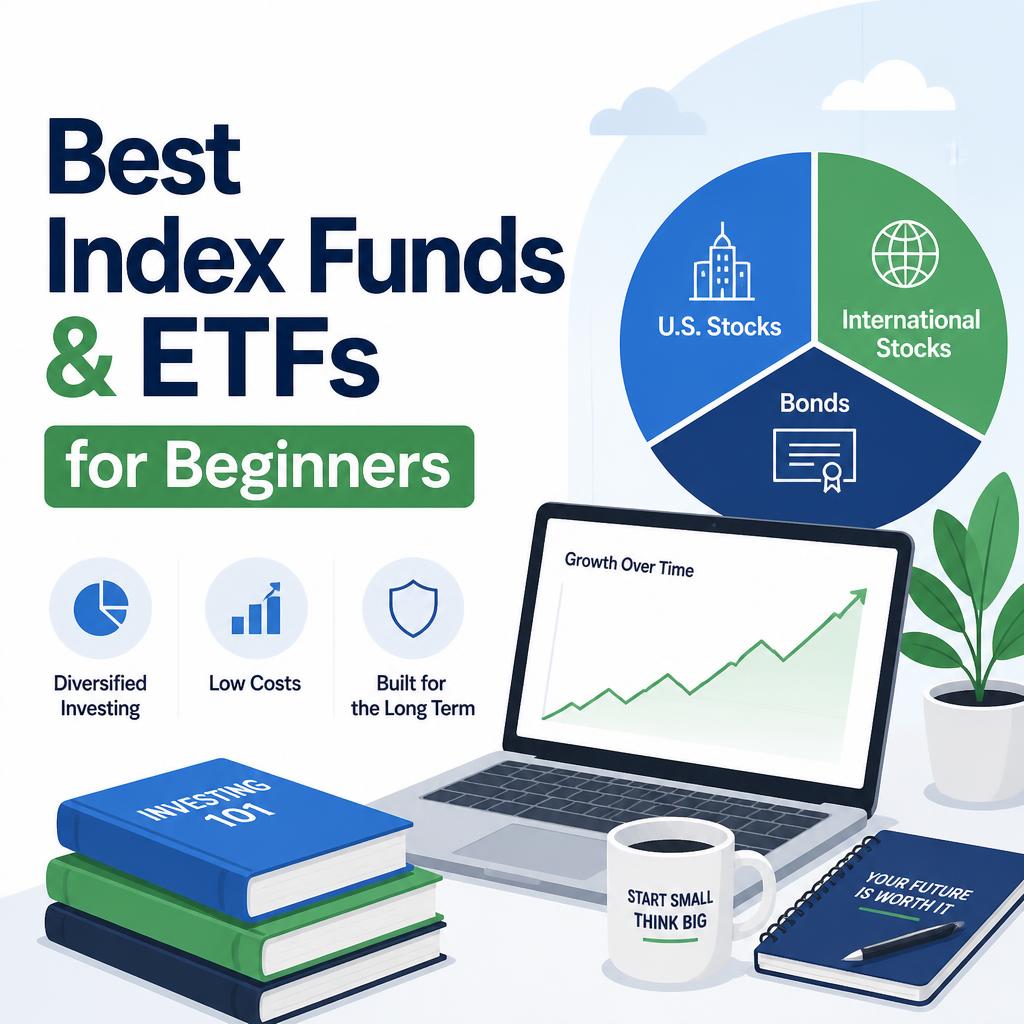
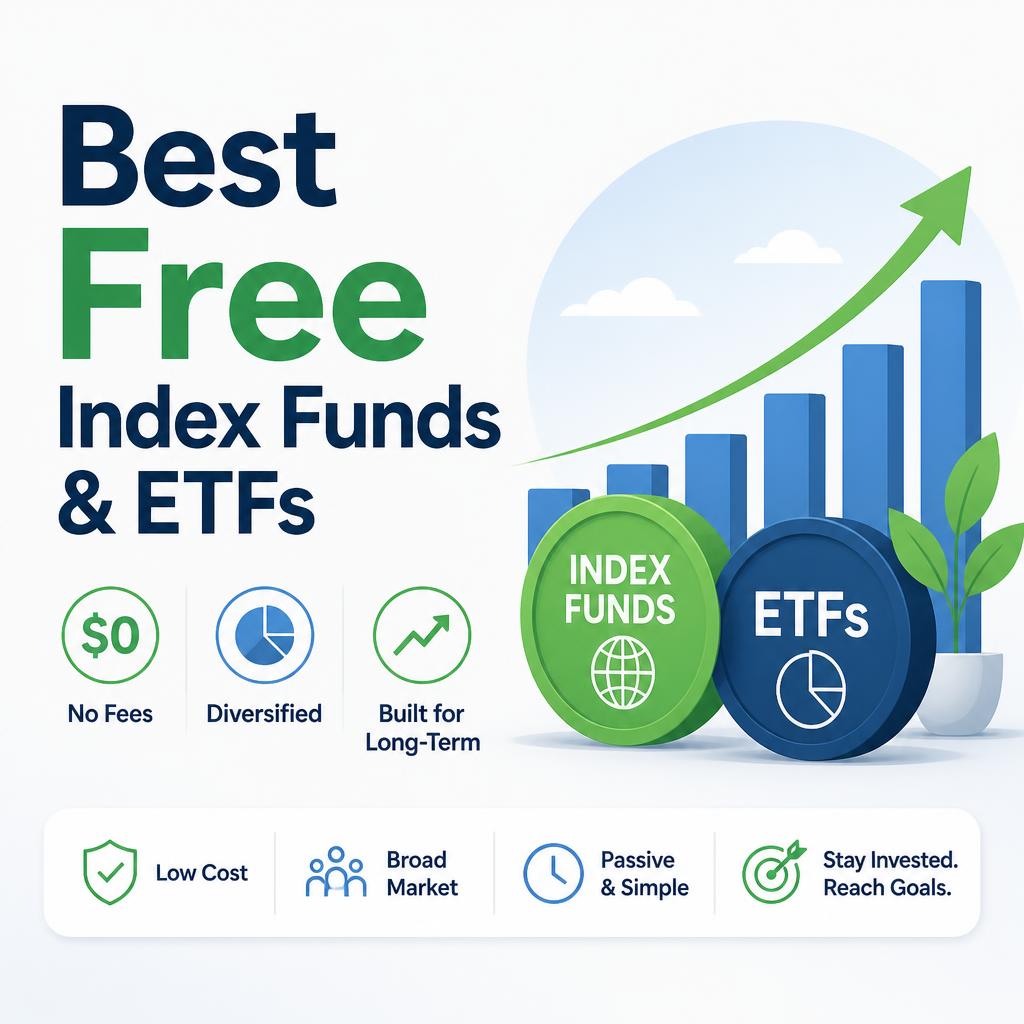
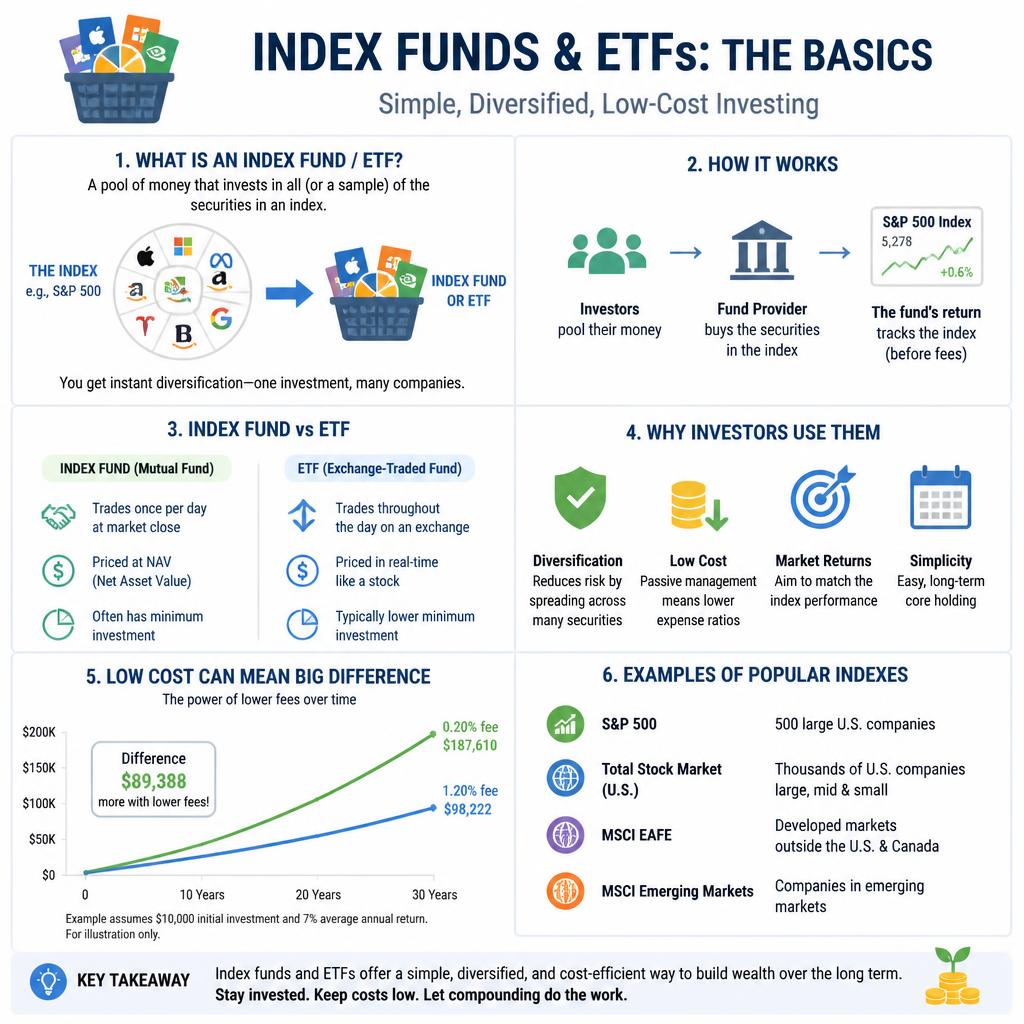
Index funds and ETFs are baskets of stocks or bonds that track a market benchmark like the S&P 500 or total U.S. stock market. Instead of picking individual stocks (where 90% of active traders underperform), you buy the entire market at once.
Why this matters: The average actively managed mutual fund charges 0.75% in fees and underperforms its benchmark by 1-2% annually. Index funds charge 0.03-0.20% and are the benchmark. Over 30 years, that 1% fee difference turns $100,000 into $432,000 vs $328,000—a $104,000 penalty for “active management.”
Index fund vs ETF: Same underlying holdings, different wrappers. Index funds trade once per day at NAV (net asset value). ETFs trade throughout the day like stocks. For most investors, the difference is irrelevant—pick whichever your broker offers cheaper.
—
Fidelity Index Funds: The Zero-Fee Disruptor
Fidelity shocked the industry in 2018 by launching the first true zero-fee index funds. No expense ratio. No minimum investment. No catch (well, one small catch—see below).
What it does best: Makes indexing accessible to anyone with $1. FZROX (total market) and FXAIX (S&P 500) charge literally $0.00 in fees. For a $10,000 investment, that’s $100+ saved over 10 years vs a 0.10% fund.
The catch: Fidelity’s zero-fee funds are proprietary—you can’t transfer them to another broker without selling (triggering taxes). If you ever leave Fidelity, you’ll owe capital gains. Not a dealbreaker for buy-and-hold investors, but lock-in exists.
Who built it: Fidelity Investments, founded 1946, $4.5 trillion AUM. One of the “big three” alongside Vanguard and Schwab.
Starting price: $0 minimum. Seriously.
Open a Fidelity account free →
—
Vanguard Index Funds: The Tax-Efficiency King
Vanguard invented the index fund in 1976 and still holds the crown for long-term, tax-optimized investing. Their patented ETF-share-class structure lets mutual fund holders benefit from ETF tax efficiency—something Fidelity and Schwab can’t replicate.
What it does best: Minimizes capital gains distributions in taxable accounts. VTSAX (total market mutual fund) and VTI (total market ETF) are share classes of the same fund, allowing tax-loss harvesting without triggering wash sales. This saves 0.1-0.3% annually for taxable account holders—compounding to tens of thousands over decades.
Who built it: Vanguard Group, founded 1975 by Jack Bogle, $8.1 trillion AUM. Unique structure: owned by its funds, which are owned by investors. No external shareholders = no profit motive to raise fees.
Starting price: $3,000 minimum for Admiral Shares (VTSAX). $1 minimum for ETFs (VTI). 0.04% expense ratio.
The tradeoff: Higher minimums and a clunkier website. Vanguard prioritizes fund structure over user experience.
Start investing with Vanguard →
—
Schwab Index Funds: The Reliable Middle Ground
Schwab offers low-cost index funds (0.03% for SWTSX, SCHB) with excellent customer service and a best-in-class mobile app. If you already bank with Schwab or want a one-stop financial hub, they’re the easy pick.
What it does best: Integrated experience. Checking, savings, brokerage, and robo-advisor all in one login. Strong phone support (average wait time under 2 minutes). Schwab Intelligent Portfolios (robo) is free with a $5,000 minimum.
Who built it: Charles Schwab Corporation, founded 1971, $8.5 trillion in client assets. Acquired TD Ameritrade in 2020.
Starting price: $1 minimum for ETFs. 0.03% expense ratio.
The tradeoff: Not quite as cheap as Fidelity (0.03% vs 0.00%) or as tax-efficient as Vanguard. Schwab is the “good enough” option—rarely the best option, but never a bad choice.
—
Feature Comparison Table
Feature Fidelity Vanguard Schwab Expense ratio (total market) ✅ 0.00% (FZROX) 0.04% (VTSAX/VTI) 0.03% (SWTSX/SCHB) Minimum investment ✅ $0 $3,000 mutual fund / $1 ETF $1 ETF Tax efficiency (taxable accounts) Good ✅ Best (ETF share class) Good Fund portability ❌ Proprietary (can’t transfer out) ✅ Fully portable ✅ Fully portable Customer service Good (8am-8pm ET) ⚠️ Weak (slow response) ✅ Best (24/7 phone) Mobile app Good ⚠️ Outdated ✅ Best rated Fractional shares (ETFs) ✅ Yes ❌ No ✅ Yes Auto-investing ✅ Yes ✅ Yes ✅ Yes Robo-advisor Fidelity Go ($0 min, 0.35% fee) ❌ None Schwab Intelligent ($5k min, free)
The Real Cost: Tracking Error & Hidden Fees
Expense ratios are just one piece. Here’s what actually impacts your returns:
Tracking Error
How closely does the fund match its benchmark? Fidelity’s FZROX tracks the U.S. total market within 0.01% annually. Vanguard’s VTI is tighter at 0.005%. Schwab’s SWTSX sits at 0.02%. Over 30 years, that 0.015% difference compounds to about $4,500 on a $100k portfolio.
Winner: Vanguard (tightest tracking, institutional-grade rebalancing)
Bid-Ask Spreads (ETFs only)
When you buy an ETF, you pay the “ask” price—slightly higher than the last trade. VTI spreads average $0.01 (0.0004% on a $250 share). Less liquid ETFs can hit 0.05-0.10%. For lump-sum investing, this is negligible. For frequent traders, it adds up.
Winner: Vanguard VTI (most liquid, tightest spreads)
Tax Drag (Taxable Accounts)
Capital gains distributions are the silent killer. When a fund sells holdings, it passes gains to shareholders—forcing you to pay taxes even if you didn’t sell. Vanguard’s ETF structure eliminates most distributions. Fidelity and Schwab still distribute small amounts annually (0.1-0.3% of NAV).
Winner: Vanguard (near-zero distributions since 2001)
—
Pricing Breakdown
Fund Expense Ratio 10-Year Cost on $10k 30-Year Cost on $100k Fidelity FZROX 0.00% $0 $0 Fidelity FXAIX 0.015% $17 $521 Vanguard VTSAX 0.04% $45 $1,390 Vanguard VTI 0.03% $34 $1,043 Schwab SWTSX 0.03% $34 $1,043 Schwab SCHB 0.03% $34 $1,043
Free Plan Differences
- Fidelity: No account minimums, no fees, unlimited trades. Most beginner-friendly.
- Vanguard: $3,000 minimum for mutual funds locks out new investors. ETFs require $1+ but no fractional shares (you’ll have cash drag).
- Schwab: $1 minimum, fractional shares, integrated banking. Middle ground.
Winner: Fidelity (true $0 entry, no compromises)
—
Pros and Cons
Fidelity Pros
- Zero expense ratios (FZROX, FXAIX)
- $0 minimum investment
- Fractional shares on ETFs
- Strong mobile app and research tools
- No foreign transaction fees on debit card
Fidelity Cons
- Proprietary funds lock you into Fidelity ecosystem
- Slightly higher tracking error than Vanguard
- Customer service hours end at 8pm ET
- Tax efficiency lags Vanguard in taxable accounts
—
Vanguard Pros
- Best-in-class tax efficiency (ETF share class structure)
- Tightest tracking error (institutional-grade fund management)
- No conflicts of interest (investor-owned structure)
- Decades of trust (invented the index fund)
Vanguard Cons
- $3,000 minimum for mutual funds
- Clunky website and mobile app
- No fractional ETF shares
- Slow customer service (email-first model)
- Can’t auto-invest in ETFs
—
Schwab Pros
- Excellent customer service (24/7 phone, <2min wait)
- Best mobile app (iOS 4.8★, Android 4.7★)
- Fractional shares on ETFs
- Integrated banking and bill pay
- Free robo-advisor (Schwab Intelligent Portfolios)
Schwab Cons
- Not the cheapest (0.03% vs Fidelity’s 0.00%)
- Not the most tax-efficient (lags Vanguard)
- Rarely the #1 pick for any specific use case
- Robo requires $5,000 minimum
—
Who Should Choose Each Option
Choose Fidelity if you…
- Are starting with less than $50,000
- Want the absolute lowest fees (0.00%)
- Prefer simplicity and don’t plan to switch brokers
- Need fractional shares to invest every dollar
- Value a modern mobile app and research tools
- Don’t care about marginal tax efficiency differences
Choose Vanguard if you…
- Have $100,000+ in taxable accounts
- Prioritize long-term tax efficiency over convenience
- Trust Vanguard’s investor-owned structure
- Can meet the $3,000 mutual fund minimum
- Plan to hold for 20+ years
- Don’t need fractional ETF shares or auto-investing
Choose Schwab if you…
- Already bank with Schwab or want integrated finances
- Value customer service over marginal fee savings
- Want a robo-advisor without paying extra (Schwab Intelligent is free)
- Need 24/7 phone support
- Prefer the best-rated mobile app
- Are okay with “good enough” on fees and tax efficiency
—
The Verdict: Fidelity Wins for Most, Vanguard for Serious Portfolios
Fidelity is the better choice for 80% of investors. If you’re starting out, building your first $50k, or just want the simplest path to indexing, Fidelity’s zero-fee funds (FZROX, FXAIX) are unbeatable. The proprietary lock-in is a non-issue if you’re buy-and-hold—and the $0 expense ratio saves real money.
Vanguard wins for tax-conscious investors with $100k+. Once you cross six figures in a taxable account, Vanguard’s ETF share class structure saves 0.1-0.3% annually in avoided capital gains distributions. Over 30 years, that’s $30,000-$90,000 on a $100k starting balance. The clunky interface and $3k minimum are worth tolerating.
Schwab is the compromise. If you need hand-holding, want everything in one place, or already use Schwab for banking, their index funds are solid. But they rarely beat Fidelity on fees or Vanguard on tax efficiency.
My recommendation: Start with Fidelity. Max out your IRA and 401k with FZROX or FXAIX. Once your taxable account hits $100k, open a Vanguard account and transition new contributions to VTSAX or VTI. You’ll capture Fidelity’s zero fees early and Vanguard’s tax efficiency late.
Get started with Fidelity (our top pick) →
If you’re a high earner with $100k+ already in taxable accounts, skip straight to Vanguard: Open a Vanguard account →
—
FAQ
Is Fidelity better than Vanguard for index funds?
For beginners and accounts under $50k, yes—Fidelity’s 0.00% expense ratio beats Vanguard’s 0.03-0.04%. For taxable accounts over $100k, Vanguard wins due to superior tax efficiency (0.1-0.3% annual savings from avoided capital gains distributions). In tax-advantaged accounts (IRA, 401k), Fidelity’s zero fees make it the clear winner.
Which is cheaper: Fidelity FZROX or Vanguard VTI?
Fidelity FZROX charges 0.00%. Vanguard VTI charges 0.03%. FZROX is cheaper upfront, but VTI offers better tax efficiency in taxable accounts and full portability (you can transfer it to any broker). For IRAs, FZROX wins. For taxable accounts over $100k, VTI’s tax advantages outweigh the 0.03% fee.
Do Fidelity, Vanguard, and Schwab offer free trials?
No trials needed—you can open accounts for free and invest with $0 (Fidelity), $1 (Schwab ETFs), or $3,000 (Vanguard mutual funds). All three offer commission-free trading. Fidelity has no account minimums.
Can I switch from Fidelity to Vanguard without selling?
Fidelity’s zero-fee funds (FZROX, FXAIX) are proprietary—you must sell them to transfer, triggering capital gains taxes. Fidelity’s non-zero funds (like FSKAX) and all Vanguard/Schwab funds are transferable via ACATS without selling. If you plan to switch brokers someday, avoid Fidelity’s zero-fee funds in taxable accounts.
Which has better customer support: Fidelity or Vanguard?
Fidelity offers phone support 8am-8pm ET with average wait times under 5 minutes. Vanguard is email-first with slower response times (24-48 hours) and inconsistent phone support. Schwab beats both with 24/7 phone support and <2-minute average wait. For hand-holding, choose Schwab. For self-directed investors, support quality matters less.
Should I pick an index fund or ETF?
In an IRA or 401k, pick whichever has lower fees (usually Fidelity’s mutual funds at 0.00%). In a taxable account with $100k+, pick Vanguard’s ETFs (VTI, VOO) for tax efficiency. ETFs also allow fractional shares at Fidelity and Schwab, letting you invest every dollar. If your broker doesn’t offer fractional ETFs (Vanguard), stick with mutual funds.
What’s the best index fund for beginners in 2026?
Fidelity FZROX (total U.S. market, 0.00% fee) or Fidelity FXAIX (S&P 500, 0.015% fee). Both require $0 to start, track the market reliably, and let you auto-invest. As your portfolio grows past $100k in taxable accounts, transition to Vanguard VTI or VTSAX for better tax efficiency. Learn more in our beginner’s guide to index funds.
—
Next Steps
- Open an account with Fidelity (best for most), Vanguard (best for $100k+ taxable), or Schwab (best for integrated banking).
- Fund your account via bank transfer (3-5 days) or wire (same day, $25 fee).
- Pick your fund:
- Set up auto-investing to dollar-cost average every month. Consistency beats timing.
- Ignore daily fluctuations. Index funds are for 10+ year holds. Check annually, rebalance if needed, otherwise leave it alone.
For a deeper dive on which specific funds to buy based on your account type, check out The Best Index Funds & ETFs for 2026.
If you’re hunting for zero-fee options beyond Fidelity, see our Best Free Index Funds & ETFs guide.