Best Dividend Investing: A Complete Guide to Building Passive Income
Dividend investing remains one of the most powerful wealth-building strategies for generating passive income and long-term financial security. If you’re struggling to pick the right dividend investments without overpaying or wasting time researching countless options, this comprehensive guide will walk you through everything you need to know about the best dividend investing strategies in 2025.
What Is Dividend Investing?
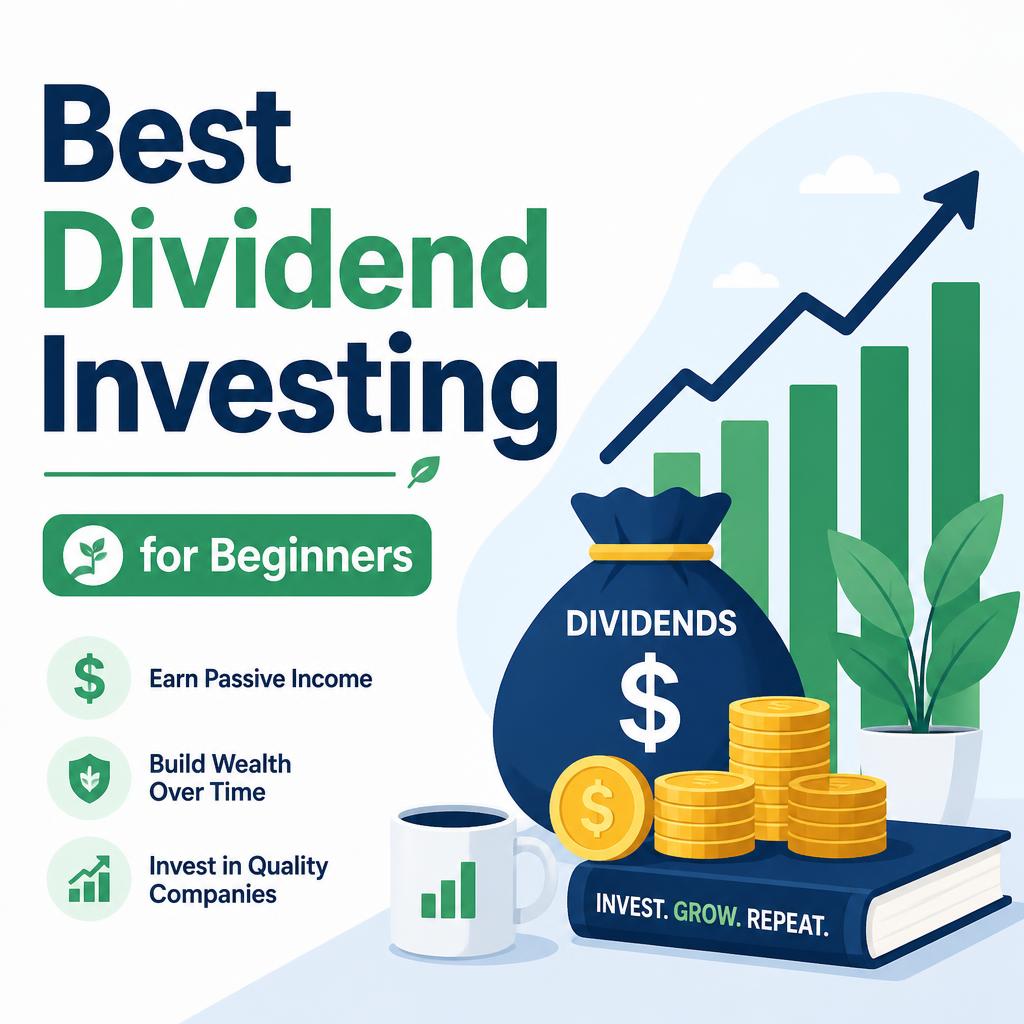
Dividend investing is a strategy focused on buying shares of companies that regularly distribute a portion of their profits to shareholders. Unlike growth investing, where returns come primarily from stock price appreciation, dividend investing provides regular cash payments while you hold the stock—creating a reliable income stream alongside potential capital gains.
The best dividend investing approach combines high-quality companies with sustainable payout ratios, consistent dividend growth, and strong underlying business fundamentals. This strategy has historically outperformed pure growth strategies during market downturns while providing the psychological comfort of regular income.
Why Dividend Investing Works
Dividend-paying companies tend to be mature, profitable businesses with predictable cash flows. They’ve moved beyond their high-growth phase and prioritize returning capital to shareholders rather than reinvesting everything back into expansion.
Research shows that dividend-paying stocks have historically provided:
- Lower volatility: Dividend stocks tend to decline less during bear markets
- Total return advantage: Dividends contribute 40% or more to long-term stock returns
- Inflation protection: Quality companies increase dividends faster than inflation
- Forced discipline: Companies paying dividends must maintain financial health
- Compound growth: Reinvested dividends accelerate wealth accumulation exponentially
The best dividend investing strategies leverage these advantages while avoiding common pitfalls like chasing yield without considering sustainability.
Key Metrics for Best Dividend Investing
Dividend Yield
Dividend yield represents the annual dividend payment divided by the stock price, expressed as a percentage. While higher yields seem attractive, the best dividend investing approach looks beyond this single metric.
Sweet spot: 2.5% to 6% yields typically balance income and sustainability. Yields below 2% may not provide sufficient income, while yields above 8% often signal financial distress or an unsustainable payout.
Payout Ratio
The payout ratio shows what percentage of earnings the company pays as dividends. Lower ratios indicate room for dividend growth and safety during economic downturns.
Target range: 30% to 60% for most sectors. REITs and utilities naturally run higher (70-80%) due to their business models and legal requirements.
Dividend Growth Rate
Consistent dividend increases signal management confidence and growing profitability. The best dividend investing focuses on companies with 5+ year track records of annual increases.
Dividend Aristocrats: S&P 500 companies with 25+ consecutive years of dividend increases demonstrate exceptional stability and shareholder commitment.
Best Dividend Investing Strategies
1. Dividend Growth Investing
This strategy prioritizes companies with strong histories of increasing dividends annually. Rather than chasing the highest current yield, you focus on companies likely to grow their payouts significantly over time.
Best for: Long-term investors in accumulation phase who can reinvest dividends for decades. Your yield-on-cost can exceed 10% after 15-20 years even if the current yield starts at 3%.
Top sectors: Consumer staples, healthcare, technology (increasingly), financial services, and industrial conglomerates.
2. High-Yield Dividend Investing
This approach targets stocks with above-average current yields, typically 4% or higher. Success requires careful analysis to distinguish quality high-yielders from value traps.
Best for: Retirees or investors needing current income who can’t wait for dividend growth to increase yield-on-cost.
Focus areas: REITs, master limited partnerships (MLPs), business development companies (BDCs), and select utilities. Learn more about choosing the right best brokerage accounts to minimize costs when implementing this strategy.
3. Dividend ETF Investing
Exchange-traded funds provide instant diversification across dozens or hundreds of dividend-paying stocks, eliminating single-stock risk.
Best for: Investors who want dividend exposure without researching individual companies, or those with smaller portfolios under $50,000.
Top considerations: Expense ratios, dividend yield, holdings concentration, and methodology (growth vs. high-yield vs. aristocrat-focused). Explore our guide on best index funds ETFs for more diversification strategies.
4. International Dividend Investing
Many foreign companies offer attractive dividends, often with higher yields than U.S. counterparts. However, currency risk, withholding taxes, and less shareholder-friendly governance require additional due diligence.
Best opportunities: Canadian banks, U.K. consumer goods, Australian miners, and European industrials.
Tax considerations: Foreign withholding taxes can reduce net yields by 10-30% depending on country and account type.
Sector Analysis for Best Dividend Investing
Real Estate Investment Trusts (REITs)
REITs must distribute 90% of taxable income as dividends, making them natural high-yielders. The best dividend investing in REITs focuses on sectors with durable demand.
Top subsectors: Data centers, cell towers, industrial warehouses, healthcare facilities, and self-storage. Avoid retail and office REITs facing structural headwinds.
Utilities
Electric, gas, and water utilities provide essential services with regulated returns, creating predictable cash flows perfect for dividends.
Key factors: Regulatory environment, infrastructure investment requirements, renewable energy transition costs, and geographic exposure.
Consumer Staples
Companies selling non-discretionary products (food, beverages, household goods, tobacco) generate stable cash flows regardless of economic conditions.
Blue-chip examples: Procter & Gamble, Coca-Cola, PepsiCo, and Colgate-Palmive have decades-long dividend growth streaks.
Financial Services
Banks, insurance companies, and asset managers generate substantial cash flows and often return 40-60% to shareholders through dividends and buybacks.
Considerations: Interest rate sensitivity, credit quality, regulatory capital requirements, and economic cycle positioning.
Healthcare
Pharmaceutical companies and medical device makers combine defensive characteristics with dividend growth potential, though patent cliffs create some risk.
Stability leaders: Johnson & Johnson, AbbVie, and Medtronic offer 2-4% yields with strong growth prospects.
Building Your Dividend Portfolio
Asset Allocation
The best dividend investing portfolios balance yield, growth, and diversification across sectors and market caps.
Suggested framework:
- 30-40%: Dividend growth stocks (yields 2-3.5%, growth 8-12% annually)
- 30-40%: High-quality yielders (yields 3.5-5%, moderate growth)
- 20-30%: REITs and income specialists (yields 4-7%)
- 0-10%: International dividend stocks (currency diversification)
Position Sizing
Avoid over-concentration even in your highest-conviction ideas. Single positions above 5% create excessive risk, while holdings below 1-2% become difficult to track meaningfully.
Optimal range: 20-40 positions for individual investors provides adequate diversification without becoming unmanageable. ETF investors can hold fewer funds (5-10) for similar diversification.
Rebalancing Strategy
Quarterly or semi-annual rebalancing prevents winning positions from becoming too large while systematically “buying low” on underperformers.
Tax efficiency: In taxable accounts, rebalance through new contributions and dividend reinvestment rather than selling winners to avoid capital gains taxes.
Tax Optimization for Dividend Investors
Taxes significantly impact net returns from dividend investing. Strategic account placement and timing can add 1-2% annually to after-tax returns.
Tax-Advantaged Accounts
Maximize dividend stocks in Roth IRAs, traditional IRAs, and 401(k) plans where dividends grow tax-free or tax-deferred. This is especially important for high-yield strategies and REITs paying non-qualified dividends. Consider reviewing best retirement IRA 401k options to optimize your dividend portfolio placement.
Priority ranking:
- Roth IRA: Best for dividend growth stocks you’ll hold 20+ years
- Traditional IRA/401(k): Ideal for high-yield REITs and other ordinary-income dividends
- Taxable accounts: Focus on qualified dividends from U.S. corporations (15-20% tax rate)
Qualified vs. Non-Qualified Dividends
Qualified dividends receive favorable capital gains tax treatment (0%, 15%, or 20% depending on income), while non-qualified dividends face ordinary income rates (up to 37%).
Qualified dividend requirements: Stock held 60+ days during 121-day period around ex-dividend date, paid by U.S. corporation or qualified foreign company.
Non-qualified sources: REITs, MLPs, BDCs, and most foreign dividends face higher ordinary income rates.
Tax-Loss Harvesting
Offset dividend income by harvesting losses on underperforming holdings in taxable accounts. Replace sold positions with similar but not identical securities to maintain exposure while capturing tax benefits.
Common Dividend Investing Mistakes to Avoid
Chasing Yield
The highest-yielding stocks often carry the greatest risk. Yields above 8-10% typically indicate market skepticism about dividend sustainability.
Warning signs: Payout ratios above 100%, declining revenue, high debt levels, or shares trading near multi-year lows.
Ignoring Total Return
Dividend income matters, but share price matters equally. A 6% yield means nothing if the stock declines 20%. Focus on total return: dividend yield + capital appreciation.
Neglecting Dividend Growth
A 3% yield growing 10% annually becomes more valuable than a 6% yield with no growth within 7-8 years. The best dividend investing balances current income with future growth.
Over-Concentration
Falling in love with a sector or individual stock creates unnecessary risk. The 2020 pandemic devastated REITs while technology thrived. The 2008 crisis crushed financials. Diversification matters.
Failing to Reinvest
Reinvesting dividends dramatically amplifies long-term returns through compounding. A $10,000 investment at 7% annual return grows to $38,000 in 20 years—but rises to $54,000 if 3% dividends are reinvested.
Evaluating Dividend Safety
Cash Flow Analysis
Strong free cash flow coverage (FCF/dividends) above 1.5x provides a safety cushion. Companies paying more in dividends than they generate in free cash flow must borrow or cut dividends eventually.
Balance Sheet Health
Low debt-to-equity ratios (below 1.0 for most industries) and investment-grade credit ratings indicate financial flexibility to maintain dividends during downturns.
Management Track Record
How did management handle the 2008 crisis, 2020 pandemic, or industry-specific challenges? Companies that maintained or minimally reduced dividends during stress demonstrate commitment to shareholders.
Industry Dynamics
Secular tailwinds support dividend safety better than cyclical exposure. Data centers benefit from cloud computing growth. Tobacco faces declining volumes. Understand the industry trajectory.
Getting Started with Best Dividend Investing
Step 1: Define Your Goals
Clarify whether you need current income, long-term growth, or balanced total return. Your time horizon, tax situation, and income needs determine the optimal strategy.
Step 2: Choose Your Approach
Decide between individual stocks, dividend ETFs, or a hybrid approach based on your portfolio size, time commitment, and expertise level.
Step 3: Open the Right Accounts
Select brokerage accounts with zero commission trading, dividend reinvestment plans (DRIPs), and strong research tools. Tax-advantaged accounts should hold your most tax-inefficient positions.
Step 4: Build Your Initial Portfolio
Start with 10-15 positions across different sectors rather than deploying everything at once. Dollar-cost averaging over 6-12 months reduces timing risk.
Step 5: Automate Reinvestment
Enable automatic dividend reinvestment for accumulation-phase portfolios. Fractional share programs let you reinvest every dollar without cash drag.
Step 6: Monitor and Maintain
Review holdings quarterly for dividend cuts, payout ratio increases, or deteriorating fundamentals. Annual portfolio reviews ensure alignment with your goals and risk tolerance.
Best Dividend Investing in Different Market Environments
Rising Rate Environment
Higher interest rates pressure dividend stock valuations, especially utilities and REITs trading as bond alternatives. Focus on dividend growth stocks with pricing power and companies benefiting from higher rates (banks, insurers).
Recession
Dividend growth stocks with defensive characteristics (consumer staples, healthcare, utilities) typically outperform. Avoid cyclical high-yielders like energy or materials that may cut dividends.
Bull Market
Dividend stocks may lag growth stocks during euphoric markets, but steady income provides psychological comfort and reduces portfolio volatility. Maintain your allocation rather than chasing momentum.
High Inflation
Companies with pricing power that can pass cost increases to customers protect dividend purchasing power. Real assets (REITs, energy, materials) often raise dividends faster than inflation.
Advanced Dividend Investing Techniques
Covered Call Writing
Selling covered calls against dividend stock positions generates additional income (1-3% monthly) while maintaining dividend eligibility. Best suited for stable, large-cap positions.
Dividend Capture Strategy
Buy stocks before ex-dividend dates to capture payments, then sell shortly after. Transaction costs and tax treatment often eliminate profits for individual investors, but can work at scale with tax advantages.
Leveraged Dividend Investing
Borrowing to invest in dividend stocks amplifies returns when dividend yield exceeds borrowing costs. Extremely risky and unsuitable for most investors—portfolio margin calls during downturns can force devastating losses.
The Psychological Edge of Dividend Investing
Dividend payments create tangible progress even when share prices decline, reducing the temptation to panic sell during corrections. This behavioral advantage helps investors stay invested through market volatility, capturing long-term gains that market-timers miss.
Regular deposits to your account provide positive reinforcement and compound wealth automatically. The best dividend investing strategies leverage this psychological benefit to maintain discipline through complete market cycles.
Conclusion
The best dividend investing combines high-quality companies, sustainable payout ratios, diversification across sectors, and tax-efficient account placement. Whether you prioritize current income through high-yield stocks or long-term wealth building through dividend growth, this strategy offers a proven path to financial independence.
Start by defining your goals, choosing between individual stocks and ETFs based on your resources, and building a diversified portfolio gradually. Reinvest dividends during accumulation years to maximize compounding, and monitor holdings regularly for signs of deteriorating fundamentals.
The companies you own will pay you quarterly whether markets rise or fall, economies expand or contract, or headlines blare optimism or doom. That reliability, combined with the power of compounding over decades, makes dividend investing one of the most effective wealth-building strategies available to individual investors.