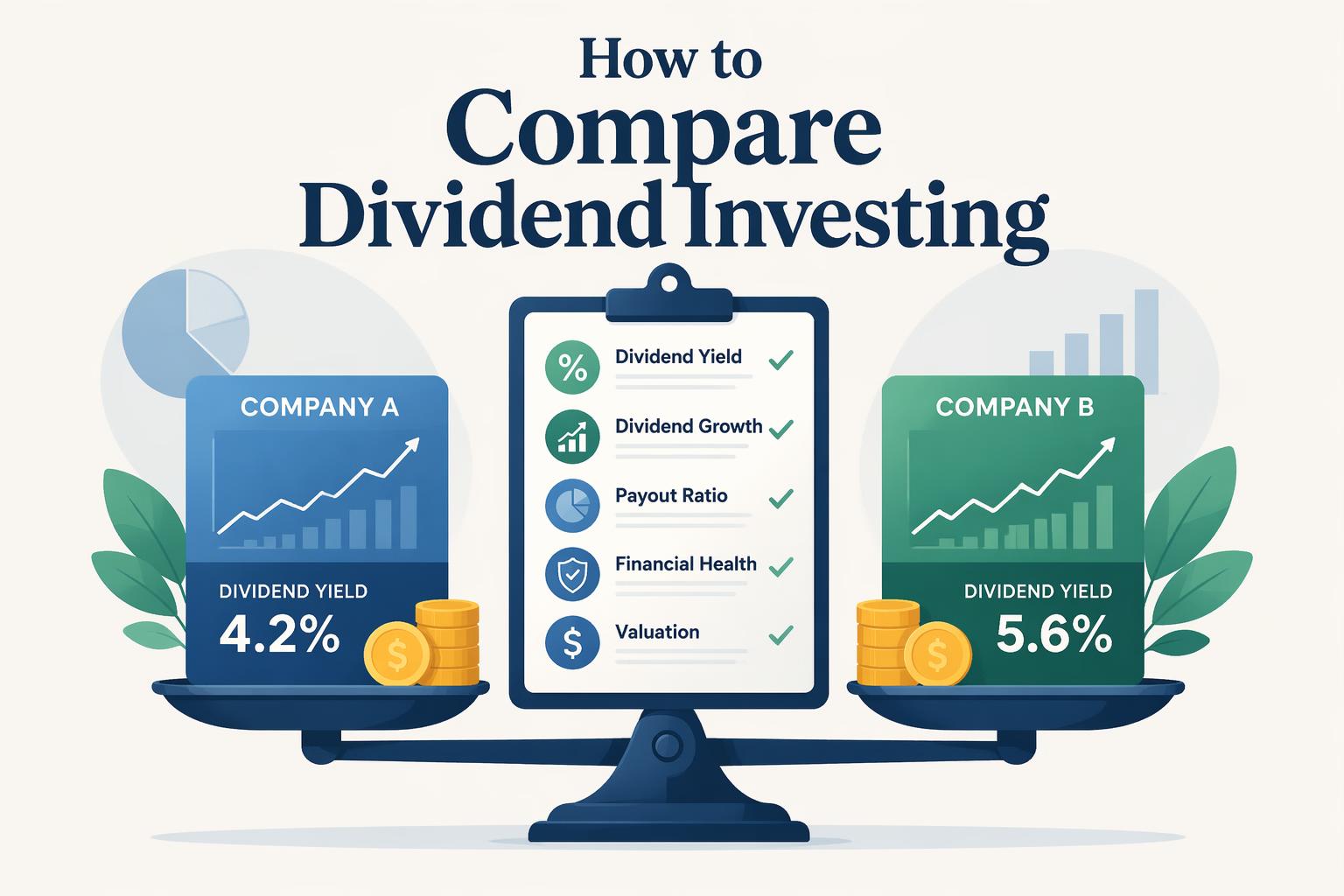
How to Compare Dividend Investing Strategies: A Step-by-Step Guide (2026)
You want passive income from your investments, but dividend investing comes in many flavors—high-yield stocks, dividend growth, REITs, ETFs. How do you compare these approaches without getting overwhelmed or picking the wrong strategy for your goals?
By the end of this guide, you’ll know exactly how to evaluate different dividend investing strategies, match them to your financial situation, and avoid the costly mistakes that trip up most income investors.
Affiliate Disclaimer: This article contains affiliate links. If you sign up through these links, I may earn a commission at no extra cost to you.
—
What You Need Before Starting
- 30 minutes to work through this comparison framework
- Your financial goals written down (target monthly income, time horizon, risk tolerance)
- Access to a stock screener or investment research platform (free tools like Yahoo Finance work, or premium platforms like Seeking Alpha Premium for deeper dividend analysis)
- Basic understanding of what dividends are (payments companies make to shareholders from profits)
—
Step 1: Define Your Dividend Investing Goal
Before comparing strategies, get specific about what you want dividend investing to accomplish.
Ask yourself:
- What monthly income do I need? (e.g., $500/month to supplement income, or $3,000/month to replace a salary)
- When do I need this income? (starting immediately, or 10+ years from now in retirement)
- How much capital am I starting with? (this determines realistic yield expectations)
Write down your answer in this format: “I want to generate $[X] per month from dividend investing, starting [timeframe], with $[Y] to invest initially.”
You should see: A clear target that lets you calculate the yield you need. For example: if you have $50,000 and need $500/month ($6,000/year), you need a 12% annual yield—which immediately tells you that high-yield strategies will be necessary (and higher risk).
> Note: If your required yield exceeds 8-10%, you’re entering high-risk territory. Consider whether you can increase your initial capital or reduce your income target.
—
Step 2: Understand the Four Main Dividend Strategies
There are four distinct approaches to dividend investing. Each has different risk/reward profiles and serves different goals.
High-Yield Dividend Stocks (8-15%+ yields)
- What it is: Individual stocks paying exceptionally high dividends relative to their stock price
- Best for: Investors who need immediate high income and can tolerate volatility
- Risk level: High—yields this high often signal financial stress or unsustainable payouts
- Example sectors: REITs, Business Development Companies (BDCs), Master Limited Partnerships (MLPs)
Dividend Growth Investing (2-4% starting yields)
- What it is: Companies with track records of increasing dividends annually
- Best for: Long-term investors focused on compounding and inflation protection
- Risk level: Moderate—these are typically stable, profitable companies
- Example companies: Dividend Aristocrats (S&P 500 companies with 25+ years of dividend increases)
Dividend ETFs (2-5% yields)
- What it is: Funds holding baskets of dividend-paying stocks
- Best for: Investors wanting instant diversification with lower research burden
- Risk level: Low to Moderate—diversification reduces individual stock risk
- Example funds: SCHD, VYM, JEPI
International Dividend Stocks (3-7% yields)
- What it is: Dividend payers based outside the US, often with higher yields
- Best for: Diversification and access to markets with different payout cultures
- Risk level: Moderate to High—adds currency risk and foreign tax complications
- Example markets: UK, Australia, emerging markets
—
Step 3: Compare Yield vs. Safety Trade-Offs
Every dividend strategy involves a trade-off between yield (how much income you get) and safety (how likely that income is to continue).
Create a comparison table for strategies you’re considering:
Strategy Typical Yield Payout Ratio Dividend Growth Rate Risk of Dividend Cut High-Yield Stocks 8-15% Often >80% Low or negative High Dividend Growth 2-4% 40-60% 5-10% annually Low Dividend ETFs 2-5% Varies 3-7% annually Low International 3-7% Varies Varies widely Moderate
- Under 60%: Safe—company has room to maintain dividends during downturns
- 60-80%: Moderate risk—less cushion but usually sustainable
- Over 80%: High risk—little margin for error; dividend cuts likely if earnings drop
How to find payout ratio:
- Go to a stock screener (Yahoo Finance, Seeking Alpha, or Finviz)
- Search for your target stock or ETF
- Look for “Payout Ratio” in the dividend or fundamentals section
You should see: A clear picture of whether you’re sacrificing safety for yield. If you need 8%+ yields but see payout ratios over 80%, you’re accepting significant cut risk.
—
Step 4: Calculate Your Required Portfolio Size
Work backwards from your income goal to determine how much you need to invest in each strategy.
Formula: Required Investment = (Annual Income Goal) ÷ (Average Yield)
Example calculations:
Goal: $500/month ($6,000/year)
- High-yield strategy (10% yield): $6,000 ÷ 0.10 = $60,000 needed
- Dividend growth strategy (3% yield): $6,000 ÷ 0.03 = $200,000 needed
- Dividend ETF strategy (4% yield): $6,000 ÷ 0.04 = $150,000 needed
You should see: The capital requirement for each strategy. This often reveals that your initial capital only supports certain strategies—if you have $50,000 and need $500/month, dividend growth strategies won’t get you there without high risk or more time.
> Reality check: If no safe strategy meets your income goal with your current capital, your options are: (1) increase capital, (2) reduce income target, (3) accept higher risk, or (4) extend your time horizon to let dividend growth compound.
—
Step 5: Evaluate Tax Efficiency
Not all dividend income is taxed the same way. This affects your real, after-tax return.
Three types of dividend taxation:
- Qualified Dividends (most US stocks held 60+ days)
- Ordinary Dividends (REITs, some foreign stocks)
- Return of Capital (some MLPs, CEFs)
How to compare tax impact:
For each strategy you’re considering, calculate after-tax yield:
- Qualified dividend: Yield × (1 – your capital gains tax rate)
- Ordinary dividend: Yield × (1 – your ordinary income tax rate)
Example:
- 8% REIT yield at 32% ordinary tax rate = 8% × 0.68 = 5.44% after-tax
- 4% qualified dividend at 15% cap gains rate = 4% × 0.85 = 3.4% after-tax
The REIT’s after-tax advantage is smaller than the pre-tax numbers suggest.
You should see: Whether a high-yield strategy’s tax burden erases its yield advantage over lower-yield qualified dividends.
> Note: If you’re investing in a tax-advantaged account (IRA, 401k), tax treatment doesn’t matter—focus purely on total return.
—
Step 6: Test Historical Stability During Downturns
Past performance doesn’t guarantee future results, but it reveals how different strategies handle market stress.
Research the 2020 COVID crash and 2022 bear market for your target strategies:
- Go to a charting tool (TradingView, Yahoo Finance, or your brokerage)
- Look up your target stock, ETF, or representative index
- Check these metrics during March 2020 and throughout 2022:
What to look for:
- Dividend growth stocks: Usually maintained dividends even if prices fell
- High-yield stocks: Many cut dividends by 30-50% or suspended them entirely
- Dividend ETFs: Typically stable payouts but prices dropped significantly
- REITs: Severe cuts in retail/office REITs, stable in industrial/data center REITs
You should see: A realistic picture of downside risk. If your high-yield strategy historically cut dividends by 40% during recessions, and you depend on that income to pay bills, you have a problem.
—
Step 7: Compare Diversification Requirements
Different strategies need different levels of diversification to manage risk.
Minimum safe diversification by strategy:
- High-yield individual stocks: 15-20 positions across sectors—one dividend cut shouldn’t crater your income
- Dividend growth stocks: 20-30 positions—concentration risk is lower but still present
- Dividend ETFs: 1-3 funds—diversification is built in
- International stocks: 10-15 positions plus currency hedging consideration
How to evaluate your diversification capacity:
- Calculate position size: Total Portfolio ÷ Number of Positions
- Ask: “Can I research and monitor this many companies?”
You should see: Whether your capital and time allow for proper diversification in your chosen strategy. If you have $30,000 and want to invest in individual high-yield stocks, you can’t safely diversify enough—ETFs make more sense.
—
Step 8: Compare Time and Effort Requirements
Be honest about how much work you’re willing to do.
Time commitment by strategy:
Strategy Initial Research Ongoing Monitoring Rebalancing Frequency High-yield stocks 20-30 hrs 2-3 hrs/week Monthly Dividend growth 15-20 hrs 1-2 hrs/month Quarterly Dividend ETFs 5-10 hrs 30 min/quarter Annual International 25-35 hrs 2-4 hrs/month Quarterly
- Reading earnings reports and dividend announcements
- Watching payout ratios and coverage metrics
- Identifying deteriorating fundamentals before dividend cuts
- Rebalancing when positions become over-concentrated
Reality check questions:
- Do I have time to read 20-30 quarterly earnings reports?
- Am I comfortable analyzing foreign financial statements?
- Would I rather spend 30 minutes per quarter and accept slightly lower returns?
You should see: An honest assessment of whether your chosen strategy matches your available time. If you work 60-hour weeks and have young kids, individual stock picking probably isn’t realistic—even if it theoretically offers higher returns.
—
Step 9: Run a Side-by-Side Cost Comparison
Costs directly reduce your returns. Compare expense ratios, commissions, and tax drag.
Costs to compare:
- Trading commissions (if any—most brokers are now $0, but some charge for OTC stocks)
- Expense ratios (ETF annual fees, typically 0.03% to 0.60%)
- Bid-ask spreads (the cost of buying/selling, higher for illiquid stocks)
- Tax drag (from Step 5)
- Currency conversion fees (for international stocks)
Example cost comparison for $100,000 invested:
Strategy A: Individual dividend growth stocks
- Commissions: $0
- Bid-ask spread cost: ~$50/year (when rebalancing)
- Tax drag (qualified dividends at 15%): -0.45% on 3% yield = -$450/year
- Total annual cost: ~$500 = 0.50%
Strategy B: Dividend ETF (SCHD)
- Expense ratio: 0.06% = $60/year
- Commissions: $0
- Tax drag (qualified dividends at 15%): -0.60% on 4% yield = -$600/year
- Total annual cost: ~$660 = 0.66%
Strategy C: High-yield BDC stocks
- Commissions: $0
- Bid-ask spread cost: ~$200/year (less liquid)
- Tax drag (ordinary dividends at 32%): -2.56% on 8% yield = -$2,560/year
- Total annual cost: ~$2,760 = 2.76%
You should see: The true cost of each strategy. Tax drag on high-yield ordinary dividends can overwhelm the yield advantage.
—
Step 10: Create Your Personal Scoring Matrix
Combine all the factors into a weighted decision matrix that reflects YOUR priorities.
Step-by-step:
- List the factors that matter to you
- Assign each a weight (1-10) based on importance to YOUR situation
- Score each strategy on each factor (1-10)
- Multiply weight × score for each cell
- Sum the weighted scores
Example matrix:
Factor Weight High-Yield Stocks Dividend Growth Dividend ETF Current income 9 9 × 9 = 81 3 × 9 = 27 5 × 9 = 45 Safety 8 3 × 8 = 24 9 × 8 = 72 8 × 8 = 64 Time required 7 3 × 7 = 21 5 × 7 = 35 9 × 7 = 63 Tax efficiency 6 2 × 6 = 12 8 × 6 = 48 7 × 6 = 42 Total Score — 138 182 214
You should see: A clear winner based on YOUR priorities, not generic advice. Your scoring matrix will differ based on your capital, time, risk tolerance, and income needs.
> Note: If two strategies score within 10-20 points of each other, consider a hybrid approach—split your portfolio between them.
—
Step 11: Validate with Real Portfolio Examples
Before committing, find real investors using your top strategy and see their results.
Where to find real portfolio examples:
- Seeking Alpha Portfolio Income service — professional dividend portfolio tracking
- Dividend subreddits (r/dividends, r/Fire) — real investors sharing their holdings
- Portfolio tracking sites (M1 Finance community pies, Public.com portfolios)
What to look for:
- Actual total returns over 3-5 years, not just yield
- Portfolio composition — how many holdings, sector allocation
- Income stability — did dividend income grow, stay flat, or decline?
- Investor commentary — what mistakes did they make? What would they change?
Red flags:
- Portfolios showing high yields but declining total value (you’re earning dividends but losing principal)
- Over-concentration in one sector (e.g., 80% energy stocks)
- Extremely high turnover (constantly buying/selling suggests the strategy isn’t working)
You should see: Real-world evidence that your chosen strategy actually works for people with similar goals and capital levels. If you can’t find successful examples, reconsider the strategy.
—
Step 12: Start Small and Measure Results
Don’t bet your entire portfolio on a strategy you haven’t personally tested.
The validation approach:
- Allocate 10-25% of your capital to your chosen strategy
- Track these metrics monthly for 6-12 months:
- Compare to your predictions from Steps 1-11
- Scale up or pivot based on results
You should see: After 6 months, you’ll know if the strategy works for YOU—not in theory, but in practice with real money and real emotions.
> Common finding: Many investors discover they overestimated their risk tolerance. If you’re losing sleep over high-yield volatility, that’s valuable information—switch to a more conservative strategy even if the yield is lower.
—
What You’ve Just Built
You now have a complete framework for comparing dividend investing strategies:
- A clear income goal and required yield
- Understanding of the four main strategies and their trade-offs
- Tax-adjusted return calculations
- Historical stability data
- Diversification and time requirements
- A personalized scoring matrix
- Real portfolio validation
- A testing plan to validate before fully committing
This framework saves you from the two most expensive dividend investing mistakes:
- Chasing yield without understanding risk (ending up in dividend traps that cut payouts)
- Copying someone else’s strategy that doesn’t match your capital, timeline, or risk tolerance
—
Common Mistakes When Comparing Strategies
“I assumed high yield = high returns” → Total return = yield + price appreciation. Many high-yield stocks have declining prices that erase dividend gains. Always check 3-5 year total return, not just yield.
“I didn’t account for taxes” → An 8% ordinary dividend taxed at 32% gives you 5.44% after-tax. A 5% qualified dividend taxed at 15% gives you 4.25% after-tax. The difference is much smaller than it appears.
“I picked a strategy I didn’t have time to execute” → Buying 25 individual stocks requires research and monitoring. If you don’t have the time, you’ll either neglect the portfolio (and miss warning signs) or abandon the strategy. Be honest about your available time.
“I needed income NOW, so I went all-in on high-yield” → High-yield strategies work until they don’t—2020 saw many 10%+ yielders cut dividends by 40-60%. If you depend on that income for living expenses, you need safety over yield. Consider lowering expenses or extending your timeline instead.
—
Next Steps
Now that you know how to compare strategies:
- If you scored dividend ETFs highest: Research SCHD, VYM, or JEPI and compare their holdings, yields, and expense ratios
- If you scored dividend growth highest: Look into Dividend Aristocrats and learn how to screen for companies with 10+ years of dividend increases
- If you scored high-yield highest: Learn to analyze payout ratios and debt levels before investing—this strategy requires deeper fundamental analysis
- Track your research: Use a spreadsheet or Seeking Alpha’s portfolio tools to monitor the stocks/ETFs you’re considering
Want deeper dividend analysis and screening tools? Seeking Alpha Premium gives you dividend safety scores, payout sustainability ratings, and access to expert dividend investor portfolios.
→ Try Seeking Alpha Premium free for 7 days →
—
FAQ
Do I need a paid subscription to compare dividend strategies? No. You can use free tools like Yahoo Finance, Finviz, and Dividend.com for basic screening. Paid tools like Seeking Alpha Premium provide deeper analysis (dividend safety scores, analyst estimates) that save time but aren’t required.
How long does it take to compare strategies properly? Plan for 2-4 hours of research spread over a few days. Rushing this decision costs far more time (and money) later when you realize a strategy doesn’t fit your situation.
Can I use multiple strategies at once? Yes—many investors use a “core and explore” approach: 70-80% in safer dividend ETFs or dividend growth stocks, 20-30% in higher-yield individual stocks for extra income. This balances safety with yield.
What if my required yield is too high for safe strategies? You have four options: (1) increase your investment capital, (2) lower your income target, (3) extend your timeline to let dividend growth compound, or (4) find additional income sources beyond dividends (covered calls, side income) rather than taking excessive dividend risk.
Should I focus on US or international dividend stocks? US dividend growth stocks offer the best combination of safety and tax efficiency for most American investors. International stocks add diversification but introduce currency risk and foreign tax complications. Start with US stocks unless you have specific international expertise.
How often should I re-evaluate my dividend strategy? Review annually or when your life situation changes significantly (retirement, major expense needs, large capital injection). Don’t switch strategies based on short-term performance—give each approach at least 3-5 years to prove itself unless something is clearly broken.