How to Save Money on Retirement (IRA/401k): A Step-by-Step Guide (2026)
Affiliate Disclosure: This article contains affiliate links. If you sign up for a service through our links, we may earn a commission at no additional cost to you. We only recommend products we genuinely believe will help you reach your financial goals.

You’re doing the right thing by thinking about retirement savings. But here’s what most people don’t realize: the way you save for retirement matters just as much as how much you save.
Hidden fees can silently eat 30% or more of your retirement nest egg over a lifetime. Choosing the wrong account type can cost you thousands in unnecessary taxes. And leaving employer matches on the table? That’s literally turning down free money.
By the end of this guide, you’ll know exactly how to maximize your retirement savings through IRAs and 401(k)s—without overpaying in fees, taxes, or wasted opportunities. Whether you’re just starting out or optimizing an existing strategy, these steps will help you keep more of your money working for you.
What you need before starting:
- Employment status clarity (employed with benefits / self-employed / both)
- Current income information (to determine contribution limits and tax deductions)
- Access to your employer’s 401(k) plan details (if applicable)
- Estimated time: 45-60 minutes to complete initial setup
Let’s get into it.
—
Step 1: Capture Your Full Employer 401(k) Match (If Available)
If your employer offers a 401(k) with matching contributions, this is your first move—before anything else.
Here’s why: employer matching is an instant 50% to 100% return on your money. No investment strategy can reliably beat that. If your employer matches 50% of your contributions up to 6% of your salary, and you contribute that full 6%, you’re getting a 3% salary boost deposited directly into your retirement account.
How to do it:
- Log into your employer’s benefits portal or contact HR to find your 401(k) match policy
- Calculate the contribution percentage needed to get the full match (commonly 3-6% of your salary)
- Set your payroll deduction to at least that percentage
- Verify the match appears in your account within 1-2 pay cycles
You should see: A matching contribution from your employer appearing alongside your own contributions in your 401(k) account statements.
> Note: Some employers have a “vesting schedule”—meaning you don’t fully own the employer match until you’ve worked there a certain number of years. Check your plan documents, but still contribute enough to get the match. Even partial vesting is free money.
Not getting the full match is leaving money on the table. This step alone can add tens of thousands of dollars to your retirement savings over a career.
—
Step 2: Choose Between Traditional and Roth Contributions
Both 401(k)s and IRAs come in two tax flavors: Traditional (tax deduction now, pay taxes later) and Roth (pay taxes now, withdraw tax-free later). Choosing the right one saves you money.
The decision framework:
- Choose Traditional if: You’re in a high tax bracket now (24% federal or higher) and expect to be in a lower bracket in retirement. The immediate tax deduction reduces your tax bill today.
- Choose Roth if: You’re early in your career with a lower income, or you expect tax rates to rise in the future. You pay taxes on contributions now while you’re in a lower bracket, then enjoy tax-free growth and withdrawals forever.
How to decide for your situation:
- Look up your current federal tax bracket based on your income
- Estimate your retirement income needs (a common rule: 70-80% of your pre-retirement income)
- If your current bracket is higher than your expected retirement bracket, lean Traditional
- If you’re in the 12% or 22% bracket now, Roth often makes more sense
- Not sure? Split contributions 50/50 between Traditional and Roth for tax diversification
You should see: When you contribute to a Traditional 401(k) or IRA, your taxable income decreases on your W-2 or tax return. With Roth, your paycheck is slightly smaller (taxes taken out), but your future self will thank you.
> Note: Some employers offer both Traditional and Roth 401(k) options. You can split your contributions between them. IRAs are separate accounts you open yourself—more on that in Step 4.
—
Step 3: Max Out Your 401(k) Contributions (If Possible)
After capturing your employer match, the next goal is maximizing your 401(k) contributions to the IRS annual limit.
2026 contribution limits:
- 401(k) employee contribution limit: $23,500 (under age 50)
- Catch-up contribution (age 50+): Additional $7,500 (total: $31,000)
Why max out your 401(k) first? Two reasons:
- Higher contribution limits than IRAs ($23,500 vs. $7,000)
- Automatic payroll deduction makes it effortless—you never see the money, so you don’t miss it
How to do it:
- Calculate how much you need per paycheck to reach the annual limit (divide $23,500 by your number of annual paychecks)
- Log into your 401(k) provider’s portal (Fidelity, Vanguard, Charles Schwab, etc.)
- Update your contribution percentage or dollar amount
- Choose your investment allocation (target-date funds are a solid default—more on this in Step 7)
You should see: Your paycheck decrease slightly (you’re saving more), and your 401(k) balance growing faster with each pay period.
> Reality check: Most people can’t max out a 401(k) on a median income while covering living expenses. If that’s you, contribute what you can after getting the full employer match, then move to Step 4 to open an IRA with lower contribution requirements.

—
Step 4: Open an IRA to Fill the Gap
If you can’t max out your 401(k), or if your employer doesn’t offer one, an IRA (Individual Retirement Account) is your next move. You open it yourself through a brokerage—not through your employer.
2026 IRA contribution limits:
- Standard contribution limit: $7,000 (under age 50)
- Catch-up contribution (age 50+): Additional $1,000 (total: $8,000)
Why IRAs matter:
- More investment options than most 401(k) plans (your 401(k) might offer 20 funds; an IRA gives you thousands)
- Lower fees if you choose the right brokerage
- Access for everyone—even if you don’t have an employer plan
How to open an IRA:
- Choose a low-cost brokerage: Vanguard, Fidelity, or Charles Schwab are the gold standard (no account fees, excellent fund options)
- Decide between Traditional IRA or Roth IRA using the framework from Step 2
- Visit the brokerage website and click “Open an IRA”
- Complete the application (10-15 minutes)—you’ll need your Social Security number, bank account details, and employment information
- Fund your account via bank transfer
- Set up automatic monthly contributions if possible (discipline beats motivation)
You should see: A new IRA account in your name, ready to accept contributions up to the annual limit.
> Income limits for Roth IRAs: If you earn over $165,000 (single) or $246,000 (married filing jointly) in 2026, you can’t contribute directly to a Roth IRA. Instead, use the “backdoor Roth IRA” strategy—contribute to a Traditional IRA, then immediately convert it to Roth. Your brokerage can walk you through this.
Contribution order recap so far:
- 401(k) up to employer match
- Max out 401(k) if possible ($23,500)
- If not maxing 401(k), contribute to IRA ($7,000)
- If you max both, you’re in the top tier of retirement savers
—
Step 5: Eliminate High-Fee Funds from Your Portfolio
Here’s where people lose the most money without realizing it: expense ratios.
An expense ratio is the annual fee you pay to own a mutual fund or ETF, expressed as a percentage. A fund with a 1% expense ratio costs you $100 per year for every $10,000 invested. That might not sound like much, but over 30 years, high fees can cost you hundreds of thousands of dollars due to lost compound growth.
How to audit your fees:
- Log into your 401(k) or IRA account
- Click on each fund you own and find the “Expense Ratio” (usually in the fund details or prospectus)
- Flag anything above 0.50%—that’s expensive
- Compare to low-cost index fund alternatives (Vanguard, Fidelity, and Schwab offer expense ratios as low as 0.03-0.15%)
What to replace high-fee funds with:
Instead of this… Use this… Expense Ratio Actively managed large-cap fund (1.0%+) S&P 500 index fund (VFIAX, FXAIX) 0.04% Actively managed bond fund (0.75%+) Total bond index fund (BND, AGG) 0.03-0.05% Target-date fund (high-fee version, 0.70%+) Target-date index fund (Vanguard, Fidelity versions) 0.08-0.15%
- In your 401(k) or IRA, navigate to “Exchange” or “Trade” (terminology varies by provider)
- Sell your high-fee fund
- Immediately buy the low-cost replacement fund
- This is NOT a taxable event inside a retirement account—you can reallocate freely
You should see: Your portfolio’s weighted average expense ratio drop below 0.20%. That’s the difference between keeping 99.8% of your returns vs. 99% or less.
> 401(k) limitation: Your employer’s 401(k) might not offer low-cost index funds. If you’re stuck with high-fee options, contribute just enough to get the match, then prioritize your IRA where you have full control. If your 401(k) fees are truly egregious (1%+ expense ratios across the board), consider discussing it with HR or the benefits team—employers sometimes don’t realize how much their plan costs employees.
Real-world impact:
- $10,000 invested at 7% annual return over 30 years with a 0.10% expense ratio: $74,872
- Same investment with a 1.00% expense ratio: $57,435
- You just saved $17,437 by choosing the right fund.
—
Step 6: Automate Contributions So You Never Miss a Month
The biggest threat to retirement savings isn’t market crashes—it’s inconsistency. Life gets busy. Expenses pop up. You tell yourself you’ll “catch up next month,” and suddenly a year has passed.
Automation removes willpower from the equation.
How to set up automatic contributions:
For 401(k)s:
- Your contributions are already automatic via payroll deduction—this is built-in
- If you get a raise, immediately increase your contribution percentage to match (avoid lifestyle inflation)
For IRAs:
- Log into your IRA brokerage account
- Find “Automatic Investments” or “Recurring Transfers” in the menu
- Link your bank account if you haven’t already
- Set up a monthly transfer on a date shortly after your paycheck hits (e.g., if you’re paid on the 1st, schedule transfers for the 5th)
- Divide your annual IRA contribution goal by 12 to get your monthly amount ($7,000 ÷ 12 = $583/month)
- Confirm the automation is active
You should see: Monthly transfers happening automatically, with no action required from you. Your IRA balance grows steadily throughout the year.
> Pro tip: If monthly contributions strain your budget, start with whatever you can afford—even $50/month builds the habit. Increase it by $25-50 every time you get a raise or pay off a debt.
Why this matters: According to Fidelity, consistent contributors accumulate 3x more retirement wealth than sporadic contributors, even when the total amount contributed is the same. Consistency + compounding = wealth.
—
Step 7: Choose a Simple, Low-Maintenance Investment Allocation
You’ve got the accounts. You’re contributing automatically. Now: what do you actually invest in?
If you’re not a professional investor (and most of us aren’t), the answer is simple: target-date funds or a three-fund portfolio.
Option 1: Target-Date Fund (Easiest)
A target-date fund is a single fund that automatically adjusts its stock/bond mix as you approach retirement. You pick the fund closest to your expected retirement year, invest everything in it, and forget about it.
How to choose one:
- Calculate your approximate retirement year (current year + years until you turn 65-70)
- Search your 401(k) or IRA for “Target Date [Year]” (e.g., “Target Date 2055”)
- Verify it’s a low-cost index version (Vanguard Target Retirement, Fidelity Freedom Index—NOT Fidelity Freedom without “Index”)
- Invest 100% of your contributions in this fund
You should see: One fund holding your entire portfolio, automatically rebalancing itself over time.
Expense ratio target: 0.10-0.15% for a target-date index fund.
Option 2: Three-Fund Portfolio (Slightly More Control)
If you want more control and slightly lower fees, use the classic three-fund portfolio:
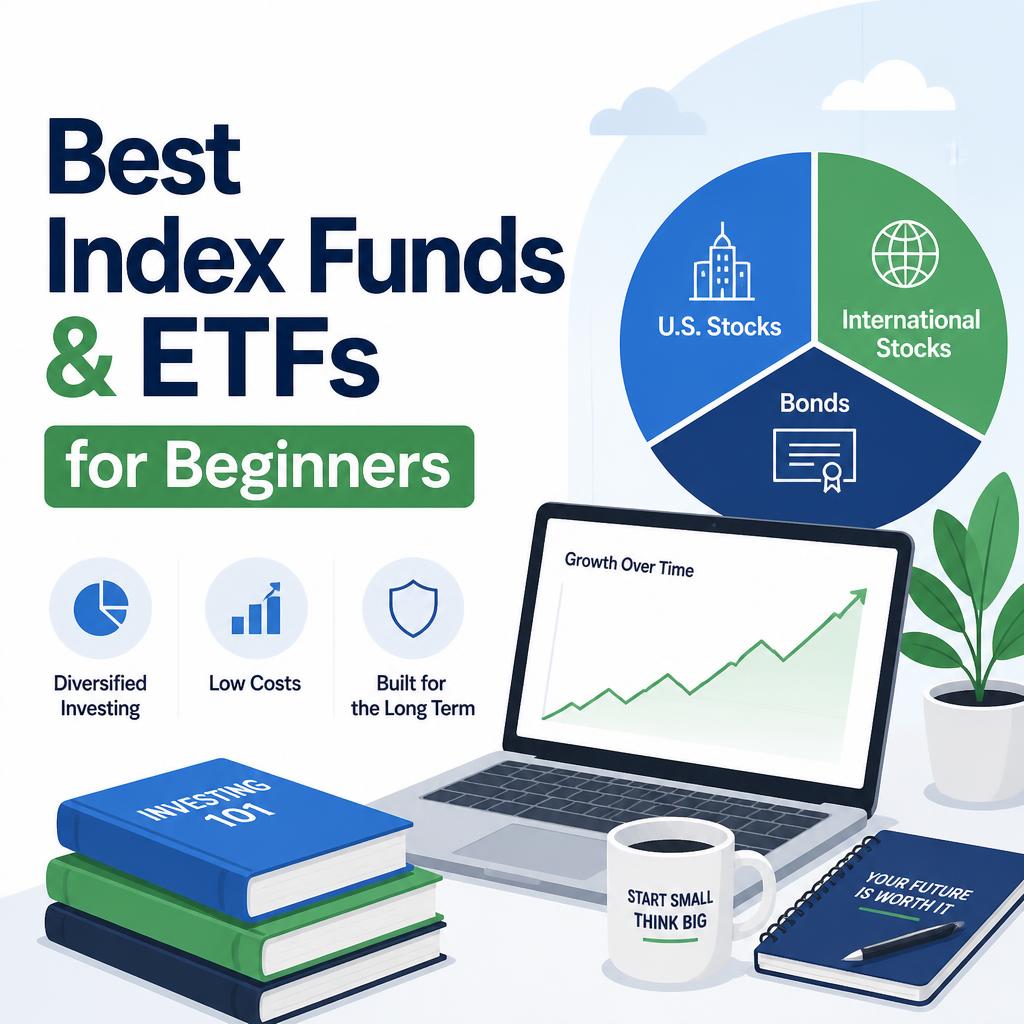
Fund Type Allocation (Age-Based) Example Funds U.S. Stock Market Index 60-80% (higher when younger) VTSAX (Vanguard), FSKAX (Fidelity) International Stock Index 10-20% VTIAX (Vanguard), FTIHX (Fidelity) Bond Index 10-30% (higher as you age) VBTLX (Vanguard), FXNAX (Fidelity)
How to set it up:
- Decide your stock/bond split based on your age and risk tolerance
- Split your stock allocation 70-80% U.S., 20-30% international
- Buy these funds in your 401(k) or IRA
- Rebalance once a year (sell winners, buy losers to maintain your target allocation)
You should see: A diversified portfolio with global exposure and controlled risk, all at rock-bottom fees (combined expense ratio around 0.05-0.10%).
> Decision paralysis? Go with the target-date fund. The difference in long-term returns between a target-date fund and a three-fund portfolio is minimal, and the target-date fund requires zero ongoing maintenance.
—
Step 8: Rebalance Your Portfolio Annually
Over time, your portfolio drifts. Stocks might grow faster than bonds, throwing off your target allocation. Or international stocks might lag, shrinking their share of your portfolio.
Rebalancing brings everything back to your target allocation—and it forces you to “buy low, sell high” without trying to time the market.
How to rebalance:
- Once per year (pick a consistent date—your birthday, January 1st, etc.), log into your accounts
- Check your current allocation percentages
- Compare them to your target allocation
- Sell overweight funds and buy underweight funds to restore balance
Example:
- Target allocation: 70% stocks, 30% bonds
- Current allocation after a strong stock year: 78% stocks, 22% bonds
- Rebalancing action: Sell 8% of stocks, buy 8% of bonds
You should see: Your allocation back to your target percentages.
> Shortcut for target-date funds: You don’t need to rebalance manually—the fund does it automatically. This is another reason target-date funds are great for hands-off investors.
Tax note: Rebalancing inside a 401(k) or IRA is tax-free. If you have taxable brokerage accounts, rebalancing there can trigger capital gains taxes—handle those separately or rebalance using new contributions instead of selling.
—
Step 9: Avoid Early Withdrawal Penalties
Retirement accounts come with a catch: your money is locked up until age 59½. Withdraw early, and you’ll pay a 10% penalty on top of ordinary income taxes.
How to avoid penalties:
- Build an emergency fund first—3-6 months of expenses in a high-yield savings account, before maxing out retirement contributions. This prevents you from raiding your retirement accounts during a crisis.
- Know the exceptions—you can withdraw from an IRA penalty-free for certain life events: first-time home purchase (up to $10,000), qualified education expenses, medical expenses exceeding 7.5% of your income, or permanent disability.
- Roth IRA contributions can be withdrawn anytime without penalty (but not earnings). This makes Roth IRAs slightly more flexible.
You should see: Your retirement accounts left untouched, growing for decades through compound interest.
The math on early withdrawal: If you pull out $10,000 from a Traditional IRA at age 40:
- 10% penalty: $1,000
- Income tax (22% bracket): $2,200
- You net $6,800 and lose decades of compound growth on that $10,000.
Don’t do it unless it’s a true emergency covered by an exception.
—
Step 10: Review and Increase Contributions Annually
Your first retirement contribution percentage isn’t your forever percentage. As your income grows, your retirement savings should grow with it.
How to review and increase:
- Set a recurring calendar reminder for the same date each year (e.g., January 1st or your work anniversary)
- Log into your 401(k) and IRA accounts
- Increase your contribution percentage by 1-2% (this is small enough to barely notice, large enough to matter over time)
- If you get a raise, immediately allocate at least half of it to retirement contributions before lifestyle inflation eats it
You should see: Your contribution rate climbing steadily each year. By following this pattern, many people go from contributing 6% in their first job to 15-20% by mid-career—without feeling the pinch.
Example progression:
- Year 1 (age 25): 6% of salary to 401(k) to capture match
- Year 3 (age 27): 8% to 401(k) after a promotion
- Year 5 (age 29): 10% to 401(k) + $3,000/year to IRA
- Year 10 (age 34): Maxing out 401(k) at $23,500/year
The earlier you increase contributions, the more time compound growth has to work its magic.
—
What You’ve Just Built
You now have a complete, optimized retirement savings system:
- ✅ Capturing every dollar of employer match (free money)
- ✅ Tax-optimized contributions (Traditional vs. Roth based on your situation)
- ✅ Low-fee investments (keeping 99.8%+ of your returns instead of losing them to expenses)
- ✅ Automated contributions (consistency without willpower)
- ✅ Proper diversification (target-date fund or three-fund portfolio)
- ✅ Annual reviews to increase contributions as your income grows
This system will save you tens of thousands—possibly hundreds of thousands—in fees, taxes, and lost opportunities over your career.
Most people never optimize this. They set up a 401(k) once, pick random funds, and never look at it again. You just put yourself in the top 10% of retirement savers simply by following these steps.
—
Troubleshooting Common Issues
“My employer doesn’t offer a 401(k) match.” Skip Step 1 and go straight to opening an IRA. You’ll have full control over your investment options and fees. If you’re self-employed, consider a Solo 401(k) or SEP-IRA—both allow much higher contribution limits than a standard IRA.
“I can’t afford to contribute much right now.” Start with whatever you can—even $25/paycheck. The habit matters more than the amount early on. As your income grows, increase contributions gradually (Step 10).
“My 401(k) only offers high-fee funds.” Contribute just enough to get the employer match, then prioritize maxing out an IRA where you can choose low-cost index funds. Some employers will improve their 401(k) options if employees advocate for it—consider raising it with HR.
“I’m not sure if I should prioritize retirement savings or paying off debt.” General rule: contribute enough to get your employer match (that’s free money), then focus on high-interest debt (credit cards, personal loans over 6-7% interest). Once high-interest debt is gone, balance between moderate debt payoff and increasing retirement contributions.
“What if I need the money before retirement?” That’s what an emergency fund is for—build 3-6 months of expenses in a high-yield savings account before aggressively maxing out retirement accounts. Roth IRA contributions (not earnings) can be withdrawn anytime without penalty, offering a middle ground.
—
Next Steps
You’ve got the foundation. Here’s how to level up:
- Set up your accounts this week—if you don’t have an IRA yet, open one at Vanguard, Fidelity, or Schwab and make your first contribution.
- Audit your current 401(k) and IRA fees—swap out any funds with expense ratios over 0.50%.
- Automate your IRA contributions—set it and forget it.
- Schedule your annual review—add a calendar reminder to increase contributions and rebalance once a year.
The earlier you optimize this system, the more compounding does the heavy lifting for you. Someone who starts at 25 and contributes $500/month will accumulate more wealth by 65 than someone who starts at 35 and contributes $1,000/month—even though the second person contributes more total dollars. Time is your greatest asset.
—
Frequently Asked Questions
Do I need to pick individual stocks in my 401(k) or IRA? No—and you probably shouldn’t. Index funds (like an S&P 500 fund or target-date fund) outperform most active stock pickers over the long term, and they require zero ongoing research. Unless you’re a professional investor, stick with low-cost index funds.
How much should I have saved for retirement by age 30? 40? 50? A rough guideline: 1x your annual salary by 30, 3x by 40, 6x by 50, and 10x by 67. These are benchmarks, not requirements—just aim to stay on an upward trajectory.
Can I contribute to both a 401(k) and an IRA? Yes! They have separate contribution limits. You can max out your 401(k) ($23,500 in 2026) and max out an IRA ($7,000 in 2026) in the same year—though there are income limits on deducting Traditional IRA contributions if you also have a 401(k).
Should I pay off my mortgage or max out retirement contributions? If your mortgage interest rate is below 5%, prioritize retirement contributions—you’ll likely earn more in the market than you’re paying in interest. If your rate is above 6-7%, it’s a judgment call based on your risk tolerance and how close you are to retirement.
What if the market crashes right after I invest? Keep contributing. Market crashes are buying opportunities when you’re decades from retirement. The worst thing you can do is stop contributing or sell during a downturn—you lock in losses and miss the recovery.
Is a financial advisor worth the cost? For most people following this guide, no—you’re already doing 90% of what a paid advisor would do. If you have complex estate planning needs, a business, or over $1 million in assets, a fee-only fiduciary advisor might be worth consulting once or twice. Avoid advisors who charge a percentage of assets under management (typically 1%/year)—that’s a high ongoing fee for basic advice.