Best Dividend Investing for Small Budgets: A Complete Guide to Building Passive Income
Starting dividend investing with a small budget can feel overwhelming. You’re worried about picking the wrong stocks and that fees will eat away at your capital. The good news? You don’t need thousands of dollars to start building dividend income. This guide will show you how to navigate dividend investing with limited funds.
Understanding Dividend Investing Fundamentals
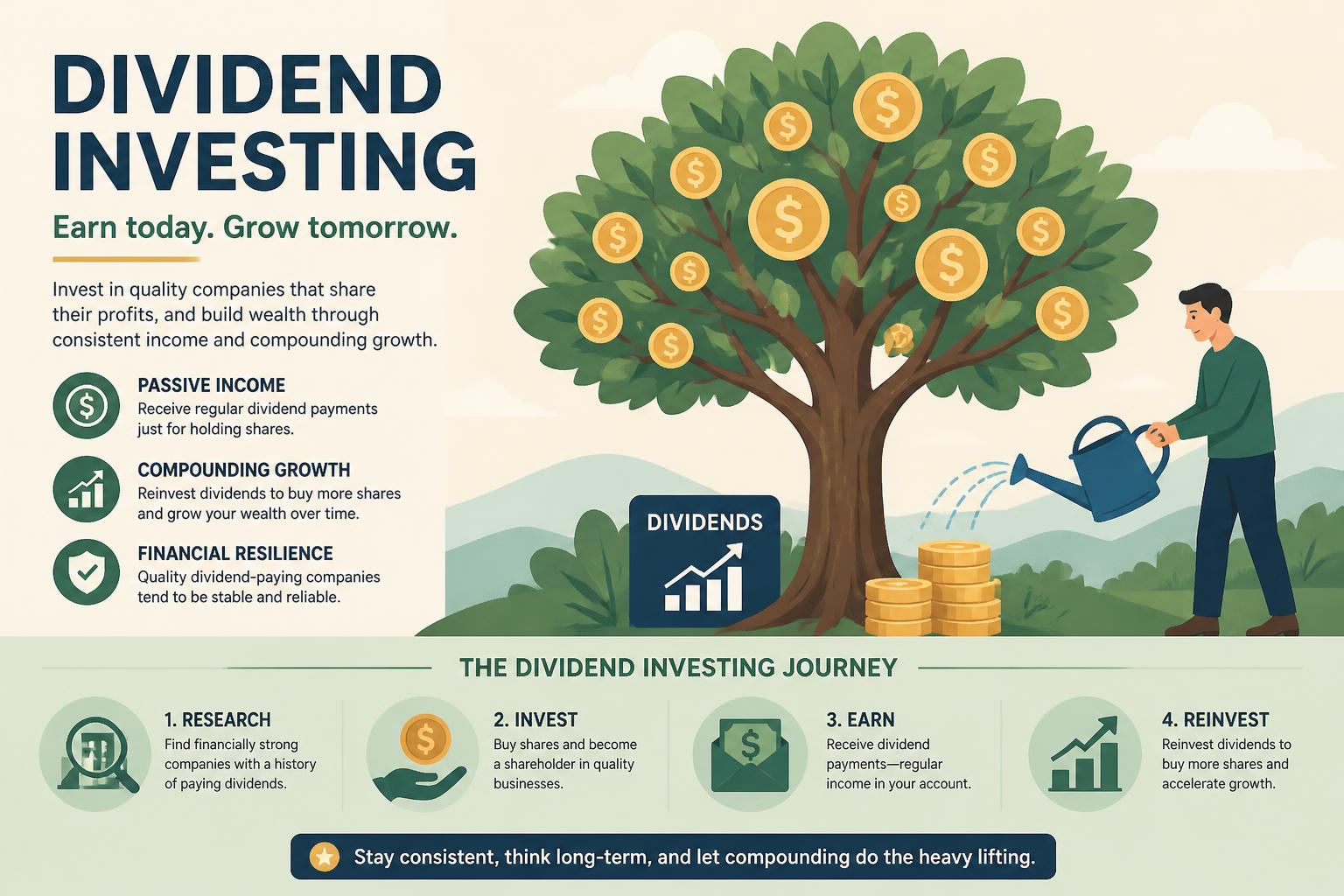
Dividend investing means buying shares in companies that regularly distribute profits to shareholders. Unlike growth investing, where you rely on stock price appreciation, dividend investing gives you regular cash payments—typically quarterly—regardless of market fluctuations.
Why Dividend Investing Works for Small Budgets
When you’re starting with limited capital, dividends offer several advantages:
Compounding acceleration: Reinvesting dividends lets you buy more shares without adding new money, creating a snowball effect.
Psychological benefits: Regular dividend payments provide tangible progress, helping you stay committed during downturns.
Lower volatility: Dividend-paying companies tend to be more established and stable, with less dramatic price swings than high-growth stocks.
Passive income foundation: Even small dividend payments can cover minor expenses or fund reinvestment, gradually reducing your reliance on active income.
The Small Budget Reality: Common Mistakes to Avoid
Before diving into strategies, let’s address the costly mistakes that derail small-budget dividend investors:
Overpaying Through Fees
Traditional brokerages historically charged $5-10 per trade, which could consume 5-10% of a $100 investment. Most brokers now offer commission-free trading, but hidden fees still exist in expense ratios and account maintenance charges.
Solution: Use zero-commission brokers like Fidelity, Charles Schwab, or Robinhood for individual stocks. For dividend ETFs, focus on funds with expense ratios below 0.10%.
Chasing High Yields Without Research
A 10% dividend yield looks attractive until you discover the company is cutting dividends or facing bankruptcy. High yields often signal high risk.
Solution: Target dividend yields between 2-6% from companies with consistent dividend growth histories. Yields above 8% warrant extreme skepticism.
Neglecting Diversification
Concentrating your small budget in 2-3 dividend stocks exposes you to significant risk. A single dividend cut can devastate your income stream.
Solution: Use dividend ETFs for instant diversification, or commit to building a portfolio of at least 15-20 individual dividend stocks over time.
Focusing on Yield Over Growth
Many beginners prioritize current yield while ignoring dividend growth rate. A stock yielding 3% that grows dividends 10% annually will outperform a 5% yielder with stagnant payouts within just a few years.
Solution: Balance current income needs with long-term growth potential. For small budgets focused on wealth accumulation, dividend growth often matters more than current yield.
Best Dividend Investing Strategies for Limited Capital
Strategy 1: Dividend ETFs for Instant Diversification
Dividend-focused exchange-traded funds (ETFs) are the most efficient path for small-budget investors seeking immediate diversification and reliable income.
Top dividend ETF options:
- Vanguard Dividend Appreciation ETF (VIG): Focuses on companies with 10+ years of dividend increases. Expense ratio 0.06%. Yields around 1.8% but offers strong dividend growth.
- Schwab U.S. Dividend Equity ETF (SCHD): Tracks high-quality dividend payers with strong fundamentals. Expense ratio 0.06%. Yields approximately 3.5%.
- iShares Core High Dividend ETF (HDV): Concentrates on the highest-yielding stocks in the market. Expense ratio 0.08%. Yields around 3.8%.
- Vanguard High Dividend Yield ETF (VYM): Holds stocks forecasting above-average dividend yields. Expense ratio 0.06%. Yields approximately 2.8%.
Implementation for small budgets: Start by investing your initial capital in a single dividend ETF that matches your goals. Many brokers allow fractional share purchases, meaning you can invest any amount—even $10—into these funds. Set up automatic monthly contributions of whatever amount you can afford, whether that’s $25, $50, or $100.
Strategy 2: Dollar-Cost Averaging into Dividend Aristocrats
Dividend Aristocrats are S&P 500 companies that have increased dividends for at least 25 consecutive years. This track record shows financial strength and business resilience.
Building your Aristocrat portfolio:
- Select your targets: Research the complete list of 67 current Dividend Aristocrats (2025). Focus on companies you understand in sectors you believe in.
- Prioritize affordability: Some Aristocrats trade below $100 per share. Examples include Realty Income (monthly dividend payer), Target, Walgreens Boots Alliance, and Kimberly-Clark.
- Establish a purchase schedule: Commit to purchasing shares in one Aristocrat per month. If you can invest $100 monthly, you could buy 1-3 shares depending on the stock price.
- Track positions: Create a simple spreadsheet documenting each purchase date, shares acquired, price paid, and current dividend yield on your cost basis.
Sample 12-month purchase plan with $100 monthly:
- Month 1: 2 shares of Company A at $50
- Month 2: 1 share of Company B at $95
- Month 3: 3 shares of Company C at $33
- Continue monthly, adding to existing positions or starting new ones
By year-end, you’ll own pieces of 8-12 different Dividend Aristocrats, creating meaningful diversification despite your small budget.
Strategy 3: Direct Stock Purchase Plans (DSPPs) and DRIPs
Some companies offer Direct Stock Purchase Plans that let you buy shares directly from the company, often with minimal initial investment requirements and no commission fees.
How DSPPs work:
- Open an account directly with the company’s transfer agent
- Make an initial investment (often $250-500 minimum, though some accept less)
- Set up automatic monthly investments (frequently as low as $25-50)
- Dividends automatically reinvest to purchase additional fractional shares
Companies offering investor-friendly DSPPs:
- Johnson & Johnson: $50 minimum initial investment, $50 minimum for additional purchases
- Coca-Cola: Low-cost direct investment program
- Procter & Gamble: Investor-friendly DSPP with reasonable minimums
- McDonald’s: Accessible direct purchase option
Dividend Reinvestment Plans (DRIPs) automatically use your dividend payments to purchase additional shares, including fractional shares, without transaction fees.
Implementation strategy: If you identify 5-10 companies you want to own long-term, consider opening DSPP/DRIP accounts for each. Even investing just $50 monthly across these positions creates diversification and leverages automatic reinvestment.
Strategy 4: Fractional Share Investing Through Modern Platforms
The rise of fractional share investing has opened access to high-priced dividend stocks. You can now own 0.1 shares of a $500 stock with just $50.
Best platforms for fractional dividend investing:
- Fidelity: Fractional shares on thousands of stocks, commission-free, automatic dividend reinvestment
- Charles Schwab: Robust fractional share program (Schwab Stock Slices)
- Interactive Brokers: Access to fractional shares with professional-grade tools
- M1 Finance: Built around fractional shares with customizable “pies” for dividend portfolios
Strategy implementation:
- Create a target portfolio of 15-25 dividend stocks across sectors
- Assign percentage allocations to each position (4-8% per stock)
- Invest your entire monthly budget, automatically distributed across all positions
- Rebalance quarterly as positions drift from target allocations
Example with $200 monthly budget:
- $20 to high-yield telecom (AT&T or Verizon)
- $20 to pharmaceutical (Johnson & Johnson, AbbVie, or Pfizer)
- $20 to consumer staples (Procter & Gamble or Coca-Cola)
- $20 to financial (JPMorgan Chase or BlackRock)
- $20 to industrial (3M or Honeywell)
- $20 to utility (Duke Energy or NextEra Energy)
- $20 to real estate (Realty Income)
- $20 to technology dividend payer (Cisco or Texas Instruments)
- $20 to retail (Target or Home Depot)
- $20 to energy (Chevron or Exxon Mobil)
This approach gives you sector diversification and access to expensive stocks that would otherwise require months of saving.
Building Your Dividend Portfolio: Step-by-Step Implementation
Phase 1: Foundation (Months 1-6)
Goal: Establish core holdings and build the habit of consistent investing.
Action steps:
- Open a commission-free brokerage account supporting fractional shares or dividend reinvestment
- Invest 100% of available capital into 1-2 broad dividend ETFs (SCHD and/or VIG recommended)
- Set up automatic monthly contributions
- Enable automatic dividend reinvestment (DRIP)
- Track your growing share count and quarterly dividend payments
Expected outcome: After six months with $100 monthly investments, you’ll have approximately $600 invested (not counting dividend reinvestment or market appreciation).
Phase 2: Expansion (Months 7-18)
Goal: Add individual dividend stocks while maintaining ETF core.
Action steps:
- Allocate 60% of new contributions to existing ETF positions
- Allocate 40% to individual dividend stocks, purchasing 1-2 new positions monthly
- Focus on Dividend Aristocrats and quality dividend growers
- Maintain position tracking spreadsheet
- Research upcoming purchases during the month before buying
Expected outcome: By month 18, you own 2 dividend ETFs and 8-12 individual dividend stocks, creating diversification across 100+ underlying companies.
Phase 3: Optimization (Month 19+)
Goal: Refine portfolio based on performance and optimize for your goals.
Action steps:
- Increase individual stock allocation to 50% of new contributions if comfortable with research
- Trim underperforming positions that cut or froze dividends
- Add to highest-conviction positions showing strong dividend growth
- Consider sector rotation to balance portfolio
- Evaluate whether your portfolio yield and growth rate align with income goals
Expected outcome: A personalized dividend portfolio reflecting your research, risk tolerance, and income objectives, generating quarterly cash flow and showing consistent growth.
Evaluating Dividend Stocks: Essential Metrics
When researching individual dividend stocks for your small-budget portfolio, focus on these metrics:
Dividend Yield: Current annual dividend per share divided by current stock price. Compare yields within the same sector rather than across different industries.
Dividend Payout Ratio: Percentage of earnings paid as dividends. Generally, ratios below 60% indicate sustainability with room for growth. Ratios above 80% suggest vulnerability to cuts during earnings declines.
Dividend Growth Rate: Historical rate of dividend increases, typically measured over 3, 5, and 10 years. Look for consistent growth of 5-10% annually.
Years of Consecutive Increases: Longer track records show business resilience through economic cycles. Prioritize companies with 10+ years of increases, with special consideration for 25+ year Dividend Aristocrats.
Free Cash Flow Coverage: Free cash flow divided by total dividend payments. Ratios above 1.5 provide comfort that dividends are well-covered by actual cash generation, not just accounting earnings.
Debt-to-Equity Ratio: Compare against sector averages. Lower ratios provide more flexibility during economic stress, protecting dividend safety.
Tax Considerations for Dividend Investors
Understanding dividend taxation helps you maximize after-tax returns from your best dividend investing strategy.
Qualified vs. Ordinary Dividends
Qualified dividends: Taxed at favorable capital gains rates (0%, 15%, or 20% depending on income). To qualify, you must hold the stock for more than 60 days during the 121-day period beginning 60 days before the ex-dividend date.
Ordinary dividends: Taxed at regular income tax rates (potentially up to 37%). REITs and master limited partnerships typically pay ordinary dividends.
Tax-Advantaged Accounts
Roth IRA: Contributions made with after-tax dollars, but all dividends and growth withdrawn in retirement are tax-free. Good for dividend stocks expected to appreciate significantly or high-yield positions.
Traditional IRA: Contributions may be tax-deductible, dividends grow tax-deferred, but withdrawals taxed as ordinary income. Useful for current tax deduction needs.
Taxable brokerage account: Offers flexibility without contribution limits or withdrawal restrictions, but dividends taxed annually. Best for dividend investing after maximizing retirement account contributions.
Strategy for small budgets: Prioritize Roth IRA contributions for dividend investing when possible. The combination of dividend reinvestment and tax-free growth creates powerful wealth-building potential.
Maximizing Returns Through Reinvestment
Dividend reinvestment transforms modest yield into substantial wealth through compounding. Consider these reinvestment scenarios:
Scenario 1: Consistent Reinvestment
- Initial investment: $1,000
- Monthly contribution: $100
- Average dividend yield: 3.5%
- Annual dividend growth: 6%
- Time horizon: 20 years
- Approximate outcome: $55,000-60,000 portfolio generating $1,900-2,100 annual dividend income
Scenario 2: No Reinvestment
- Same parameters, but dividends withdrawn as cash
- Approximate outcome: $45,000-48,000 portfolio generating $1,575-1,680 annual dividend income
- Difference: $10,000-12,000 less portfolio value, $325-420 less annual income
The reinvestment scenario produces roughly 20% more wealth and income despite identical contributions.
Managing Your Portfolio: Maintenance Schedule
Dividend portfolio management requires regular attention without obsessive monitoring.
Monthly tasks (30 minutes):
- Make scheduled contributions
- Record dividend payments received
- Review news for any holdings announcing dividend changes
- Research next purchase target if buying individual stocks
Quarterly tasks (1-2 hours):
- Review complete portfolio performance
- Calculate total dividend income for the quarter
- Verify all dividends reinvested properly
- Assess whether any positions warrant concern
- Rebalance if any position exceeds target allocation by more than 5%
Annual tasks (3-4 hours):
- Comprehensive portfolio review and performance analysis
- Tax planning and documentation preparation
- Strategy refinement based on changing life circumstances
- Research potential new positions for the coming year
- Consider whether portfolio allocation between ETFs and individual stocks remains appropriate
Scaling Your Dividend Income Over Time
As your portfolio grows and your budget potentially increases, you can accelerate progress:
Increasing contribution rate: Every $25 monthly increase in contributions compounds significantly over decades. As your income grows, direct increases toward dividend investments before lifestyle inflation absorbs them.
Opportunistic positioning: During market corrections, temporarily increase contributions to buy quality dividend stocks at discounted prices, accelerating your yield on cost and long-term returns.
Sector rotation: As sectors rotate through economic cycles, tactically overweight sectors offering temporarily elevated yields from quality companies facing temporary headwinds.
Common Questions About Small-Budget Dividend Investing
How much do I need to start dividend investing?
You can start with as little as $10-25 using fractional shares or certain dividend ETFs. Commit to consistent monthly investments of $50-100 to build momentum.
Should I focus on dividend yield or dividend growth?
For wealth accumulation with small budgets, prioritize dividend growth over current yield. A 2% yielder growing dividends 10% annually becomes more valuable than a 5% yielder with flat payouts within five years.
How many dividend stocks should I own?
Target 15-25 individual positions for adequate diversification if building individual stock portfolios. Or own 2-4 dividend ETFs covering different strategies (high yield, dividend growth, international) for instant diversification.
When should I take dividends as cash instead of reinvesting?
Reinvest dividends during accumulation years. Consider taking dividends as income only when portfolio size generates enough cash flow to meaningfully support spending needs—typically requiring portfolio values of $250,000-500,000 for modest income supplementation.
Can I live off dividend income?
Yes, but it requires significant portfolio size. A $1 million portfolio yielding 4% generates $40,000 annually. Most small-budget investors need 20-30 years of consistent investing to reach portfolio sizes supporting full retirement income.
Taking Action: Your Next Steps
Starting your dividend investing journey with a small budget requires commitment more than capital. Here’s how to begin:
- This week: Open a commission-free brokerage account supporting fractional shares. Fidelity, Charles Schwab, and Interactive Brokers all offer excellent platforms for dividend investors.
- This month: Make your first investment in a dividend ETF like SCHD or VIG. Start with whatever amount you can afford, even if just $25-50.
- Ongoing: Set up automatic monthly contributions and enable dividend reinvestment. Consistency matters more than amount.
- Build knowledge: Spend 30 minutes weekly reading about dividend investing, researching companies, and understanding market dynamics. The r/dividends subreddit and Dividend.com provide valuable resources.
- Track progress: Create a simple spreadsheet documenting your investments, dividend income, and portfolio growth. Watching your dividend income grow—even from $5 quarterly to $10 quarterly—provides powerful motivation.
The best dividend investing strategy is the one you actually implement and maintain. Start small, stay consistent, and let time and compounding work. Your modest beginning today becomes meaningful passive income in the future.
The key isn’t finding the perfect dividend stock or timing the market perfectly. It’s establishing the discipline to invest regularly, choosing quality dividend-paying companies or funds, reinvesting distributions, and maintaining your strategy through market ups and downs. With patience and persistence, your small budget becomes a growing dividend income stream.