Best Retirement Account for Small Budgets: Getting Started
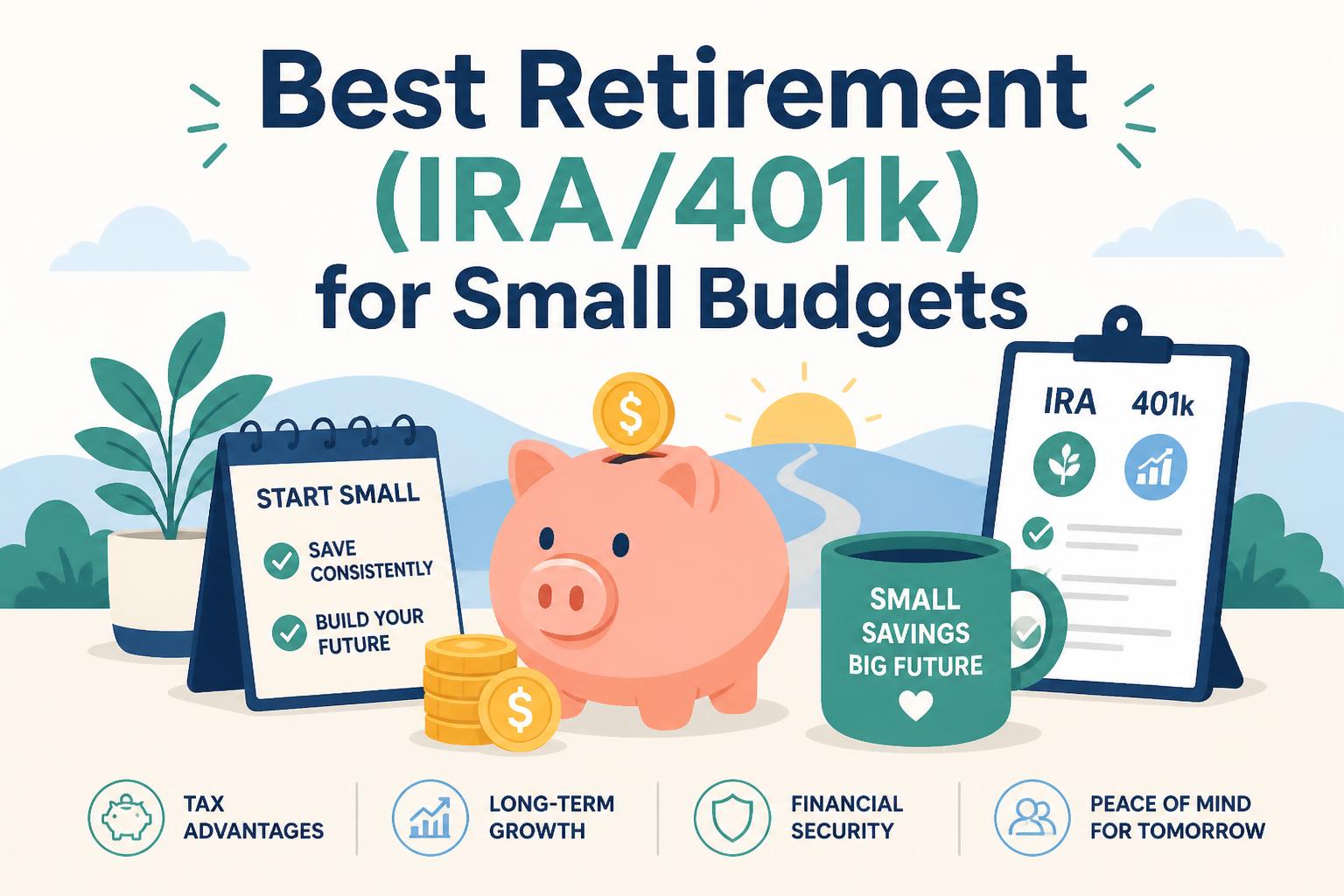
You can start saving for retirement with $25 a month. The problem is most guides assume you have thousands to invest upfront or a steady $500/month to contribute. They’re written for people who don’t need them.
This guide is for everyone else.
Your Options
Traditional IRA
You contribute pre-tax dollars, which lowers your taxable income now. The money grows tax-deferred. When you withdraw in retirement, you pay ordinary income tax on it.
2024 limits: $7,000/year ($8,000 if you’re 50+)
Makes sense if: You expect to earn less in retirement than you do now.
Roth IRA
You contribute after-tax dollars. No tax deduction now, but qualified withdrawals in retirement are tax-free—including all growth.
2024 limits: $7,000/year ($8,000 if you’re 50+)
Income caps: Single filers over $161k and married couples over $240k face reduced or eliminated eligibility.
Makes sense if: You’re young, expect higher income later, or want tax-free growth.
401(k)
Employer-sponsored. Comes in traditional (pre-tax) or Roth (after-tax) versions. The big advantage is employer matching.
2024 limits: $23,000/year ($30,500 if you’re 50+)
Makes sense if: Your employer matches contributions. It’s free money.
SEP IRA and Solo 401(k)
For self-employed people. Much higher contribution limits based on business income.
Makes sense if: You freelance, contract, or run a side business.
Why Small Budgets Get Stuck
The retirement industry wasn’t built for people saving $50 a month.
Some providers require $1,000+ to open an account. Others charge annual fees that eat 5% of a small balance. The number of choices causes decision paralysis, so people do nothing.
Others start, miss a few months during a tight stretch, and abandon the account entirely instead of just reducing contributions.

The Best Account for Small Budgets
Roth IRA with a no-minimum provider.
Here’s why it works:
You can contribute whatever you can afford each month. $25 this month, $100 next month—doesn’t matter. No minimums at Fidelity, Schwab, or Vanguard. Tax-free growth protects every dollar. No forced withdrawals at 73 like traditional IRAs. If you absolutely need the money, you can withdraw contributions (not earnings) without penalty.
When a 401(k) Wins
Contribute to a 401(k) first if:
Your employer matches. Even a 50% match up to 3% of salary is an immediate 50% return. Capture the full match before funding anything else.
You’re in a high tax bracket. The immediate deduction from traditional 401(k) contributions saves thousands if you’re in the 24%+ bracket.
You can save more than $7k/year. The $23k limit matters if you’re able to max it out.
Opening Your First Account
Step 1: Figure Out Your Number
Look at your budget. Find a monthly amount you can commit to consistently. $25 or $50 works. Consistency beats sporadic large contributions.
Step 2: Pick a Provider
For small budgets:
- $0 to open
- $0 minimums to invest
- No commission on trades
- Low expense ratios
Fidelity: Zero minimums. Good app. Access to Fidelity Zero index funds (0.00% fees).
Schwab: Zero minimums. Strong customer service.
Vanguard: Zero minimums for accounts. Some funds require $1k minimums. Best for index fund investors.
Step 3: Open the Account
Takes 10-15 minutes online. You’ll need your SSN, address, employment info, and bank account. Choose “Roth IRA.” Add a beneficiary. You don’t need to deposit money yet.
Step 4: Automate It
Set up automatic transfers for the day after your paycheck hits. Don’t rely on remembering. $50/month becomes $600/year and compounds for decades.
Step 5: Pick Your Investment
Don’t overthink this.
Target-date fund: One fund that adjusts its stock/bond mix as you approach retirement. Fidelity Freedom Index funds (0.08% expense ratio) or Vanguard Target Retirement funds (0.08%) work.
Total market index fund: FSKAX at Fidelity or VTSAX at Vanguard. Instant diversification across thousands of companies. Low fees.
Skip: Individual stocks (too risky), actively managed funds over 0.50% expense ratios, and crypto in retirement accounts.
Mistakes That Kill Small Accounts
Stopping When Money Gets Tight
Life happens. Instead of halting contributions, reduce them. $100/month to $25/month keeps the habit alive. Restarting after stopping completely is harder.
Ignoring Fees
A 1% annual fee sounds harmless. On $5,000 that’s $50/year. Over 30 years, high fees cost you hundreds of thousands in lost growth. Stay under 0.20% expense ratios.
Chasing Hot Investments
Your coworker’s 300% crypto gains are exciting until you hear about the 80% losses. Small accounts can’t recover from speculative bets. Boring index funds outperform most active strategies.
Cashing Out Early
Withdrawing before 59½ triggers taxes and a 10% penalty. A $5,000 withdrawal might net you $3,250 after penalties—and you lose decades of compound growth.
Skipping Employer Match
If your employer offers any match, get it before opening an IRA. Turning down free money makes no sense.
Making It Grow
Start Early
$100/month from age 25-35 (10 years, $12k total) beats $100/month from age 35-65 (30 years, $36k total). Early contributions have decades to compound. At 8% returns, the early starter ends up ahead despite contributing less.
Bump It With Raises
Get a 4% raise? Increase retirement savings by 2%. You still see more take-home pay and accelerate wealth building.
Use Catch-Up After 50
At 50, limits increase by $1k for IRAs and $7,500 for 401(k)s. Most people have more budget room by then.
Consider Roth Conversions
In years when income drops (job loss, career change), convert some traditional IRA funds to Roth. You pay taxes at a lower rate now for tax-free growth later.
Questions
Can I have both a 401(k) and an IRA?
Yes. High earners may hit deductibility limits on traditional IRA contributions.
What if I can only afford $25/month?
Start there. At 8% returns over 30 years, that’s nearly $35k. Beats $0.
Debt or retirement?
Capture employer match first. Pay off high-interest debt. Split remaining funds between debt and retirement.
Self-employed—can I open an account?
Yes. SEP IRAs and Solo 401(k)s offer higher limits.
What if I change jobs?
IRAs stay with you. 401(k)s roll over to your new employer’s plan or an IRA without taxes or penalties.
Start Now
Pick the best retirement account for your budget and start. You don’t need the perfect strategy. You need a good-enough approach and consistency.
Action plan:
- This week: figure out your monthly amount ($25 minimum)
- This month: open a Roth IRA at Fidelity, Schwab, or Vanguard
- Before month-end: set up automatic contributions
- Within 60 days: pick a target-date or total market index fund
- Every year: increase contributions by at least $10/month
The difference between retiring comfortably and working into your 70s usually isn’t income. It’s starting early and staying consistent, even with small amounts.
Your account doesn’t need thousands. It needs to start today.