Best Index Funds & ETFs for Small Budgets: A Complete Guide to Smart Investing
You can start investing with $100, or less if your broker offers fractional shares. This guide covers index funds and ETFs that work when you don’t have much capital.
Why Index Funds & ETFs Work for Small Budgets
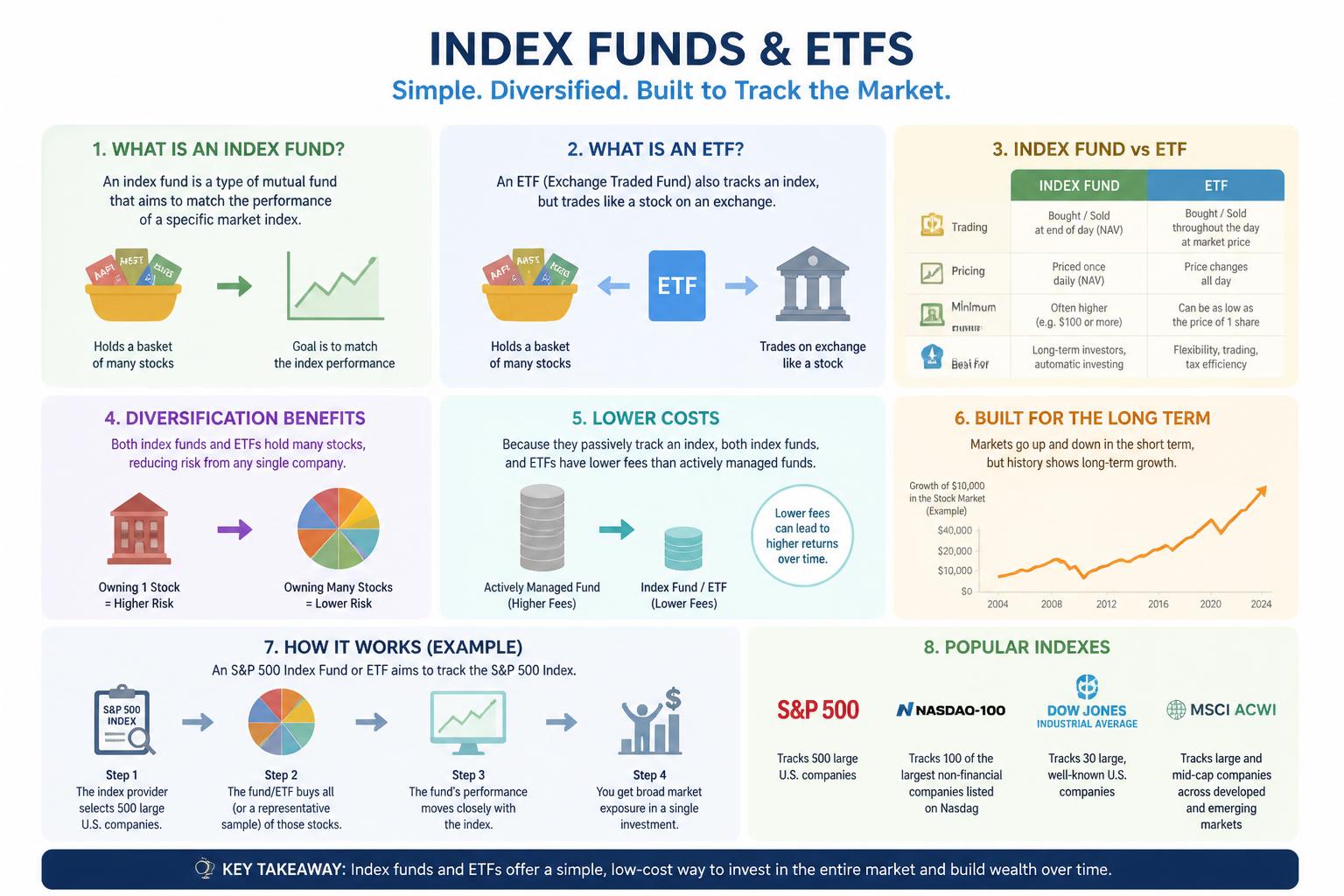
Index funds and ETFs track entire market indexes. One purchase gives you exposure to hundreds or thousands of companies. The fees are low, the minimums are often zero, and you don’t need to research individual stocks.
What you get:
- Low minimum investments (many brokers offer fractional shares)
- Low fees (expense ratios as low as 0.03%)
- Automatic diversification
- No need to constantly rebalance
Understanding the Cost Structure
The expense ratio is an annual fee expressed as a percentage. A 0.10% expense ratio means you pay $1 per year for every $1,000 invested.
What you’re paying:
- Expense ratios: Lower is better
- Trading commissions: Most major brokers charge nothing for stocks and ETFs
- Fund minimums: Traditional mutual funds often require $1,000-$3,000. ETFs cost one share.
- Account minimums: Some brokers require minimum balances, though many have dropped them
Best Broad Market Index Funds & ETFs
Vanguard Total Stock Market Index Fund (VTSAX) / Vanguard Total Stock Market ETF (VTI)
Expense Ratio: 0.04%
Minimum Investment: $3,000 for VTSAX, one share for VTI (~$200-250)
Tracks the entire U.S. stock market: small, mid, and large caps across all sectors.
Best for: Complete U.S. market exposure
Schwab Total Stock Market Index Fund (SWTSX) / Schwab U.S. Broad Market ETF (SCHB)
Expense Ratio: 0.03%
Minimum Investment: No minimum for SWTSX, one share for SCHB
Similar coverage to Vanguard but with a lower expense ratio and no minimum for the mutual fund.
Best for: Low fees and flexibility
Fidelity ZERO Total Market Index Fund (FZROX)
Expense Ratio: 0.00%
Minimum Investment: $0
Zero annual fees. Tracks a slightly different index than Vanguard’s but performance is nearly identical.
Best for: Beginners with very small starting amounts
Best S&P 500 Index Funds & ETFs
The S&P 500 tracks the 500 largest U.S. companies, about 80% of the total U.S. market.
SPDR S&P 500 ETF Trust (SPY)
Expense Ratio: 0.09%
Average Daily Volume: Highest of all ETFs
The oldest and most heavily traded ETF. High liquidity, but the expense ratio is higher than competitors.
Best for: Active traders who prioritize liquidity
Vanguard S&P 500 ETF (VOO)
Expense Ratio: 0.03%
Minimum Investment: One share (~$400-500)
S&P 500 exposure with one of the lowest expense ratios. Performance mirrors SPY but costs less over time.
Best for: Long-term buy-and-hold
Fidelity 500 Index Fund (FXAIX)
Expense Ratio: 0.015%
Minimum Investment: $0
Lowest expense ratio in this category with no minimum.
Best for: Small budgets
Best International Index Funds & ETFs
Diversifying beyond the U.S. protects against domestic downturns and captures growth elsewhere.
Vanguard Total International Stock Index Fund (VTIAX) / Vanguard Total International Stock ETF (VXUS)
Expense Ratio: 0.11%
Minimum Investment: $3,000 for VTIAX, one share for VXUS
Over 8,000 stocks across developed and emerging markets outside the U.S.
Best for: Comprehensive international exposure
iShares Core MSCI Total International Stock ETF (IXUS)
Expense Ratio: 0.07%
Minimum Investment: One share (~$60-75)
Similar coverage to VXUS at a lower expense ratio and more affordable share price.
Best for: Budget international diversification
Schwab International Index Fund (SWISX) / Schwab International Equity ETF (SCHF)
Expense Ratio: 0.06%
Minimum Investment: No minimum for SWISX
Focuses on developed markets, excluding emerging economies. Less volatile than total international funds.
Best for: Stable developed markets
Best Bond Index Funds & ETFs
Bonds provide stability and income, balancing stock volatility.
Vanguard Total Bond Market Index Fund (VBTLX) / Vanguard Total Bond Market ETF (BND)
Expense Ratio: 0.05%
Minimum Investment: $3,000 for VBTLX, one share for BND (~$70-80)
Tracks the entire U.S. investment-grade bond market: government and corporate bonds of various maturities.
Best for: Steady income
iShares Core U.S. Aggregate Bond ETF (AGG)
Expense Ratio: 0.03%
Minimum Investment: One share (~$100-110)
Similar exposure to BND with a slightly lower expense ratio and high liquidity.
Best for: Ultra-low costs in bond allocation
Schwab U.S. Aggregate Bond Index Fund (SWAGX) / Schwab U.S. Aggregate Bond ETF (SCHZ)
Expense Ratio: 0.04%
Minimum Investment: No minimum for SWAGX
No minimum on the mutual fund version.
Best for: Adding bonds on a small budget
Target-Date Index Funds
Target-date funds automatically adjust asset allocation as you approach retirement, becoming more conservative over time.
Vanguard Target Retirement Funds
Expense Ratio: 0.08%
Minimum Investment: $1,000
Pick a fund with a target year close to your expected retirement (e.g., Vanguard Target Retirement 2050). The fund rebalances automatically.
Best for: Hands-off investing
Fidelity Freedom Index Funds
Expense Ratio: 0.12%
Minimum Investment: $0
No minimum investment.
Best for: Beginners with very small starting amounts
How to Build Your Portfolio with Limited Funds
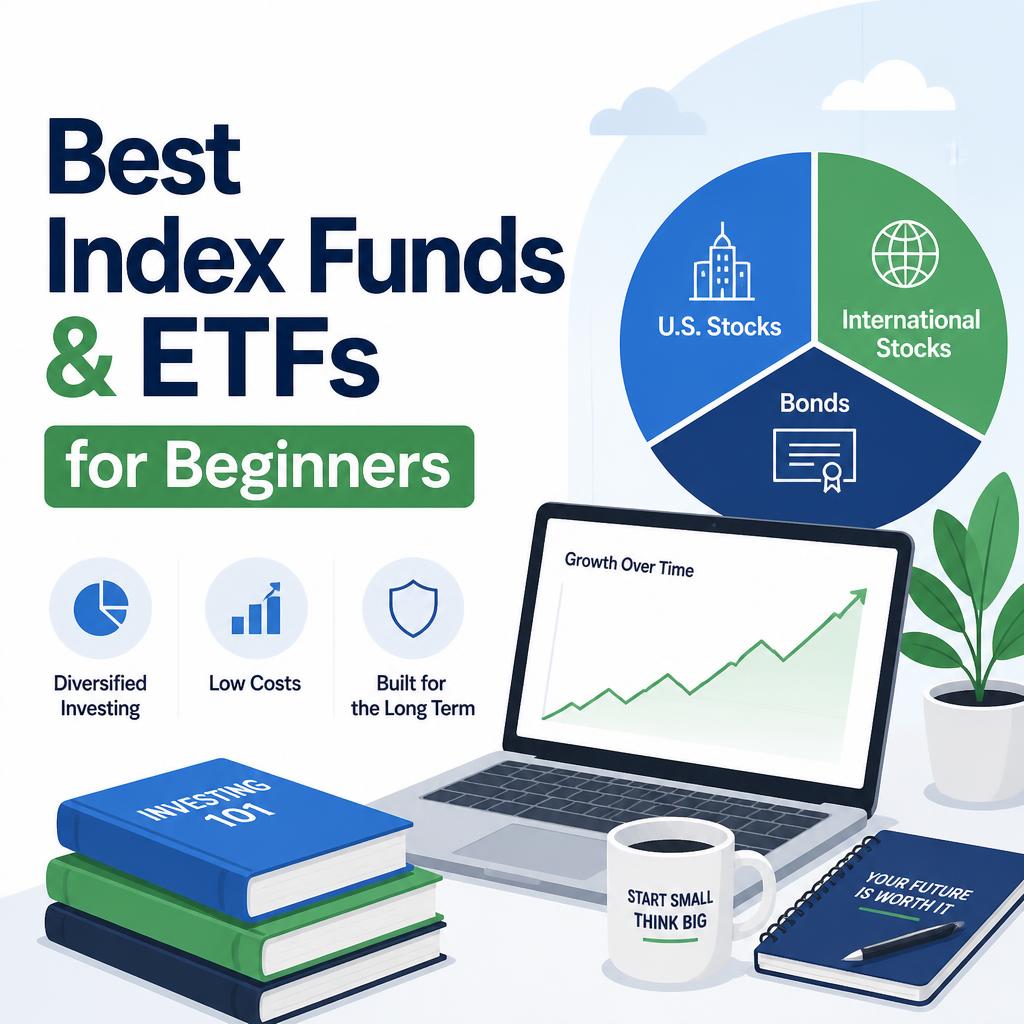
The Simple Three-Fund Portfolio:
- 70% U.S. Total Stock Market (VTI, SWTSX, or FZROX)
- 20% International Stocks (VXUS, IXUS, or SWISX)
- 10% Bonds (BND, AGG, or SWAGX)
This works for investors in their 20s-40s. Increase the bond percentage as you approach retirement.
Getting Started with $100:
- Month 1: $100 into a total market fund (FZROX or fractional shares of VTI)
- Month 2: $100 into the same fund
- Month 3: $100 into an international fund (IXUS or fractional shares of VXUS)
- Continue rotating to maintain target allocation
Dollar-Cost Averaging:
Invest a fixed amount regularly regardless of market conditions. This:
- Eliminates market timing stress
- Automatically buys more shares when prices are low
- Builds a consistent habit
- Reduces volatility impact
Choosing Between Mutual Funds and ETFs
Mutual funds if:
- You want to invest exact dollar amounts
- You prefer automatic investments
- You’re at Vanguard, Fidelity, or Schwab
ETFs if:
- You want to trade throughout the day
- You prefer not being locked to one broker
- You want maximum flexibility
For most small-budget investors, the differences are minimal. Focus on low expense ratios and consistent contributions.
Common Mistakes to Avoid
Chasing performance: Last year’s winner rarely repeats. Stick with broadly diversified index funds.
Overlooking expense ratios: A 0.50% difference seems small, but over 30 years on $100,000, it costs over $30,000 in lost returns.
Trading too frequently: Every trade potentially triggers taxes and breaks your long-term strategy. Set your allocation and hold it.
Waiting for the “perfect” time: Time in the market beats timing the market. Start now with whatever you can afford.
Ignoring tax-advantaged accounts: Max out IRA and 401(k) contributions before investing in taxable accounts.
Where to Open Your Account
Best brokers for small budgets:
Fidelity:
- No account minimums
- Zero-fee index funds
- Good research tools
- Fractional share investing
Charles Schwab:
- No account minimums
- No minimum mutual fund investments
- Strong customer service
Vanguard:
- Industry-low expense ratios
- $1,000 minimum for target-date funds, $3,000 for most others
- Best for buy-and-hold
- Client-owned structure keeps costs low
M1 Finance:
- No minimum investment
- Automated rebalancing
- Free
- Good for hands-off investing
All offer commission-free stock and ETF trading.
Tax Considerations for Small Investors
Tax efficiency matters even with small amounts.
Prioritize tax-advantaged accounts:
- Traditional IRA/401(k): Contributions are tax-deductible now, withdrawals taxed in retirement
- Roth IRA: Contributions taxed now, withdrawals tax-free in retirement
- HSA: Triple tax advantage for medical expenses
In taxable accounts:
- Hold tax-efficient index funds (total market, S&P 500)
- Avoid frequent trading to minimize capital gains taxes
- Consider tax-loss harvesting
Taking Action Today
The best index funds and ETFs for small budgets have ultra-low expense ratios, broad diversification, and accessibility. Whether you start with $50 or $5,000, start now and invest consistently.
Your action plan:
- Open an account with Fidelity, Schwab, or Vanguard
- Choose 1-3 index funds from this guide based on your risk tolerance
- Set up automatic monthly contributions
- Ignore market noise and stay the course
- Increase contributions as your income grows
For more detailed guidance, check out our comprehensive guide on best index funds and ETFs.
The perfect portfolio is the one you’ll stick with. Start simple, stay consistent, and let compound growth do the work. Your future self will thank you.