Is Index Funds & ETFs Worth It in 2026? The Brutally Honest Answer
If you’re reading this, you’ve probably heard the advice a thousand times: “Just buy index funds.” “ETFs are the smart way to invest.” “Passive investing always wins.”
But here’s what nobody tells you upfront: index funds and ETFs aren’t automatically worth it just because they’re popular. Some cost more than they should. Some track the wrong benchmarks. And some investors would actually do better with a different approach entirely.
So let’s cut through the marketing hype and answer the real question: are index funds and ETFs worth it for you in 2026?
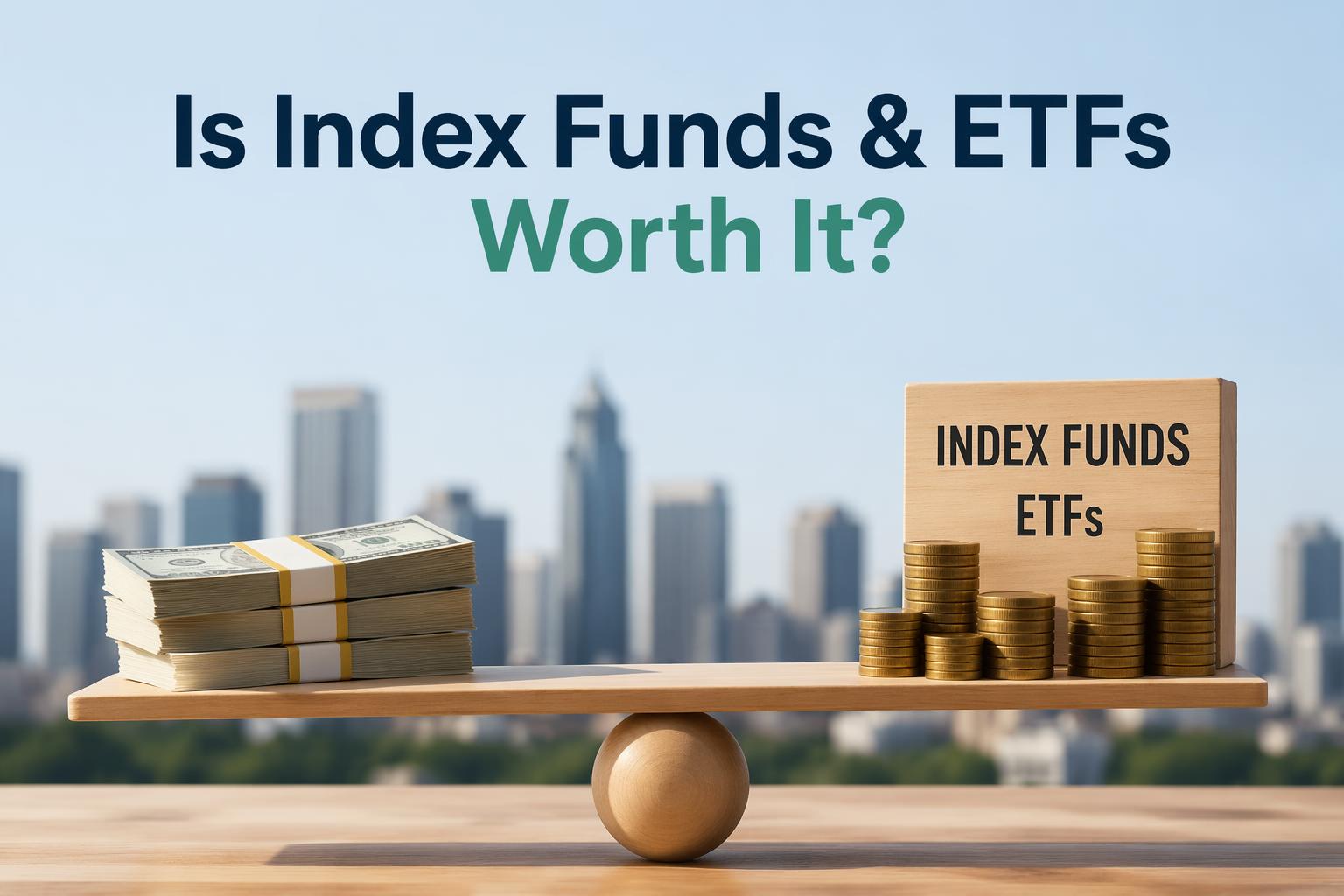
Table of Contents
- What Actually Are Index Funds & ETFs?
- The Case FOR Index Funds & ETFs in 2026
- When Index Funds & ETFs Aren’t Worth It
- The Real Cost: What You’re Actually Paying
- How to Pick Index Funds & ETFs That Don’t Suck
- FAQ: Your Burning Questions Answered
What Actually Are Index Funds & ETFs?
Let’s start with the basics, because the financial industry loves to make simple things sound complicated.
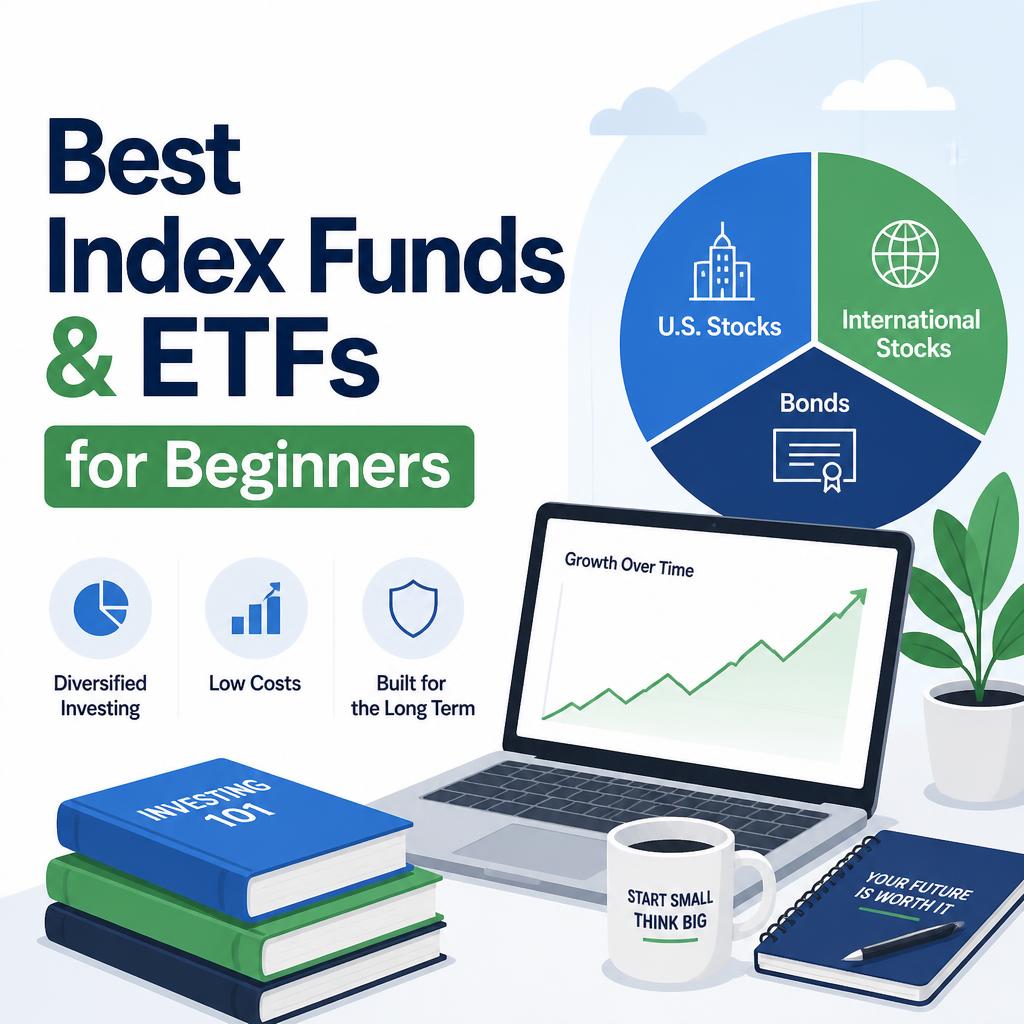
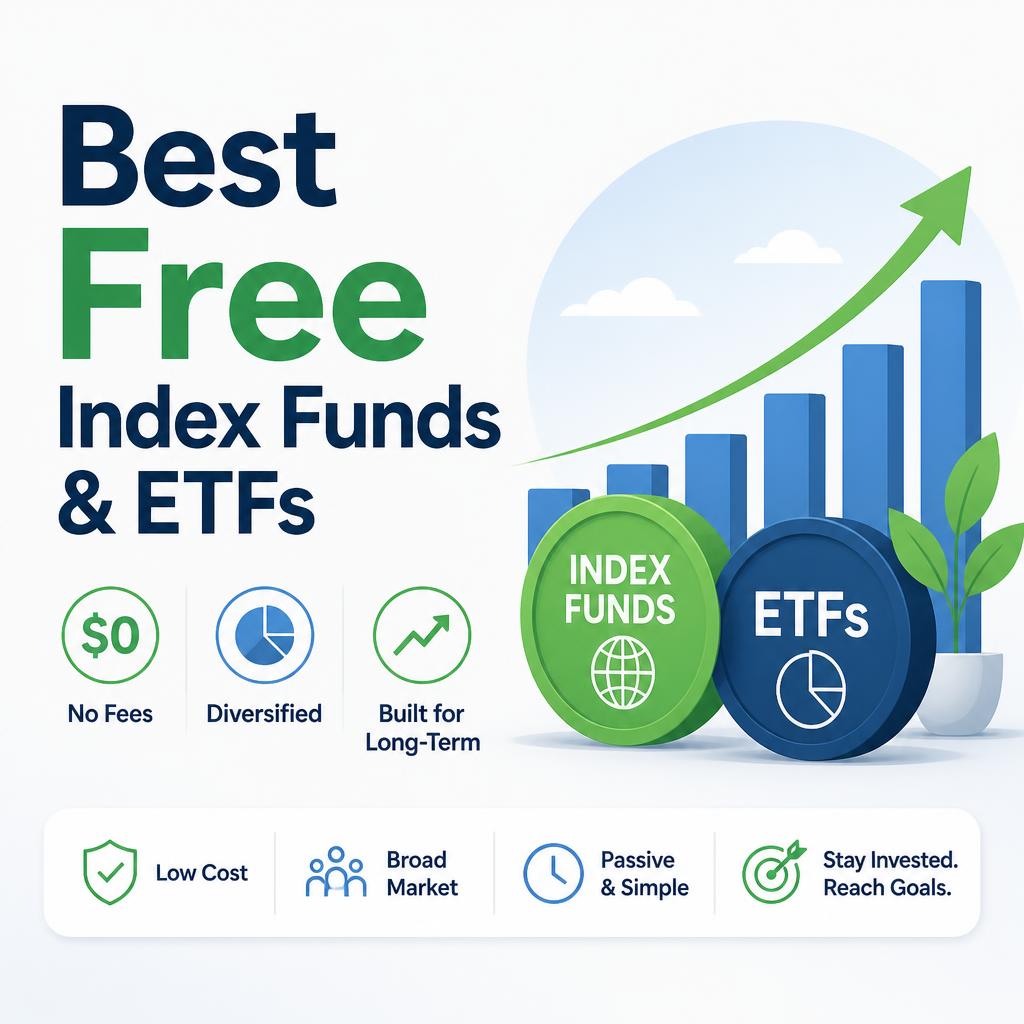
Index funds are mutual funds that track a market index—like the S&P 500 or the total U.S. stock market. You buy shares once per day at 4 p.m. ET at whatever price the market closes at. You can’t trade them throughout the day, and you can often set up automatic investments for exact dollar amounts (like $500 every month).
ETFs (exchange-traded funds) also track indexes, but they trade like stocks. You can buy and sell them any time the market is open, prices fluctuate throughout the day, and you typically buy whole shares (not fractional dollar amounts, though some brokers now offer fractional ETF shares).
Here’s the part that matters: both are passive investments. They don’t try to beat the market by picking individual stocks. They just own everything in the index they track, in the same proportions. Over 40% of all ETFs are passively managed, according to 2026 data.
The promise? Low costs, broad diversification, and the market’s average return—which historically has been around 10% per year for the S&P 500 since 1928.
But “worth it” depends on whether that promise holds up in your specific situation.
The Case FOR Index Funds & ETFs in 2026
Let’s start with why millions of investors swear by index funds and ETFs. The data from 2026 makes a pretty compelling argument.
Active Managers Keep Losing
In 2025, 79% of actively managed large-cap U.S. equity funds underperformed the S&P 500. Over the past 20 years? 92% of domestic active funds underperformed their benchmarks.
Translation: if you hire a fund manager to pick stocks for you, there’s a 9-in-10 chance they’ll do worse than if you’d just bought the index. And when you look at the 15-year window, less than 5% of active large-blend funds both survived and outperformed passive peers.
That’s not a rounding error. That’s a systemic failure of active management.
The Fees Are Absurdly Low
In 2026, the playing field for costs is better than it’s ever been:
- Index equity ETFs: 0.14% average expense ratio (asset-weighted)
- Index mutual funds: 0.05% average expense ratio in 2025
- Active equity mutual funds: 0.40% average expense ratio
The State Street SPDR Portfolio S&P 500 ETF (SPYM) charges just 2 basis points—that’s 0.02%. On a $10,000 investment, you’d pay $2 per year.
Compare that to an active fund charging 1.0% (not uncommon), and you’re paying $100 per year for the privilege of likely underperforming.
You Get Instant Diversification
Buy one share of a total market index fund or ETF, and you own thousands of companies across every sector. You’re not betting on Tesla or Apple or any single stock—you’re betting on the entire economy.
If one company goes bankrupt? You barely notice. If a sector crashes? The rest of your portfolio cushions the blow.
Tax Efficiency (Especially for ETFs)
ETFs have a structural advantage: they generally don’t owe capital gains taxes when investors cash out, thanks to a mechanism called “in-kind redemption.” That makes them more tax-efficient than most mutual funds, especially if you’re investing in a taxable brokerage account (not an IRA or 401(k)).
Index mutual funds are also more tax-efficient than active mutual funds, but ETFs take the crown here.
You Can’t Screw It Up
Here’s the uncomfortable truth: most investors are terrible at investing. They buy high when everyone’s excited, panic-sell during crashes, and chase last year’s hot fund.
Index funds and ETFs remove the temptation. You buy, you hold, you ignore the noise. Sticking to a long-term plan is better than chasing trends—and the data proves it.
When Index Funds & ETFs Aren’t Worth It
But let’s flip the script. There are real situations where index funds and ETFs are not the right answer, and pretending otherwise is dishonest.
You’re Trying to Beat the Market in the Short Term
If your goal is to double your money in six months or “get rich quick,” index funds will disappoint you. They deliver the market’s average return, nothing more. Some years that’s +30%, other years it’s -20%.
Active trading, options, or concentrated bets on individual stocks might get you there faster (or wipe you out entirely). But index funds won’t.
You Need Income Right Now
Most broad-market index funds and ETFs pay small dividends—typically 1-2% per year. If you’re retired and need to generate income today, a diversified portfolio of dividend-focused funds or bonds might make more sense.
The Fidelity Investment Grade Bond ETF (FIGB), for example, charges 36 basis points and is actively managed to provide flexibility across bond types. Bonds are harder to index than stocks, giving active bond managers an edge in some cases.
You’re Over-Concentrated Without Realizing It
Here’s a trap I see all the time: someone buys three “different” index funds and thinks they’re diversified, but all three funds hold the same mega-cap tech stocks (Apple, Microsoft, Nvidia, Amazon). When tech crashes, their entire portfolio craters.
People usually freeze or own overlapping funds due to choices in global funds. Avoid over-concentration in your portfolio—read the holdings before you buy.
The Fund You Picked Is Garbage
Not all index funds and ETFs are created equal. Some charge high fees for no reason. Some track obscure, illiquitous indexes. Some are tiny and at risk of being liquidated (larger, established ETFs are less likely to be liquidated).
If you picked a fund with a 0.75% expense ratio when a nearly identical fund charges 0.05%, you’re leaving money on the table for no reason.
The Real Cost: What You’re Actually Paying
Let’s talk about the number that actually matters: the expense ratio.
This is the annual fee you pay, expressed as a percentage of your investment. It’s automatically deducted from the fund’s returns, so you never see it as a line item—but you absolutely feel it over time.
Here’s what the 2026 landscape looks like:
Fund Type Average Expense Ratio Example Fund Fee on $10,000 Index equity ETF 0.14% SPDR S&P 500 (SPYM) at 0.02% $2/year Index mutual fund 0.05% Fidelity ZERO funds at 0.00% $0/year Active equity mutual fund 0.40% Typical active fund $40/year Bond ETF (active) 0.36% Fidelity Investment Grade Bond (FIGB) $36/year
- At 0.02% fees (SPYM): You end with $100,626
- At 0.40% fees (active fund): You end with $91,524
- Difference: $9,102 lost to fees
That’s nearly $10,000 gone—not because the active fund performed worse (we assumed the same 8% gross return), but purely because of higher fees.
And remember: 79% of active funds also underperform after fees, so in reality the gap is even worse.
Currency Risk and Withholding Tax
If you’re investing in international index funds or ETFs, there’s one more cost to watch: withholding tax on foreign dividends. Some countries automatically take a cut of dividends before they reach your fund.
The good news? Currency risk largely washes out for equities over long periods, so don’t let that scare you away from global diversification.
How to Pick Index Funds & ETFs That Don’t Suck
Alright, you’re convinced. Now what do you actually buy?
Step 1: Match the Fund to Your Goal
- Want total U.S. stock market exposure? Look for funds tracking the S&P 500 or total U.S. market indexes.
- Want global diversification? Consider funds like the SPDR MSCI All Country World Index (0.12% fee), Amundi Prime All Country World (0.07%), or Vanguard’s FTSE All-World (0.19%).
- Want bonds for stability? FIGB (0.36%) is actively managed and offers flexibility across bond types.
- Want a target-date fund? The iShares LifePath Target Date 2070 ETF (ITDJ) starts with 99% stocks and 1% bonds, gradually shifting to 60% bonds and 40% stocks by 2070. It charges just 13 basis points overall.
Step 2: Check the Expense Ratio
If you’re comparing two funds that track the same index, pick the cheaper one. The gap between the cheapest and most expensive funds can cost you tens of thousands over a retirement.
Step 3: Look at the Size and Liquidity
Larger, established ETFs are less likely to be liquidated. If a fund has less than $50 million in assets, that’s a red flag.
Step 4: Understand the Replication Method
Physical replication is the traditional tracking method: the fund actually buys all (or most of) the stocks in the index. This is the gold standard for accuracy.
Synthetic replication uses derivatives to mimic the index’s performance. It’s less common in the U.S. but more prevalent in Europe. Not inherently bad, but worth understanding.
Step 5: Set Up Automatic Investments (If Using Mutual Funds)
Index mutual funds let you set up automatic purchases for exact dollar amounts—like $500 every month. This is perfect for dollar-cost averaging and removes the temptation to time the market.
ETFs require you to buy whole shares (unless your broker offers fractional shares), so automation is trickier.
Step 6: Don’t Overthink It
Seriously. The difference between a 0.05% expense ratio and a 0.12% expense ratio will not make or break your retirement. Pick a low-cost, broad-market fund, invest consistently, and ignore the noise.
FAQ: Your Burning Questions Answered
Can I lose money in an index fund?
Yes. Index funds and ETFs go down when the market goes down. In a crash, you could lose 30-40% of your investment—on paper. But if you hold long-term, the market has historically recovered and then some.
Are ETFs cheaper than mutual funds?
Usually, but not always. Index mutual funds average 0.05% fees, while index ETFs average 0.14%. Some mutual funds (like Fidelity’s ZERO funds) charge literally 0.00%. Compare specific funds, not categories.
Should I choose ETFs or mutual funds for my Roth IRA?
Either works. ETFs are more tax-efficient, but that doesn’t matter in a Roth IRA (since it’s already tax-advantaged). If you want to automate exact-dollar contributions, mutual funds are easier. If you like trading flexibility, go with ETFs.
Which fund type is best for dollar-cost averaging?
Index mutual funds, because you can invest exact dollar amounts automatically. ETFs require whole shares, which makes precise automation harder (unless your broker supports fractional ETF shares).
What are the top US ETFs for 2026?
According to Morningstar’s 2026 analysis:
- State Street SPDR Portfolio S&P 500 ETF (SPYM): 2 basis points, best long-term U.S. stock exposure
- Fidelity Investment Grade Bond ETF (FIGB): 36 basis points, actively managed bond flexibility
- iShares LifePath Target Date 2070 ETF (ITDJ): 13 basis points, automated asset allocation for long-term investors
How do I know if an ETF will be liquidated?
Larger, established ETFs with billions in assets are rarely liquidated. Avoid tiny, niche ETFs with less than $50 million in assets—they’re at higher risk of closing.
Do I need multiple index funds or just one?
One global index fund (like an “all-world” fund) can cover everything. Multiple funds are fine if you want to tilt toward specific regions or sectors, but make sure you’re not accidentally over-concentrating in the same stocks.
—
The Bottom Line: Are They Worth It?
Here’s the truth: index funds and ETFs are worth it for most people, most of the time—but only if you pick the right ones, keep costs low, and stick with them through the boring middle years.
They’re not magic. They won’t make you rich overnight. But they give you a fighting chance to build wealth without getting fleeced by high fees or outsmarted by your own emotions.
In 2026, with expense ratios at historic lows and decades of data proving that passive beats active, the math is hard to argue with. Just don’t assume every index fund is created equal—and don’t be the person who buys three overlapping funds and calls it diversification.
Pick a low-cost, broad-market fund. Automate your contributions. Ignore the noise. And let compounding do the work.
That’s it. That’s the whole strategy. And yes, it’s worth it.