What Is a Brokerage Account? (And Why Most People Pick the Wrong One)
If you’ve ever Googled “how to start investing,” you’ve seen the term brokerage account thrown around like everyone already knows what it means. Most people don’t. That confusion is exactly why so many beginners either overpay in fees, pick platforms that don’t match their goals, or never start investing at all.
A brokerage account is your gateway to buying stocks, ETFs, bonds, and other investments. It’s not a bank account. It’s where you hold and trade securities. The problem? There are dozens of brokers, all claiming superiority, and most explanations assume you already understand the difference between a discount broker and a robo-advisor.
This guide breaks down what brokerage accounts actually are, how they work, which types exist, and how to pick one without wasting time or money. By the end, you’ll know exactly what you need and what you don’t.
Table of Contents
- What Is a Brokerage Account?
- How Brokerage Accounts Work
- Types of Brokerage Accounts
- Standard Brokerage vs. IRA: What’s the Difference?
- Full-Service vs. Discount Brokers vs. Robo-Advisors
- How to Pick the Right Brokerage Account in 2026
- Best Brokerage Accounts in 2026
- How to Open a Brokerage Account
- Common Mistakes People Make When Choosing a Broker
- FAQ
—
What Is a Brokerage Account?
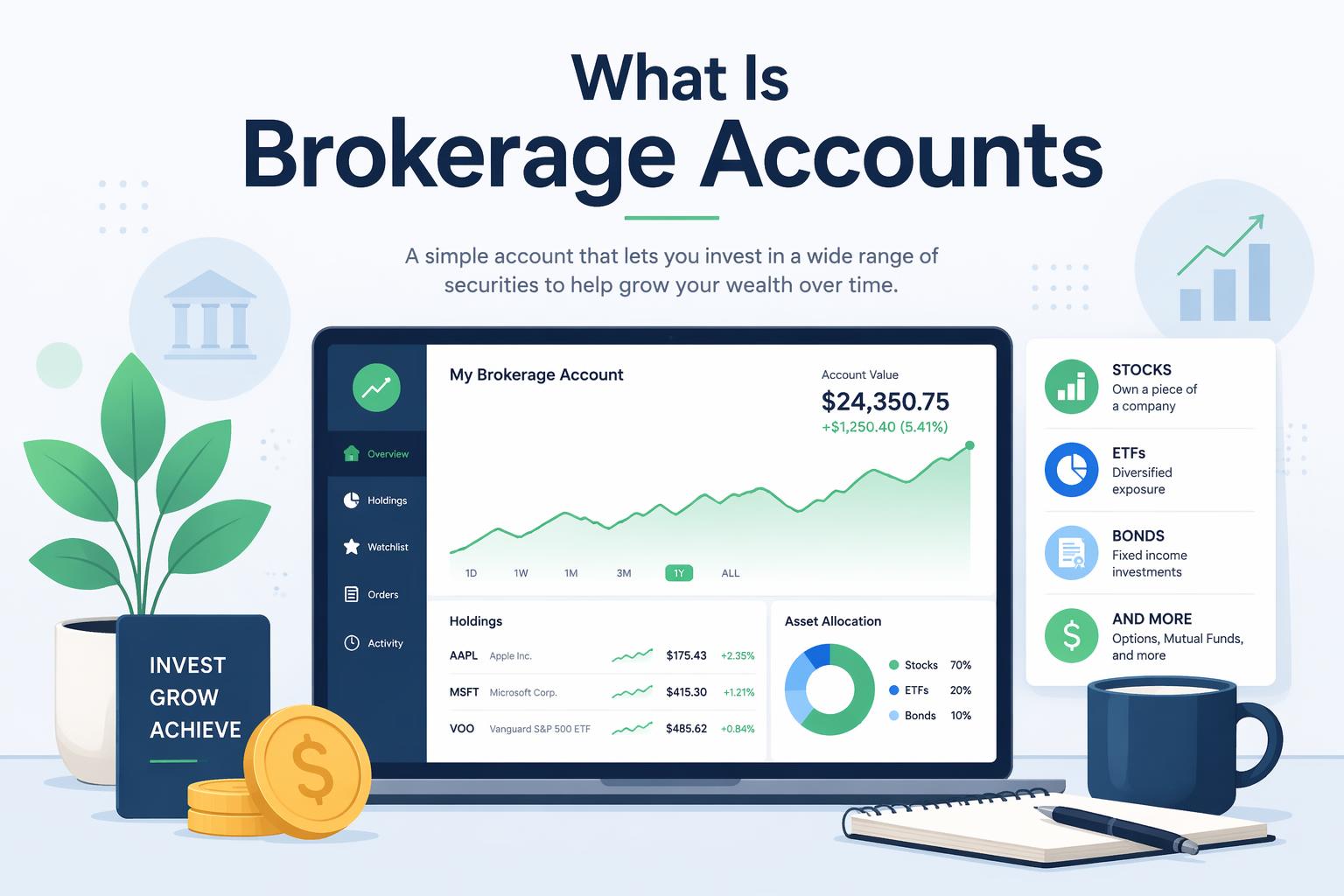
A brokerage account is an investment account that lets you buy and sell securities like stocks, bonds, ETFs, mutual funds, and sometimes cryptocurrencies. You deposit money into the account, then use that money to purchase investments through a brokerage firm.
Your bank account holds cash. Your brokerage account holds investments and the cash you haven’t deployed yet.
What makes brokerage accounts different from bank accounts:
- No FDIC insurance on investments. Your cash balance may be insured, but stocks and bonds are not. Instead, accounts are protected by SIPC (Securities Investor Protection Corporation) up to $500,000 per customer per firm if the brokerage fails. That doesn’t protect you from market losses.
- No limits on deposits or withdrawals. Standard brokerage accounts have no contribution caps. You can move money in and out whenever you want, unlike IRAs, which have annual limits and penalties for early withdrawal.
- Taxable by default. Any gains, dividends, or interest you earn are taxable in the year you realize them, unless the account is wrapped in a tax-advantaged structure like an IRA or 401(k).
Brokerage accounts are the most flexible way to invest. You’re not locked into employer plans, and you control what you buy, when you sell, and how much you put in.
—
How Brokerage Accounts Work
Opening a brokerage account is straightforward. You provide personal information (name, address, Social Security number), link a bank account, deposit money, and start trading.
The typical flow:
- You deposit cash from your bank into your brokerage account.
- You place an order to buy a stock, ETF, or other security.
- The broker executes the trade on your behalf, often within seconds.
- The investment appears in your account, and the cash is deducted.
When you sell, the process reverses. The broker sells your shares, and the proceeds land back in your cash balance. You can withdraw that cash to your bank or reinvest it.
What happens behind the scenes
Your broker doesn’t physically hold stock certificates for you. Instead, securities are held in “street name,” the broker’s name, on your behalf. You still own the shares, but the broker is the custodian. This setup makes trading fast and electronic.
Most brokers also offer margin accounts, which let you borrow money to buy more securities than your cash balance would allow. Margin amplifies both gains and losses, and it comes with interest charges. Beginners should avoid margin until they understand the risks.

—
Types of Brokerage Accounts
Not all brokerage accounts are the same. The structure you choose affects taxes, contribution limits, and when you can access your money.
1. Standard brokerage account (taxable account)
This is the default. No contribution limits, no withdrawal penalties, no age restrictions. You pay taxes on gains, dividends, and interest in the year you earn them.
Use this for money you might need before retirement, once you’ve maxed out tax-advantaged accounts, or if you want total flexibility.
2. Individual retirement account (IRA)
IRAs are tax-advantaged wrappers around a brokerage account. You get the same investment options, but the tax treatment is different.
- Traditional IRA: Contributions may be tax-deductible now. You pay taxes when you withdraw in retirement. Annual contribution limit applies.
- Roth IRA: Contributions are made with after-tax dollars. Withdrawals in retirement are tax-free. Income limits apply.
Both types penalize early withdrawals (before age 59½) with a 10% penalty, plus taxes on Traditional IRA distributions.
Use IRAs for long-term retirement savings if you want tax benefits.
3. Joint brokerage account
Owned by two people, most often spouses. Both have access, and ownership transfers automatically to the surviving account holder.
Good for couples managing shared investments.
4. Custodial account (UGMA/UTMA)
An adult manages the account for a minor. When the child reaches the age of majority (18 or 21, depending on the state), control transfers to them.
Useful for parents saving for a child’s future.
—
Standard Brokerage vs. IRA: What’s the Difference?
The biggest difference is taxes and flexibility.
Feature Standard Brokerage IRA (Traditional or Roth) Contribution limit None Yes (annual cap) Withdrawal penalty No Yes (before 59½) Tax treatment Taxable each year Tax-deferred or tax-free Flexibility Total Restricted
—
Full-Service vs. Discount Brokers vs. Robo-Advisors
The broker you choose determines how much control you have, how much you pay, and what kind of help you get.
Full-service brokers
These firms offer personalized advice, portfolio management, and financial planning. You get a dedicated advisor, but you pay for it, often 1% of assets under management annually, plus higher trading fees.
Good for high-net-worth investors who want hands-off management or people who value personal relationships and tailored advice.
Examples: Morgan Stanley, Merrill Lynch, UBS
Discount brokers
These are self-directed platforms. You make your own decisions, execute your own trades, and pay lower fees. Most charge $0 commissions on U.S. stocks and ETFs in 2026.
Good for DIY investors who don’t need advice or anyone who wants to keep costs low.
Examples: Fidelity, Charles Schwab, E*TRADE, Robinhood, Interactive Brokers
Robo-advisors
Robo-advisors use algorithms to build and manage your portfolio. You answer a few questions about your goals and risk tolerance, and the platform invests for you. Fees are low (around 0.25% to 0.50% annually), but you don’t get human advice.
Good for hands-off investors who want automatic rebalancing or beginners who don’t know what to buy.
Examples: Betterment, Wealthfront, SoFi Invest
—
How to Pick the Right Brokerage Account in 2026
Choosing a broker isn’t about finding “the best one.” It’s about finding the one that fits your investing style, experience level, and goals.
1. Know your investing style
Are you a trader who checks the market daily? Or a passive investor who buys index funds and ignores the noise?
Active traders need advanced tools, fast execution, and access to options, futures, or margin. Passive investors need simplicity, low fees, and automatic investing features.
2. Check the fees
Most brokers charge $0 commissions on U.S. stocks and ETFs in 2026, but fees still hide in other places:
- Options contracts: Around $0.50 to $0.65 per contract
- Mutual fund fees: Some brokers charge transaction fees for certain funds
- Account maintenance fees: Rare, but some brokers charge inactivity fees
- Margin interest: If you borrow to invest, you’ll pay interest
Compare the total cost, not just the headline commission.
3. Look at the investment selection
Not all brokers offer the same assets. If you want to trade:
- Stocks and ETFs: Every broker has these
- Options: Most brokers support options, but some (like Public) offer rebates for trading them
- Cryptocurrencies: Robinhood, Webull, and a few others let you trade crypto in the same app
- Fractional shares: Fidelity, Robinhood, SoFi, and others let you buy partial shares with as little as $1
- Over-the-counter (OTC) securities: Only advanced platforms like Interactive Brokers offer these
4. Test the platform
A clunky interface will frustrate you. Most brokers let you open an account with $0 and explore before funding it. Some, like Webull, offer paper trading, a practice mode with $1 million in fake money so you can test strategies without risk.
5. Consider customer support
If something breaks, can you get help? Charles Schwab offers 24/7 phone support. Robinhood relies on email and in-app chat, which can be slow. If you’re new, prioritize brokers with live support.
6. Check for educational resources
Beginners benefit from brokers that teach. E*TRADE offers webinars and daily market discussions. Fidelity has research tools and screeners. Robinhood has a slick interface, and that’s about it.
—
Best Brokerage Accounts in 2026
What the top brokers look like in 2026, based on current data:
Fidelity
- Rating: 5.0
- Fees: $0 commissions on U.S. stocks and ETFs
- Account minimum: $0
Fidelity works well for beginners and offers solid research tools. The app is clean, the educational content is strong, and there are no hidden fees.
Robinhood
- Rating: 4.5
- Fees: $0 commissions
- Account minimum: $0
Robinhood has a slick interface and works for beginners who want to start small. It supports fractional shares and crypto, but customer support is weak.
E*TRADE
- Rating: 4.5
- Fees: $0 commissions
- Account minimum: $0
E*TRADE provides extensive educational resources and webinars. If you want to learn while you invest, this is the platform.
Webull
- Rating: 5.0
- Fees: $0 commissions
- Account minimum: $0
Webull’s paper trading feature allows you to practice with $1 million in play money before risking real cash. The platform is fast, customizable, and packed with research tools.
SoFi Active Investing
- Rating: 4.6
- Fees: $0 commissions; $10/month for financial planning access
- Account minimum: $0
SoFi offers unlimited access to a financial planner for $10/month. If you want low-cost advice without paying a full 1% AUM fee, this is a solid middle ground.
Public
- Rating: 4.4
- Fees: $0 commissions; rebates for options trading
- Account minimum: $0
Public offers rebates for trading options, which can offset costs. It’s not the most feature-rich platform, but if you trade options frequently, the rebates add up.
Charles Schwab
- Rating: 4.9
- Fees: $0 commissions
- Account minimum: $0
Schwab offers 24/7 support and educational resources. If you value being able to call someone when things go wrong, Schwab delivers.
Interactive Brokers
- Rating: 5.0
- Fees: $0 commissions on U.S. stocks
- Account minimum: $0
Interactive Brokers gives you access to over-the-counter securities, international markets, and advanced order types. If you know what you’re doing, this is the most powerful platform.
—
How to Open a Brokerage Account
Opening an account takes about 10 minutes.
- Choose your broker. Use the criteria above to narrow it down.
- Provide personal information. You’ll need your name, address, Social Security number, and employment details.
- Link your bank account. This is how you’ll transfer money in and out.
- Fund the account. Most brokers let you start with $0, but you’ll need cash to buy anything.
- Start trading. Once your deposit clears, you can place your first order.
Most brokers approve accounts instantly. If they need to verify your identity, it might take a day or two.
—
Common Mistakes People Make When Choosing a Broker
1. Picking based on hype alone
Robinhood exploded in popularity because of its slick app and meme stock hype. But it’s not the right fit for everyone. If you need research tools or phone support, Robinhood will frustrate you.
2. Ignoring fees beyond commissions
$0 commissions sound appealing until you realize your broker charges $0.65 per options contract or a $50 transfer-out fee. Read the fee schedule.
3. Opening an account without testing the platform
A clunky interface will make you hate investing. Open a demo account or paper trade first.
4. Choosing a broker that doesn’t match your skill level
Interactive Brokers is powerful, but beginners will drown in its complexity. Fidelity and Robinhood are better starting points.
5. Not checking SIPC coverage
SIPC protection is capped at $500,000 per customer per firm. If you have more than that, consider spreading assets across multiple brokers.
—
FAQ
How much money do I need to open a brokerage account?
Most brokers in 2026 have $0 account minimums. You can open an account without depositing anything, but you’ll need cash to buy investments.
Is my money insured at brokerage firms?
Your cash balance may be FDIC-insured if held in a bank sweep account. Securities are protected by SIPC up to $500,000 per customer per firm if the brokerage fails, but SIPC does not protect you from market losses.
Is the cheapest broker always the right choice?
No. Cheap brokers sometimes cut corners on customer support, research tools, or platform stability. The right broker fits your needs, not just your budget.
How quickly can I start trading with an online broker?
Most brokers approve accounts instantly. Your first deposit clears within 1-3 business days, but some brokers give you instant buying power while the transfer processes.
Can I have multiple brokerage accounts?
Yes. Many investors use multiple brokers to take advantage of different features: one for long-term investing, another for active trading, or a third for a Roth IRA.
What’s the difference between a standard brokerage account and an IRA?
Standard brokerage accounts have no contribution limits or withdrawal penalties, but gains are taxed annually. IRA accounts have annual contribution limits and penalties for early withdrawal, but offer tax benefits.
Do I need a financial advisor, or can I invest on my own?
It depends. If you’re comfortable researching investments and managing your own portfolio, a discount broker is enough. If you want personalized advice, consider a full-service broker or a robo-advisor.
What happens if my broker goes out of business?
SIPC protects your account up to $500,000 if the broker fails. Your securities are transferred to another broker, and any cash balance is returned.