The Ultimate Guide to Cheapest Dividend Investing: Maximizing Returns Without Breaking the Bank
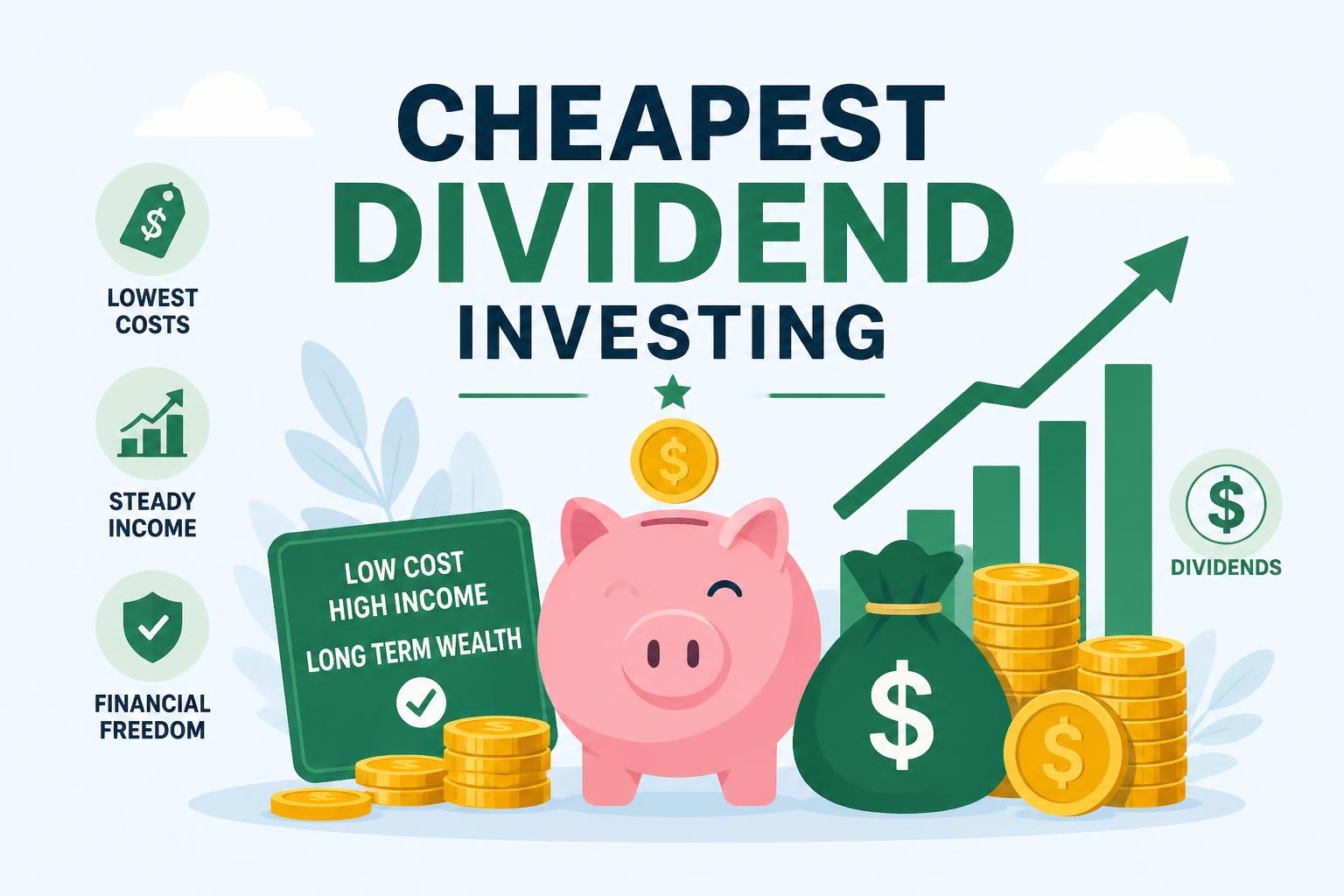
Dividend investing doesn’t have to drain your wallet. Some of the most effective dividend strategies cost pennies compared to traditional approaches. If you’re trying to pick the right strategy without overpaying, you’re in the right place.
Understanding Low-Cost Dividend Investing
Successful dividend investing isn’t about expensive fund managers or hefty commissions. It’s about building a portfolio of quality dividend-paying assets while keeping costs down.
Every dollar spent on fees and commissions is a dollar that could compound for you. Over decades, these costs can rob you of tens or hundreds of thousands in potential wealth.
Why Cost Matters More Than You Think
A 1% annual fee might not sound like much, but over 30 years on a $100,000 investment growing at 7% annually, that 1% could cost you over $200,000 in lost returns. That’s money that could have compounded and generated more dividends.
Low-cost dividend investing focuses on three core principles:
- Minimize trading costs through commission-free brokers
- Reduce fund expenses by choosing low-cost ETFs and index funds
- Optimize tax efficiency to keep more of your dividend income
The Best Low-Cost Dividend Investment Vehicles
Dividend ETFs: Your Most Affordable Option
ETFs have changed the game for cost-conscious investors. Unlike traditional mutual funds with high expense ratios and sales loads, dividend ETFs typically charge 0.03% to 0.06% annually.
Popular low-cost options include:
- Vanguard Dividend Appreciation ETF (VIG): Expense ratio of 0.06%
- Schwab U.S. Dividend Equity ETF (SCHD): Expense ratio of 0.06%
- Vanguard High Dividend Yield ETF (VYM): Expense ratio of 0.06%
These funds give you instant diversification across dozens or hundreds of dividend-paying stocks, eliminating the need to purchase individual shares and pay multiple commissions.
Individual Dividend Stocks: When DIY Makes Sense
With commission-free trading now standard at major brokers like Fidelity, Charles Schwab, and Robinhood, buying individual dividend stocks has never been cheaper. This works best when you have enough capital to build a diversified portfolio of at least 15-20 stocks.
The key is selecting quality dividend aristocrats—companies that have increased their dividends for 25+ consecutive years. These businesses typically offer stable cash flows, strong competitive advantages, proven management teams, and sustainable payout ratios.
Commission-Free Brokers: The Game Changer
The brokerage industry’s shift to zero-commission trading has eliminated one of the biggest barriers to affordable dividend investing. Previously, buying $500 worth of stock might cost you $7-10 in commissions, a 1.4-2% immediate loss.
Today’s top commission-free brokers for dividend investors:
Fidelity offers fractional shares, automatic dividend reinvestment, and robust research tools—all with zero commissions on stocks and ETFs.
Charles Schwab provides commission-free trading, solid customer service, and access to thousands of mutual funds with no transaction fees.
Robinhood has an ultra-simple interface ideal for beginners, though it lacks some advanced features serious dividend investors may want.
M1 Finance uses a unique “pie” investing approach that automates portfolio rebalancing and dividend reinvestment.
The DRIP Strategy: Compound Growth on Autopilot
Dividend Reinvestment Plans (DRIPs) are the ultimate set-it-and-forget-it strategy for cheap dividend investing. Instead of receiving cash dividends, you automatically reinvest them to purchase additional shares—often with no commissions.
Many companies offer direct stock purchase plans (DSPPs) that let you bypass brokers and buy shares directly from the company. These plans typically charge minimal or zero fees, allow fractional share purchases, enable automatic monthly investments, and reinvest dividends commission-free.
Over time, this creates a powerful snowball effect. Your dividends buy more shares, which generate more dividends, which buy even more shares—all without any action or cost on your part.
Tax-Efficient Dividend Investing Strategies
Reducing your tax burden is as important as minimizing fees. Here’s how to keep more of your dividend income:
Qualified vs. Ordinary Dividends
Not all dividends are taxed equally. Qualified dividends—those paid by U.S. companies and certain foreign corporations—get preferential tax treatment, with rates of 0%, 15%, or 20% depending on your income. This beats ordinary dividend tax rates, which match your regular income tax bracket.
Strategic Account Placement
Where you hold your dividend investments matters:
Roth IRA: Your best option for dividend growth stocks. All dividends and capital gains grow tax-free forever. Once you reach retirement age, withdrawals are completely tax-free.
Traditional IRA/401(k): Good for high-yield dividend investments since you defer taxes until withdrawal. However, all distributions are taxed as ordinary income, regardless of whether they were qualified dividends.
Taxable Accounts: Best for qualified dividend payers and dividend growth stocks you plan to hold long-term. You’ll benefit from lower qualified dividend tax rates and long-term capital gains treatment.
Building a Low-Cost Dividend Portfolio
Starting with a budget-friendly dividend portfolio doesn’t require a fortune. Here’s a practical approach for investors at different capital levels:
Starting with $1,000
At this level, focus on low-cost dividend ETFs to get instant diversification. A simple two-fund portfolio might include:
- 70% SCHD (U.S. dividend growth)
- 30% VYMI (International high dividend yield)
This gives you exposure to hundreds of quality dividend payers across multiple sectors and geographic regions.
Growing to $5,000
As your portfolio grows, you can add individual dividend aristocrats while keeping a core ETF position. Consider:
- 50% in dividend ETFs (SCHD, VYM)
- 50% in 10-15 individual dividend aristocrats
This hybrid approach balances the simplicity of ETFs with the potential for higher yields from carefully selected individual stocks.
Reaching $10,000+
With more substantial capital, you can build a comprehensive dividend portfolio:
- Core holdings in dividend ETFs (40%)
- Individual dividend aristocrats (40%)
- REITs for diversification and higher yields (10%)
- International dividend stocks (10%)
Common Mistakes That Cost Dividend Investors Money
Chasing High Yields
A 10% dividend yield might look tempting, but it often signals trouble. Unsustainably high yields typically result from falling stock prices due to business problems, unstable earnings that can’t support the dividend, or one-time special dividends that won’t repeat.
Focus on dividend growth rate rather than current yield. A stock yielding 2% with 10% annual dividend growth will eventually outearn a stock with a 5% yield and no growth.
Overtrading
Even with commission-free trading, excessive buying and selling generates tax liabilities and prevents you from benefiting from long-term compound growth. The best dividend investing strategy is often the most boring: buy quality companies and hold them for decades.
Ignoring Expense Ratios
A difference of 0.5% in expense ratios compounds dramatically over time. Always compare expense ratios when choosing between similar dividend funds. For more on selecting the best dividend investing strategies, research fund costs carefully.
Neglecting Diversification
Putting all your money into high-yield sectors like utilities or REITs exposes you to concentrated risk. A well-diversified dividend portfolio spans multiple sectors, different market capitalizations, various geographic regions, and a mix of high yield and dividend growth.
Advanced Cost-Saving Techniques
Dollar-Cost Averaging
Rather than investing a lump sum all at once, dollar-cost averaging spreads your investments over time. This reduces the risk of poor market timing, helps you buy more shares when prices are low, creates disciplined investing habits, and works perfectly with automatic investment plans.
Many brokers offer automatic investment programs that execute your dollar-cost averaging strategy with zero effort or cost.
Tax-Loss Harvesting
In taxable accounts, strategically selling positions at a loss can offset dividend income and capital gains, reducing your tax bill. With commission-free trading, you can harvest losses without worrying about transaction costs.
The key is avoiding wash sales by not repurchasing the same security within 30 days. Instead, you can immediately purchase a similar but not substantially identical investment to maintain market exposure.
Minimizing Turnover
Fund turnover—how frequently a fund buys and sells its holdings—generates taxable events and trading costs. Look for dividend funds with low turnover rates (under 20% annually) to minimize these hidden costs.
Index-based dividend ETFs typically have much lower turnover than actively managed funds, resulting in greater tax efficiency and lower expenses.
Getting Started Today
The cheapest way to begin dividend investing is simple:
- Open a commission-free brokerage account with Fidelity, Schwab, or M1 Finance
- Fund your account with whatever amount you can afford—even $100 is enough to start
- Purchase a low-cost dividend ETF like SCHD or VYM
- Enable automatic dividend reinvestment to compound your returns
- Set up automatic monthly contributions to dollar-cost average over time
This approach costs virtually nothing in fees, requires minimal time, and sets you on the path to building sustainable dividend income.
The Long-Term Impact of Low-Cost Investing
The difference between high-cost and low-cost dividend investing becomes staggering over time. Consider two investors who each invest $10,000 annually for 30 years, both earning 7% before fees:
Investor A (low-cost approach with 0.1% fees): Portfolio value after 30 years: $944,608
Investor B (high-cost approach with 1.1% fees): Portfolio value after 30 years: $775,697
That 1% fee difference costs Investor B $168,911—nearly six years of contributions lost to unnecessary expenses.
Conclusion: Cheap Doesn’t Mean Inferior
The cheapest dividend investing strategies aren’t inferior—they’re often superior precisely because they minimize the costs that erode your returns. By combining commission-free trading, low-cost ETFs, tax-efficient account placement, and automatic dividend reinvestment, you can build a powerful dividend portfolio that generates growing passive income for decades.
The best time to start was yesterday. The second-best time is today. Open that brokerage account, make your first investment, and begin your journey toward financial independence through smart, low-cost dividend investing.
In dividend investing, every penny saved in fees is a penny that can be reinvested to generate more dividends. Over time, those pennies become dollars, and those dollars become tens of thousands in additional wealth. Choose the low-cost path—your future self will thank you.