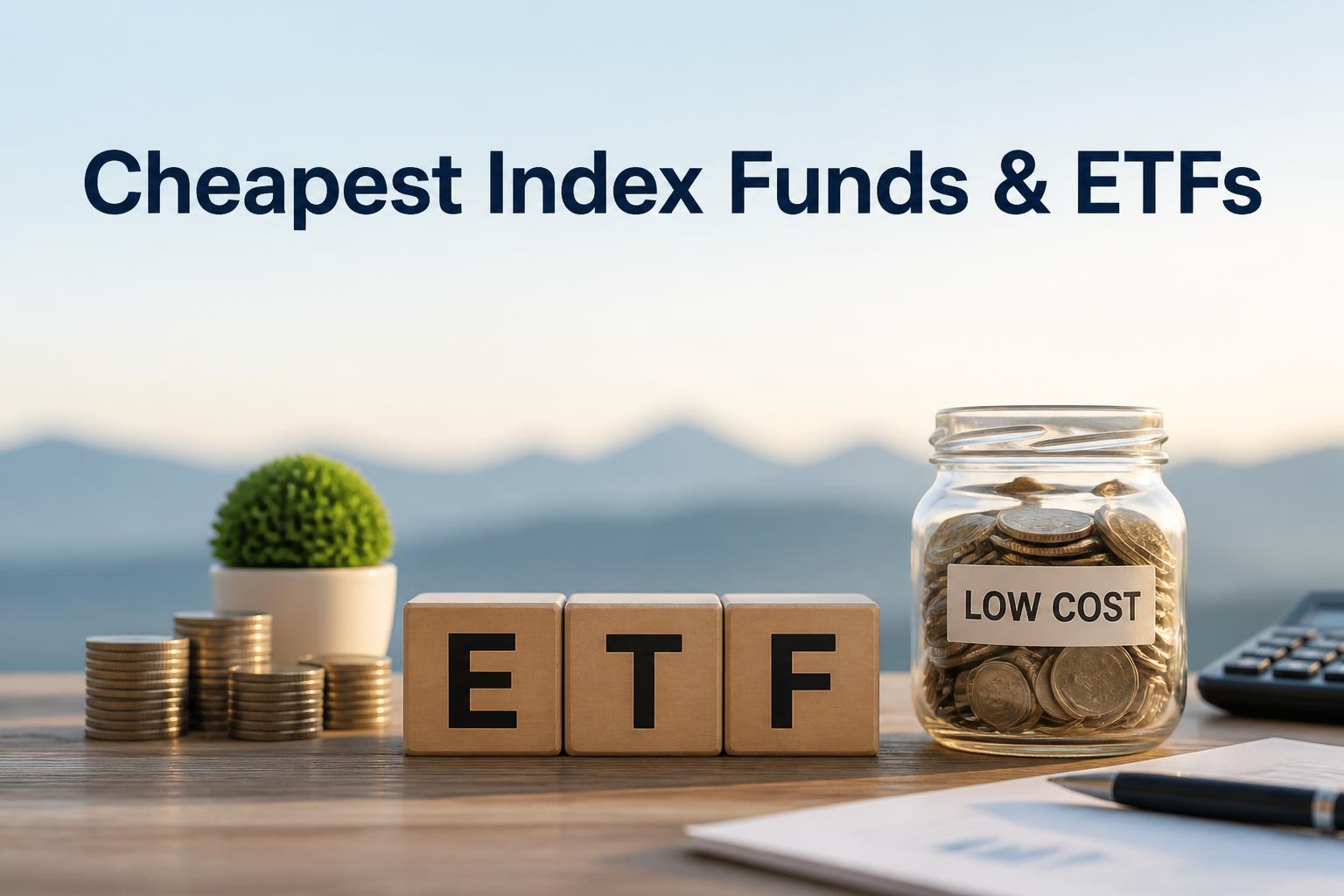
The Ultimate Guide to the Cheapest Index Funds & ETFs: Maximize Returns, Minimize Costs
Every dollar you pay in fees can’t compound. A $10,000 investment at 7% for 30 years becomes $76,123. Pay just 0.50% more in annual fees and you end up with $65,980. That’s $10,000 gone.
This guide shows you the cheapest index funds and ETFs available, so you can build a solid portfolio without overpaying.
Why fees matter
High fees compound against you. An expense ratio is the annual fee as a percentage of your investment. A 0.03% ratio costs $3 per year on $10,000 invested. A 0.50% ratio costs $50.
Index funds cost less than actively managed funds because they track an index instead of paying analysts to pick stocks. But even among index funds, costs vary.
The cheapest funds run below 0.10%, with many at 0.03% or lower.
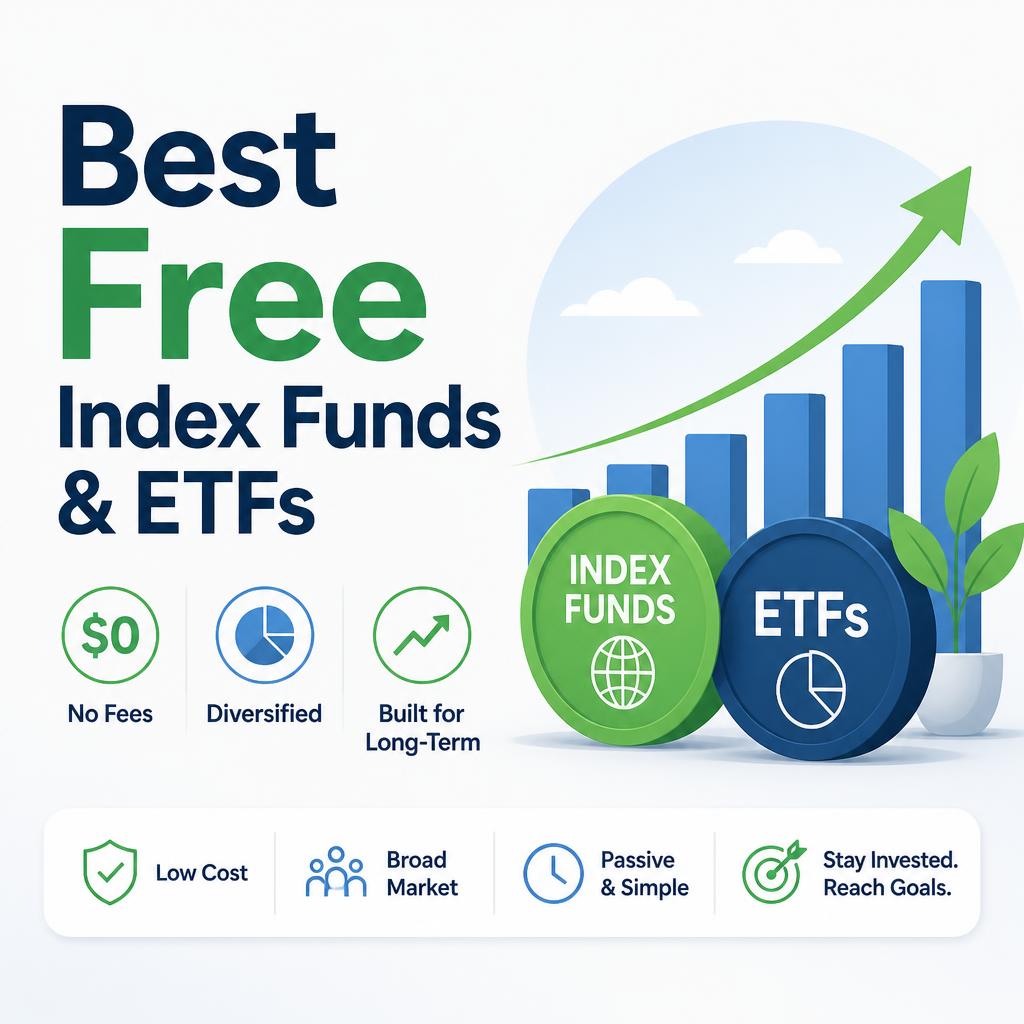
The 7 cheapest index funds & ETFs
1. Vanguard S&P 500 ETF (VOO)
Expense Ratio: 0.03%
VOO tracks the S&P 500 — 500 of America’s largest companies. Over $400 billion in assets, tight bid-ask spreads, near-perfect tracking.
2. Fidelity ZERO Large Cap Index Fund (FNILX)
Expense Ratio: 0.00%
Zero fees. FNILX tracks Fidelity’s U.S. Large Cap Index. Only available to Fidelity customers, can’t be transferred to other brokerages, and doesn’t track the S&P 500 exactly. But if you’re already at Fidelity, it’s hard to beat.
3. Schwab U.S. Broad Market ETF (SCHB)
Expense Ratio: 0.03%
SCHB tracks nearly 2,500 U.S. stocks across all market caps — more comprehensive than S&P 500-only funds. Includes small and mid-cap alongside large cap.
4. iShares Core S&P Total U.S. Stock Market ETF (ITOT)
Expense Ratio: 0.03%
ITOT covers the entire U.S. equity market, roughly 3,500 stocks. Managed by BlackRock.
5. Vanguard Total Stock Market ETF (VTI)
Expense Ratio: 0.03%
VTI tracks about 4,000 U.S. stocks — large, mid, small, and micro-cap. Over $400 billion in assets. Probably the most popular total market ETF.
6. Schwab International Index Fund (SWISX)
Expense Ratio: 0.06%
SWISX tracks the MSCI EAFE Index: developed markets outside North America, including Europe, Australia, and the Far East. Reduces your U.S. concentration.
7. Vanguard Total Bond Market ETF (BND)
Expense Ratio: 0.03%
BND tracks U.S. investment-grade bonds. Stabilizes your portfolio when stocks drop and generates income.
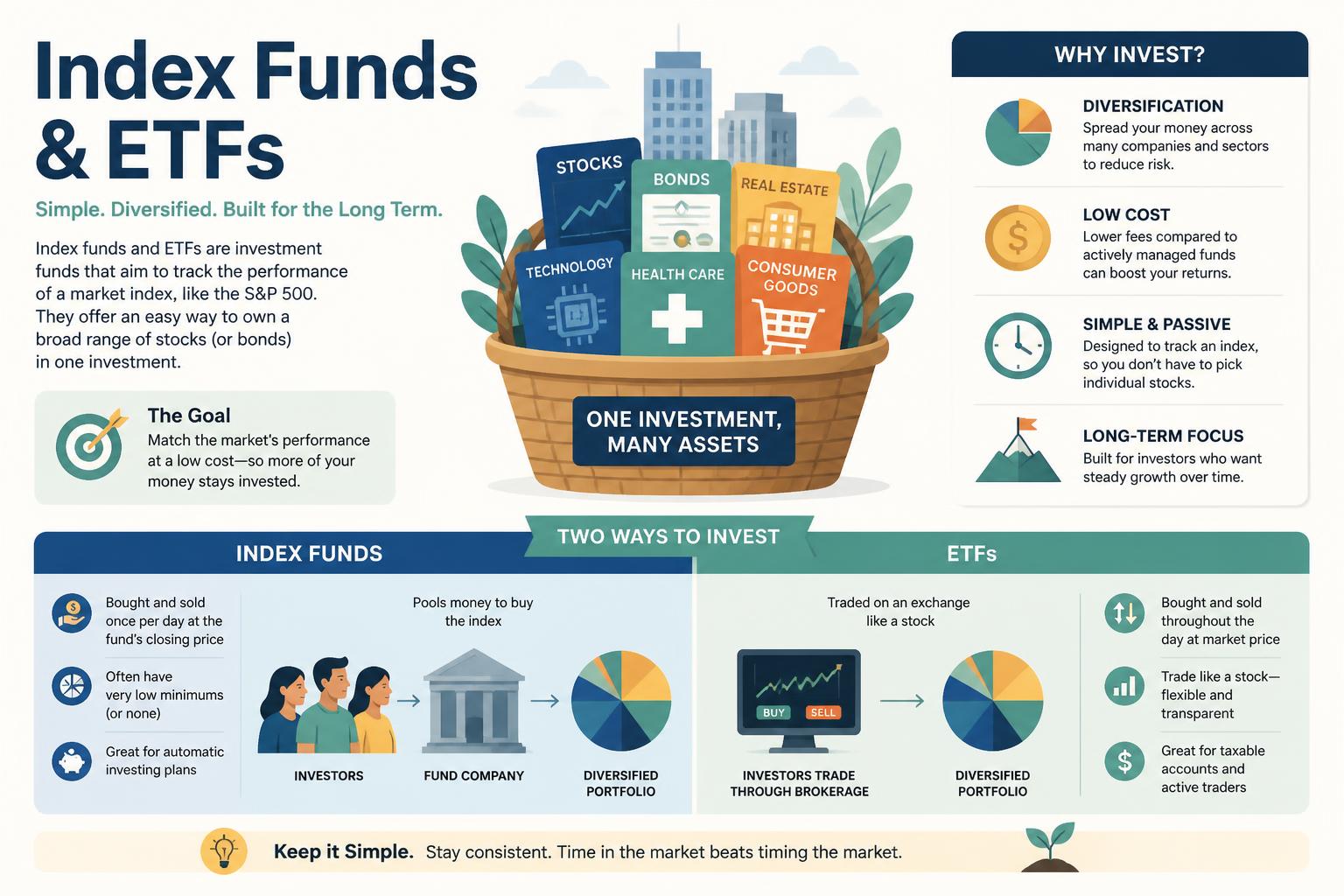
Index funds vs. ETFs
Both can be ultra-low-cost. The differences:
Index mutual funds:
- Trade once per day at market close
- Easy to automate
- May have minimums
- Fractional shares always available
ETFs:
- Trade throughout the day
- No minimums (buy one share)
- More tax-efficient
- Bid-ask spreads to watch
For most long-term investors, the cost difference is negligible. Choose based on your platform and how you like to invest.
Build a portfolio with cheap index funds
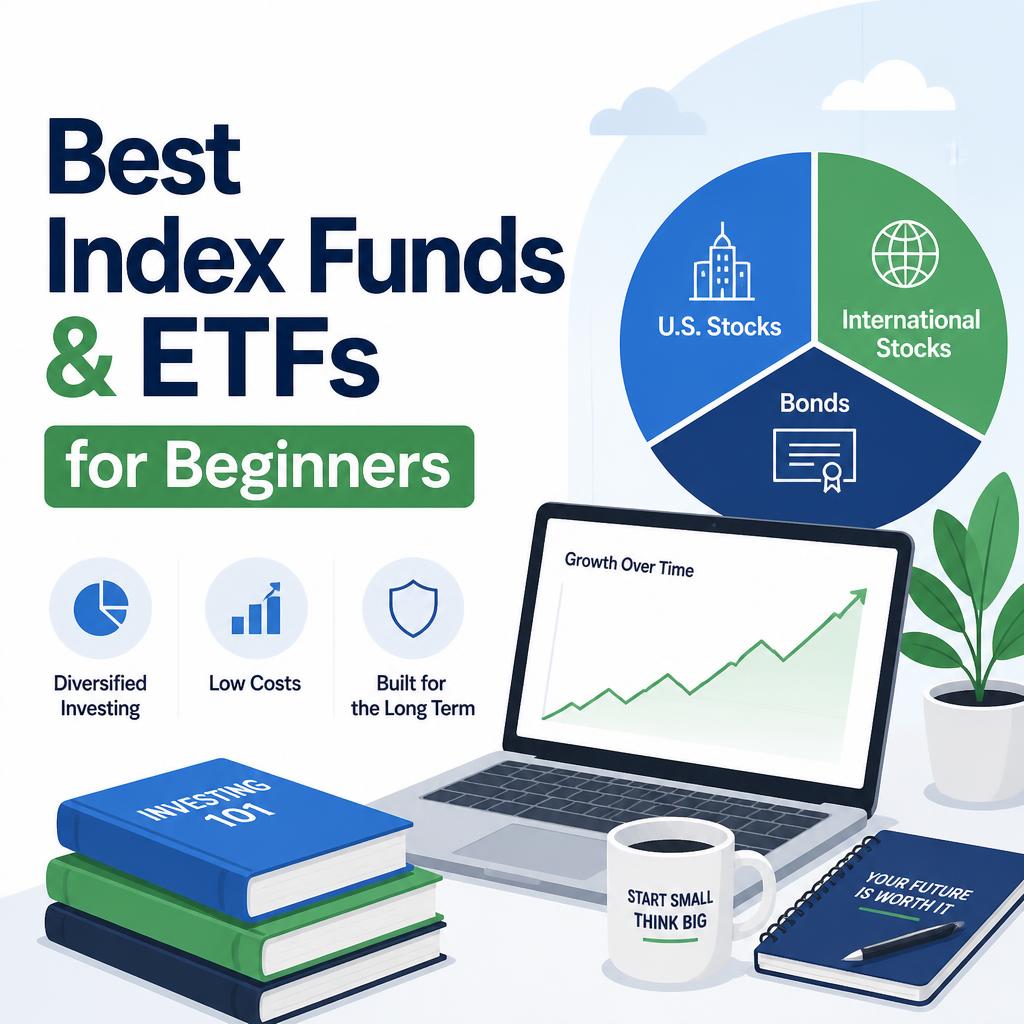
You don’t need dozens of holdings. Here’s a simple three-fund approach:
Conservative (age 60+):
- 40% U.S. stocks (VTI or SCHB)
- 20% International stocks (SWISX)
- 40% Bonds (BND)
- Blended expense ratio: 0.036%
Moderate (age 40-60):
- 55% U.S. stocks
- 25% International stocks
- 20% Bonds
- Blended expense ratio: 0.039%
Aggressive (age 20-40):
- 70% U.S. stocks
- 30% International stocks
- 0% Bonds
- Blended expense ratio: 0.039%
Each portfolio costs less than $4 per year for every $10,000 invested.
How to actually save money
Picking cheap funds is only part of it.
Choose the right brokerage. Vanguard, Fidelity, and Schwab offer commission-free trading on their funds and ETFs. Avoid brokers that charge transaction fees.
Minimize trading. Even with no commissions, excessive trading costs you through bid-ask spreads, tax consequences, and lost time in the market. Buy and hold. Rebalance once or twice a year at most.
Avoid fund overlap. Holding both VOO (S&P 500) and VTI (total market) is redundant. The S&P 500 makes up about 80% of VTI, so you’re doubling up while paying two expense ratios.
Use tax-loss harvesting. In taxable accounts, harvest losses to offset gains. Just don’t repurchase the same security within 30 days (wash sale rule).
Max out tax-advantaged accounts first. IRAs and 401(k)s provide tax benefits that dwarf any expense ratio savings.
When “cheap” isn’t cheap
Watch for:
Poor tracking. A fund with a 0.05% expense ratio that consistently underperforms its benchmark by 0.30% costs more than a 0.10% fund with perfect tracking.
Low liquidity. Wide bid-ask spreads on ETFs effectively raise costs.
Proprietary indexes. Some funds track non-standard indexes that deviate from market benchmarks. Know what you’re buying.
Hidden restrictions. Zero-fee funds might lock you into a brokerage or have other limits.
New funds. A 0.02% expense ratio means nothing if the fund shuts down in two years.
Competition driving costs lower
Vanguard, Fidelity, Schwab, and BlackRock keep cutting costs to attract assets. Multiple providers now offer funds under 0.05%. Fidelity’s zero-fee funds forced competitors to respond. Fees have moved in one direction: down.
Your action plan
Step 1: Open an account at Vanguard, Fidelity, or Schwab.
Step 2: Decide your asset allocation based on age, risk tolerance, and goals.
Step 3: Pick 2-4 low-cost funds covering U.S. stocks, international stocks, and bonds (if appropriate).
Step 4: Set up automatic investments or schedule regular purchases.
Step 5: Review annually. Rebalance only when allocations drift significantly.
Step 6: Stay the course through volatility.
For more guidance on selecting funds for your situation, check out our guide on best index funds & etfs.
Common mistakes
Overthinking allocation. The difference between 80/20 and 70/30 stock/bond split matters less than actually investing and staying invested.
Chasing performance. Last year’s top fund is often next year’s laggard.
Timing the market. You won’t consistently buy low and sell high. Regular investing beats market timing.
Ignoring international exposure. U.S. stocks won’t always lead the world.
Paying for advice you don’t need. If you’re buying and holding index funds, you probably don’t need to pay 1% annually for an advisor.
The bottom line
The cheapest index funds and ETFs today run at or below 0.03%. A portfolio of VTI, SWISX, and BND costs less than $4 per year per $10,000 invested. Compare that to a typical actively managed fund charging 0.75%-1.00% — you save $70-$97 annually on that same $10,000. Over 30 years at 7% returns, that savings alone grows to over $7,000.
Stop overpaying. The best index funds combine rock-bottom costs with market-matching returns. Your future self will thank you for every basis point you save today.